Columnar Jointed Basalt
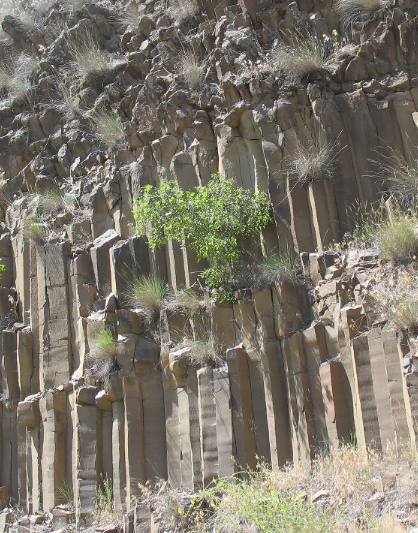
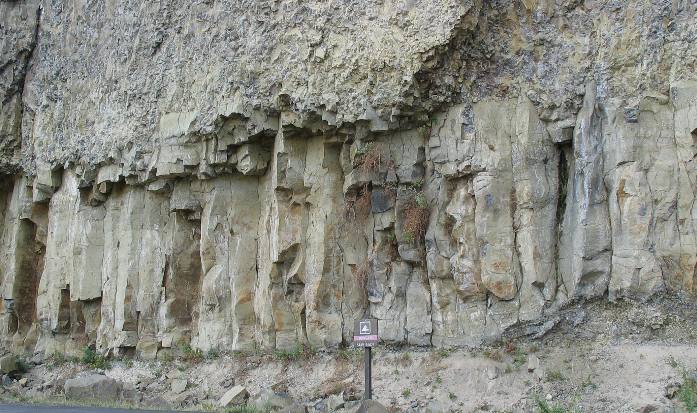
Columnar jointed Basalt along the Salmon River in Riggins, Idaho
This is a basalt flow that pushed up through a large fissure in the earth's crust. As this massive flow cooled, it began to shrink and formed the vertical fractures you see here. This process is called columnar jointing. With time, these columns of rock fracture again but this time horizontally leaving large blocks. Eventually, the blocks break away and tumble to the valley below. This is pretty much a text book example of columnar jointed basalt.
This shows both the columnar (vertical) joints and the horizontal fractures on the top part of these columnar joints. The size of the columns depends somewhat on the rate of cooling;
very rapid cooling may result in very small columns, while slow cooling
is more likely to produce large columns. These are smaller columns.
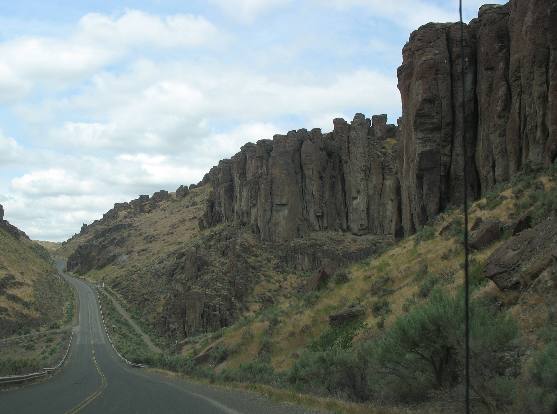
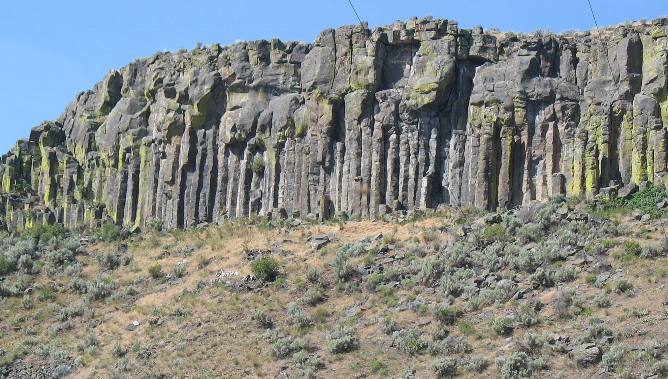
Columnar jointed Basalt south of Buhl, Idaho
Columnar jointed basalt south of Buhl, Idaho on the way to Balanced Rock.
The size of the columns depends somewhat on the rate of cooling; very rapid cooling may result in very small columns, while slow cooling is more likely to produce large columns. As you can see these are larger columns. This is a magnificent example of columnar jointed basalt. The size of the columns depends somewhat on the rate of cooling; very rapid cooling may result in very small columns, while slow cooling is more likely to produce large columns. And these are larger columns.
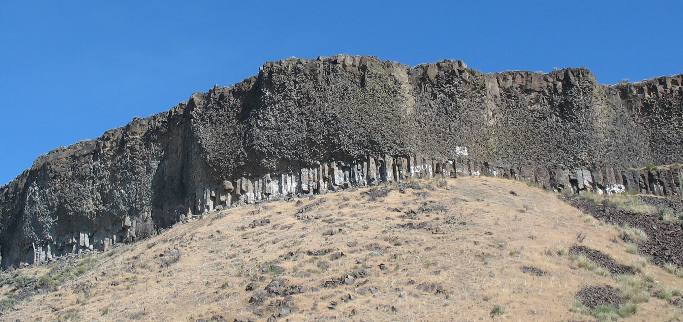
Columnar jointed basalt cliffs on the Boise River near Idaho City, Idaho
Knowing that the size of the columns depends on the rate of cooling; with and rapid cooling may result in very small columns, while slow cooling is more likely to produce large columns.
So what happened here? It this two different flows? The bottom flowing in wet/winter weather while the top flow setting up in hot/dry summer weather? I do not know but I do see what looks like two different cooling times.
Columnar jointed basalt cliffs on the Boise River near Idaho, City
This picture shows both the columnar (vertical) joints and the horizontal fractures on the top part of these columnar joints.
Columnar Basalt in Yellowstone National Park
The speed with which lava cools can determine the type of rock that is formed. In this instance the cooling lava has formed columnar jointed basalt.
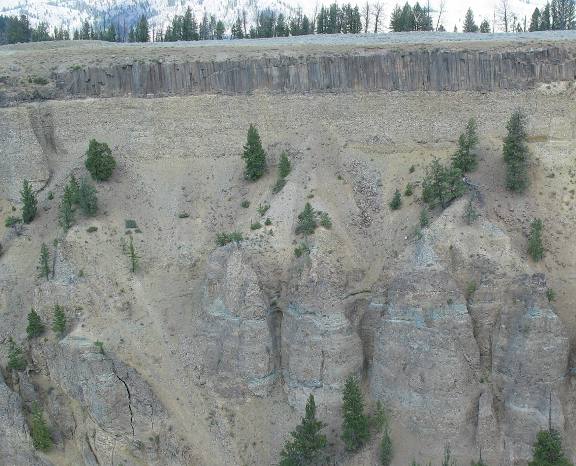
Columnar basalt cap rock protecting a thick layer of glacial moraine in Yellowstone National Park
The cliff wall on the other side of the Yellowstone River near Tower Falls, in Yellowstone National Park, has some interesting geology. A thick layer of columnar jointed basalt provides a cap over an even thicker layer of glacial moraine (river rock or cobblestones if you will) that appears to be around 50 feet thick.
A kiosk indicated that the lava flow across the river is 25 feet deep and was deposited 1.3 million years ago. The kiosk indicates there is a loose mix of gravel (river rock/cobblestones) carried here by glacial melt water on top of the columnar jointed basalt. I can see earth on top of the basalt layer but I can not identify it as cobblestones from this distance. If that be the case then the deep deposit of glacial debris was in place before the lava welled up and flowed over the debris field. Then another glacier formed and deposited yet another layer of glacial debris on top.
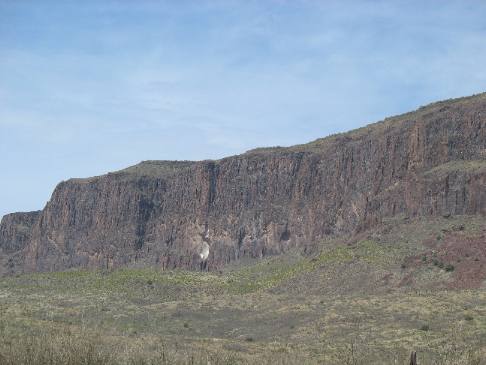
Columnar basalt in ancient lava flow near Ft Davis, Texas
The magma that formed these rocks either flowed out or was blasted out of two main volcanic centers, one south of Ft Davis the other north west of Ft Davis.
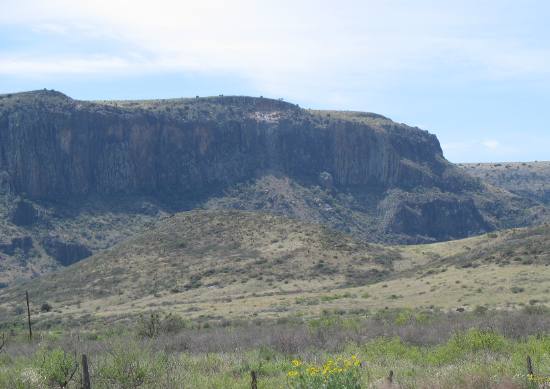
Columnar Jointed Basalt in ancient lava flow near Ft. Davis, Texas
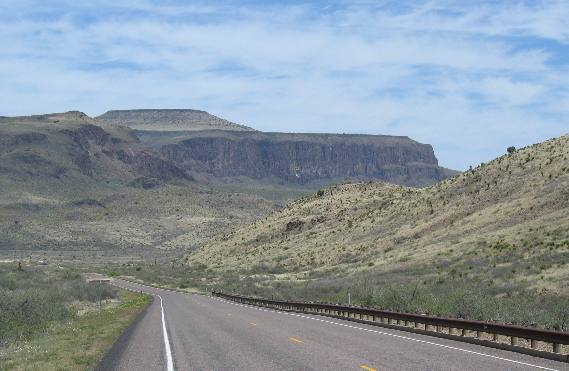
Some of these 37-million year old lava flows are nearly 1,000 feet thick.
Large face of columnar jointed basalt near Ft Davis, Texas
Columnar-jointed lava flow caps mesa between Balmorhea and Ft Davis, Texas.
Click here for some Columnar Jointed Basalt in Idaho
Click here for more Miscellaneous Subjects
More Geology PagesSome Miscellaneous Subjects ** Our Cute Signs
Mike & Joyce Hendrix
Mike & Joyce Hendrix who we are We hope you liked this page. If you do you might be interested in some of our other Travel Adventures: Mike & Joyce Hendrix's home page Travel Adventures by Year ** Travel Adventures by State ** Plants ** Marine-Boats ** Geology ** Exciting Drives ** Cute Signs ** RV Subjects ** Miscellaneous Subjects
We would love to hear from you......just put "info" in the place of "FAKE" in this address: FAKE@travellogs.us Until next time remember how good life is.
|
|
||

|
|||
|
|
|||
|
|
|||
|
|