Slides

Home ** Travel Adventures by Year ** Travel Adventures by State ** Plants ** Marine-Boats ** Geology ** Exciting Drives ** Cute Signs ** RV Subjects ** Miscellaneous Subjects

More Geology Pages ** Some Miscellaneous Subjects ** Our Cute Signs


Slides


Out of West Yellowstone on US-287 .....the road to Ennis, Montana you can see stark visible evidence of earthquake activity. Along the north shore of Lake Hebgen (part of the Madison River) you can see fault scarps where past earthquakes have moved the earth on both sides of the fault. Reading about earthquakes and seeing where they have moved the earth is an exciting experience.


A little further to the west (west of Hebgen Lake) is Quake Lake. An earthquake in August of 1959
registering 7.3 on the Richter scale caused a large portion of a mountain to slide into the valley, instantly damming the Madison River. The "scar" where the mountain fell into the valley is still visible 43-years later. A section of Lake Hebgen along the fault line dropped 20 feet in less than a second. When the bottom of this large lake dropped it drained other portions of the lake as the surrounding water rushed in to fill the hole, this created enormous waves in the lake resulting in tremendous damage. Over 20 individuals perished as a result of the earthquake, one of the largest to occur in North
America. There is an "earthquake" Visitors Center operated by the Forestry Service, on US 287, that explains in detail what happened.


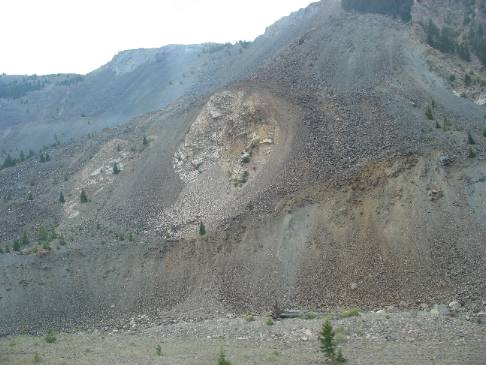
Earthquake slide of 1959 in Montana

Earthquake slide of 1959 in Montana


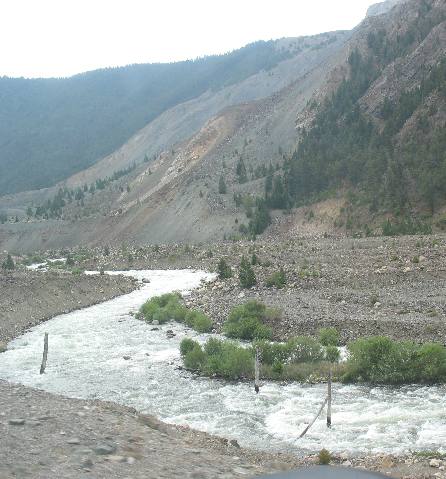
We are traveling east on US 287 about 20-miles northwest of West Yellowstone, Montana. The bare spot on the mountainside is where a magnitude 7.5 earthquake triggered a landslide in August of 1959 that completely covered the Madison River seen here.


In fact the landslide buried the river under several hundred feet of debris.


Look closely at this section of the river because much of that landslide material was removed in order to allow the Madison River to flow again thus removing the possibility of a major flood if that landslide dam gave way after water backed up behind it.


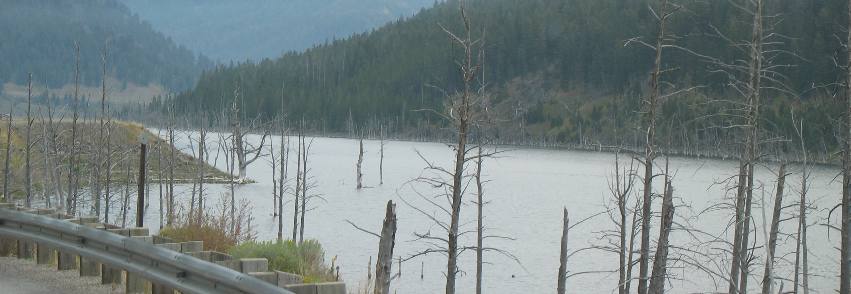
Quake Lake created by the earthquake induced slide of 1959 in Montana

Quake Lake created by the earthquake induced slide of 1959 in Montana


Earthquake Lake was formed in August of 1959 when a 7.5 magnitude earth quake triggered slide blocked flow of the Madison River. A 50 foot spillway was hurriedly cut through the slide by the U.S. Army Corps of Engineers to avert a possible flood downstream. Five miles of U.S. Highway 287 were flooded or outright destroyed.

The dead trees along the lakeshore were drowned by high water 48-years ago.


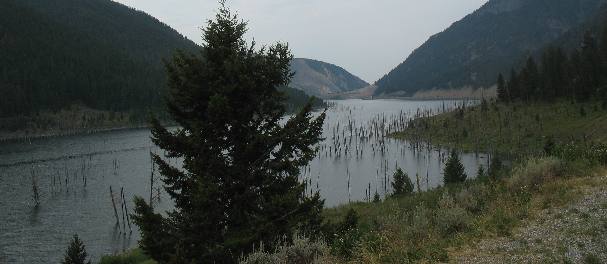
Quake Lake several miles upstream from the dam created by the 1959 slide

Quake Lake several miles upstream from the dam created by the 1959 slide


Earthquake Lake as seen several miles from the landslide that created the lake.

Look in the center of the picture for the mountain with the bare spot on it. That is where the slide took place that dammed the Madison River creating this lake.


Now let's go back and visit the slide area that created Earthquake Lake.


Earthquake slide from the big 1959 Earthquake

Earthquake slide from the big 1959 Earthquake


The entire mountainside fell not just that kinda bare spot. Remember that this quake and the resultant landslide took place in August of 1959 some 48 years ago. Only a few scattered trees have managed to find a foothold on the scar in those 48-years.


The bottom part of this landslide is what the U.S. Army Corps of Engineers removed in an effort to get the Madison River flowing again. Although the Corps of Engineers removed a lot of material there is still enough material remaining to create the dam that holds back Earthquake Lake. I suspect, from the looks of Earthquake Lake, that there is 50' to 100' of landslide material still in place.


When we were in this area 6-years ago we stopped and visited the Earthquake Visitor Center operated by the National Forestry Service. If you are ever in West Yellowstone, Montana you should take time to visit the Earthquake Visitor Center. It is located about 20-miles northwest of West Yellowstone, Montana on US 287.


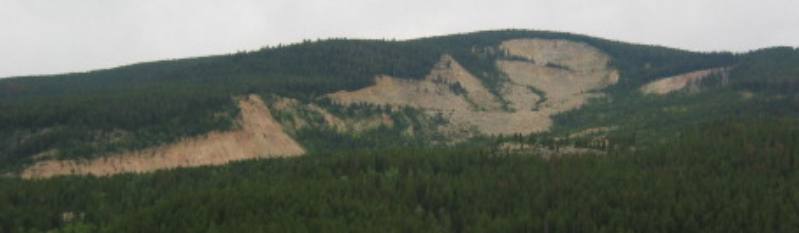
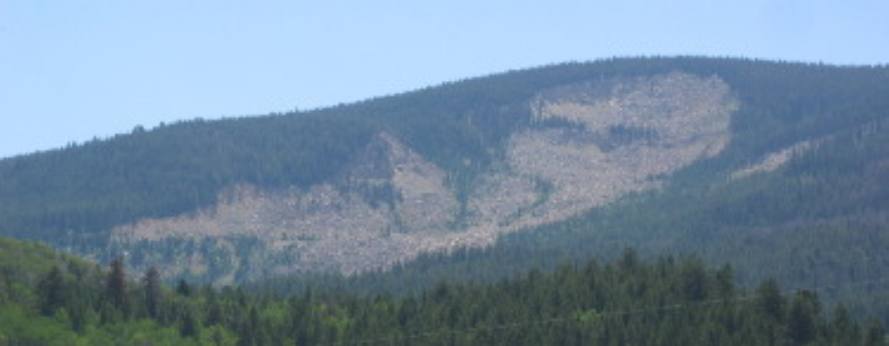
The Gros Ventre Slide area located in the southeast corner of Teton National Park is one of those geologic wonders that capture the imagination. From far off, for everyone to see is this huge "bald-spot" in the side of a prominent mountain on the east side of the Teton Valley. For 20-miles or so when traversing the valley you can see this "alien" complete with eyes and mouth prominently featured. To just say that the Gros Ventre Slide area is unusual is just not enough. It is special, unique if you will.


Gros Ventre Slide

Gros Ventre Slide


The slide area looks a bit different from each angle. These pictures are from the west looking to the southeast.


Gros Ventre Slide

Gros Ventre Slide


This is a look at the Gros Ventre Slide from many miles away looking to the southeast. Any way you look at it there was a lot of material that slid off that mountain.


Gros Ventre Slide

Gros Ventre Slide


This is looking south at the gaping hole in the mountain from on top of the slide debris at the opposite side of the valley. From this angle you can not make out the "alien" like you can when looking at it from the west.


When you stand at the base of the slide (where these pictures were taken) the path of the slide can be clearly seen. This slide took place in 1924 yet the "scar" is still visible. Look closely at the picture. The slide material came not only from the bare spots but from the light green area as well. The light green area has actually started to recover and hide the scar left 81-years ago. As you can see a tremendous amount of earth and rocks moved down the mountainside and into the valley with much of it actually flowing up the other side of the valley.


Gros Ventre Slide

Gros Ventre Slide


Young trees carried down hundreds of feet from higher elevations managed to survive in spite of the change of location (most are growing at awkward angles now). Englemann spruce and quaking aspen produced rings of different thickness in their growth layers indicating the time of the landslide and their relocation.


New trees have have begun to grown on the landslide (both the scar area and debris field). Many colorful plants may be seen at certain times of the year. The slide's debris field, is the habitat of mice, chipmunks, conies, marmots and beaver, many of which rely on crevasses in rocks for protection and homes.


An interpretive trail helped us understand this unique area.


Gros Ventre Slide

Gros Ventre Slide


What you see is the remnants of one of the largest earth movements in the world.


Tree trunks are still here over 80 years after the event. That is hard for someone from back east to comprehend. A dead tree back east will totally decay in a few years with absolutely noting remaining in 5 to 10-years.


Gros Ventre Slide

Gros Ventre Slide


On June 23, 1925, earth, rock and debris moved rapidly from an altitude of 9,000 feet, across the valley bottom and up the slope of the red bluffs on the other side. The action lasted only minutes but a river (Gros Ventre River) was dammed and the landscape drastically change.


Gros Ventre Slide

Gros Ventre Slide


The "red bluffs", common along the interior reaches of the Gros Ventre River, are in the background of this picture. We are actually well up the mountainside on the opposite side of where the slide fell into the valley. Eyewitnesses said the debris rolled up the other side of the valley (where we are) much like water would do when falling over 1,000 feet.


Gros Ventre Slide

Gros Ventre Slide


When we are in the appropriate place on the interpretive trail, which is on the slide itself, we can see yellow gray rocks resting against the red bluffs on the far side of the slide (across the valley) from where they were originally.


Gros Ventre Slide

Gros Ventre Slide


Eye witnesses of the slide likened it to a wave of water as it rushed down the mountainside, crossed the valley and dashed up the slope of the red bluffs. This is the spot where the wave of earth & rocks finally came to rest on the far side of the valley and part way up the mountain on the other side.


Witnesses estimated the entire action took only two minutes.


Gros Ventre Slide rubble

Gros Ventre Slide rubble


Most of the wood debris seen here once floated on the lake formed by the slide. This natural dam failed some years later and the water level rapidly dropped about 60-feet, leaving the debris where you now see it. The debris was blocked from going downstream during the flood when this natural dam gave way.


Gros Ventre Slide debris

Gros Ventre Slide debris


Gros Ventre Slide debris

Gros Ventre Slide debris


Large trees had little chance to survive the violent action of the landslide though some of the smaller trees survived and are still growing, although usually in a tilted position.


Slide Lake on the Gros Ventre River in Wyoming

Slide Lake on the Gros Ventre River in Wyoming


That low area with trees is where the slide crossed the valley and dammed up the Gros Ventre River. It was much higher until the "natural slide dam" gave away and 60' feet of water in the reservoir rushed downstream is a devastating flood that destroyed the town of Kelly in addition to scouring the sides of the canyon through which the Gros Ventre River flows.


Slide Lake

Slide Lake


Slide Lake is now much smaller than before the flood caused by some of the slide created dam giving away. That event will be discussed more below. Some 60' of the slide dam washed away so this lake was 60' deeper before the great flood.


Flood scar when Gros Ventre Slide dam partially washed away

Flood scar when Gros Ventre Slide dam partially washed away


These pictures are taken about 1/2-mile below the slide/dam where the canyon walls were washed away when the dam created by the slide gave away years later. Actually the complete dam did not entirely give way but the top 60' did. The wall of water that escaped the reservoir washed away the sides of this valley as it rushed downstream.

The town of Kelly downstream 5 to 10 miles was destroyed even though it was not situated in a narrow valley like this. Thankfully, the wall of water had room to spread out and dissipate some of the devastating energy by the time it reached Kelly. Still, six people in Kelly lost their lives in that flood.


Flood scar when Gros Ventre Slide dam partially washed away

Flood scar when Gros Ventre Slide dam partially washed away


On May 18, 1927, a portion of the landslide dam failed, resulting in a massive flood that was 6 feet (2 m) deep for at least 25 miles (40 km) downstream. The small town of Kelly, six miles (10 km) downstream, was wiped out killing six people.


Kelly, Wyoming

Kelly, Wyoming


This is downtown Kelly today. I would guess that the population is less than 100 residents. Kelly is located about 3-miles east of the Gros Ventre Campground we were staying in. It is also the town that was destroyed when the Gros Ventre Slide dam gave way and a wall of water swept the town away. Kelly is located about 15-miles northeast of Jackson, Wyoming and on the southeast edge of Grand Teton National Park.


Kelly, Wyoming

Kelly, Wyoming


House in downtown Kelly, Wyoming the town destroyed when the Gros Ventre Slide dam gave way and flooded the town.


Click here for more Geology pages


Click here for more Miscellaneous Subjects


More Geology Pages

Some Miscellaneous Subjects ** Our Cute Signs


Mike & Joyce Hendrix

Mike & Joyce Hendrix who we are

We hope you liked this page. If you do you might be interested in some of our other Travel Adventures:

Mike & Joyce Hendrix's home page

Travel Adventures by Year ** Travel Adventures by State ** Plants ** Marine-Boats ** Geology ** Exciting Drives ** Cute Signs ** RV Subjects ** Miscellaneous Subjects


We would love to hear from you......just put "info" in the place of "FAKE" in this address: FAKE@travellogs.us

Until next time remember how good life is.


    Passport America, Save 50% on Campsites


    Passport America, Save 50% on Campsites


Home ** Travel Adventures by Year ** Travel Adventures by State ** Plants ** Marine-Boats * * Geology ** Exciting Drives ** Cute Signs ** RV Subjects ** Miscellaneous Subjects