Bruneau area of southern IdahoIdaho: Bruneau Dunes State
Park and Bruneau
Canyon Overlook June 7, 2007. We are staying at Three Island Crossing State Park located in the town of Glynn's Ferry. $4 entry fee plus $21 for RV site with water & elect. Very nice campground and it is full. Mature trees with good shade and green grass. If by chance the campground at Three Island Crossing is full there is a nice commercial campground at a winery located at the front gate to the State Park. They were $20 for FHU and they had shade. Point being----they would be a good alternative and some would like it better than the state park since is was $1 cheaper and it had FHU. After visiting Three Island Crossing State Park the second place we wanted to experience today was Bruneau Dunes State Park and Bruneau Canyon Overlook. Bruneau Dunes State Park just happens to be located 25-miles west of Three Island Crossing. Driving there is an interesting drive along the Snake River Valley through a beautiful agricultural area.
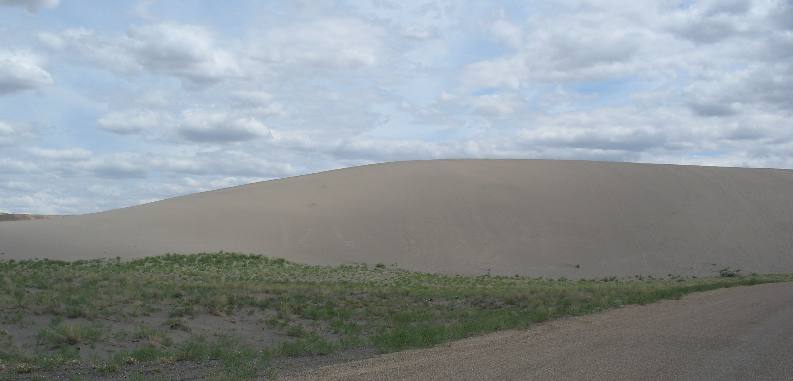
Bruneau Dunes, Bruneau Dunes State Park, in the Snake River Valley of southern Idaho
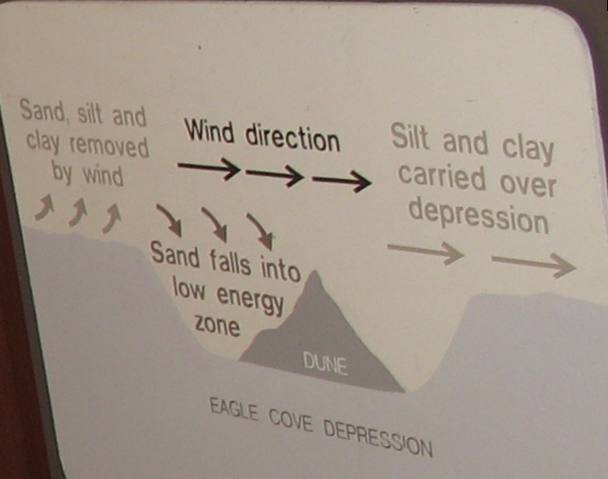
Bruneau Dunes is located in an ancient Snake River meander scar, known as Eagle Cove. The Snake River plain is a broad trench extending approximately 300 miles across southern Idaho. Volcanic activity was present for thousands of years. Lava flows occasionally dammed the Snake River canyon forming lakes which deposited large amounts of sediment that have become part of the sand supply for the dunes. Bruneau Dunes is part of the southern Idaho semi-arid desert, a region of dramatic extremes, yet featuring a diverse range of plant and animal life. This area of Idaho averages only 7 inches of precipitation per year, with a normal summer temperature in the 90's.
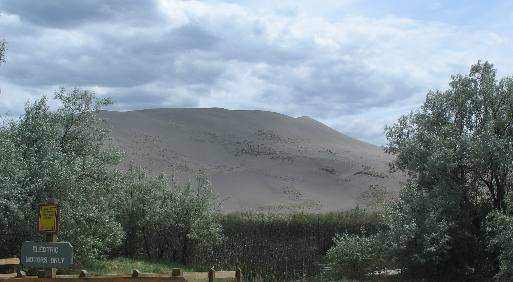
Bruneau Dunes, Bruneau Dunes State Park, in the Snake River Valley of southern Idaho
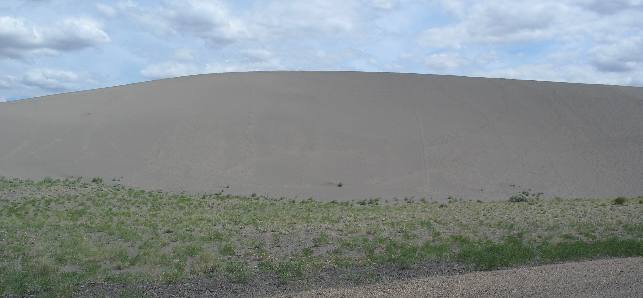
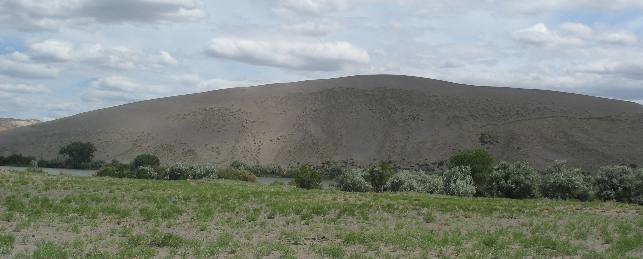
The dune field of Bruenau Dunes is not large as dune fields go. However, Bruneau Dunes is the tallest single sand dune structure in North America. Bruneau Dunes are located inside an old river meander scar surrounded by a much higher mesa on all sides.
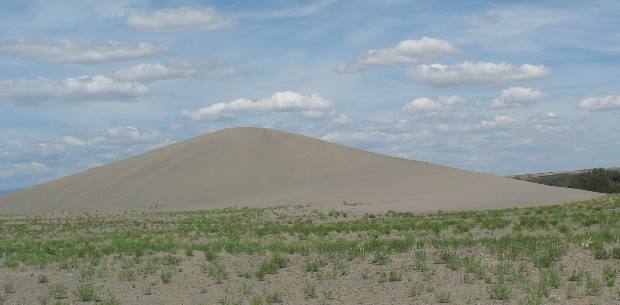
Bruneau Dunes, Bruneau Dunes State Park, in the Snake River Valley of southern Idaho
Bruneau Dunes is the tallest single sand dune structure in North America.
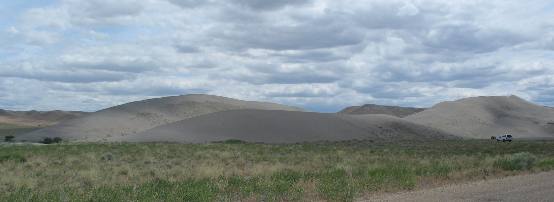
Bruneau Dunes, Bruneau Dunes State Park, in the Snake River Valley of southern Idaho
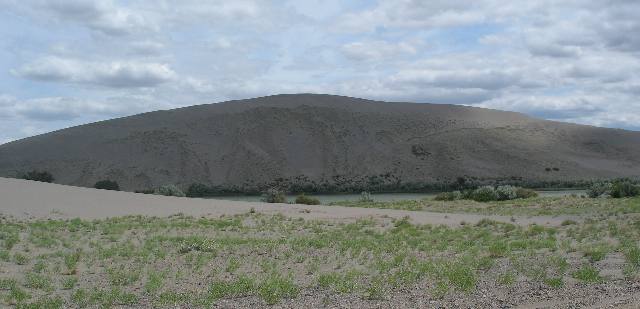
This picture almost encompasses the entire dune field. Bruneau Dunes is the tallest single sand dune structure in North America.
Bruneau Dunes, Bruneau Dunes State Park, in the Snake River Valley of southern Idaho
Eagle Cove makes a natural sand trap. Bruneau Dunes started to form approximately 11,000 years ago after the tremendous Bonneville flood. Bruneau Dunes is the tallest single sand dune structure in North America. Ideal conditions existed here for sand dune formation: A circular basin, carved by the Snake River, which forms a natural trap to catch wind-blown sand. A supply of sand coming from ancient sediments laid down in the Snake River Plateau. A wind blowing at least 10 miles per-hour to transport the sand granules.
Bruneau Dunes, Bruneau Dunes State Park, in the Snake River Valley of southern Idaho
Grains of sand in this dune field are all about the same size. Smaller sand continues on blowing while larger grains aren't moved by the wind. Keep in mind that Bruneau Dunes is the tallest single sand dune structure in North America.
Bruneau Dunes, Bruneau Dunes State Park, in the Snake River Valley of southern Idaho
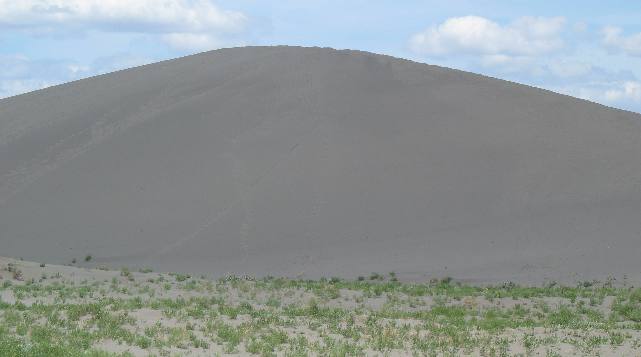
While Bruneau Sand Dunes aren't the largest sand dunes by any means Bruneau Dunes is the tallest single sand dune structure in North America.
Bruneau Dunes, Bruneau Dunes State Park, in the Snake River Valley of southern Idaho
Bruneau Dunes is the tallest single sand dune structure in North America.
Bruneau Dunes, Bruneau Dunes State Park, in the Snake River Valley of southern Idaho
Bruneau Dunes is the tallest single sand dune structure in North America.
We didn't spend much time in Bruneau Dunes State Park. It is a unique geological feature but it did not hold our interest for long. We are glad we saw it and would recommend anyone visiting the area to spend the time to visit the State Park and Visitor Center. Our next adventure was to drive out to the Bruneau Canyon Overlook 18-miles south of the small crossroads town of Bruneau
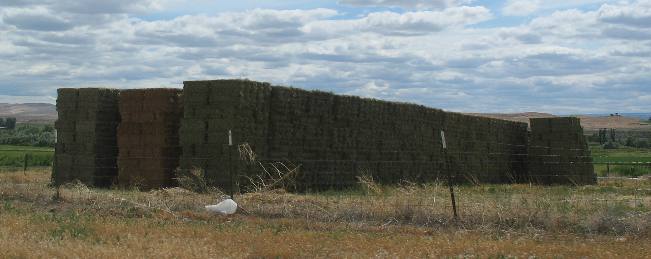
Alfalfa stored in the Snake River Valley for southern Idaho's dairy industry
The first 5 or so miles out of Bruneau was through a well irrigated valley producing of all things ------------- alfalfa, and loads of it as this huge stack of alfalfa hay attests. Of course this alfalfa is destined for the huge dairy industry scattered in the Snake River Valley of southern Idaho.
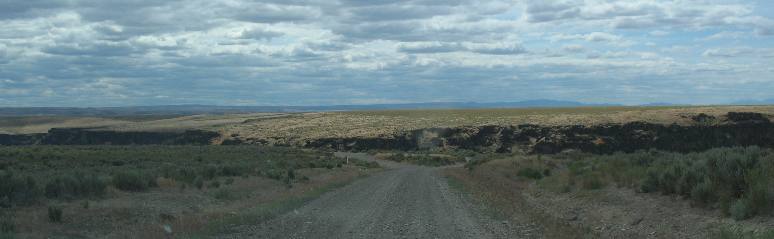
From Bruneau set your odometer on -0- then turn south on Hot Springs Road---there is also a brown sign pointing toward "Bruneau Canyon Overlook". About 10-miles down Hot Springs Road it turns into decently maintained gravel. When the odometer reaches 18-miles you should see signage for Bruneau Canyon Overlook where you turn right (west) one mile or so.
Bruneau Canyon in southern Idaho
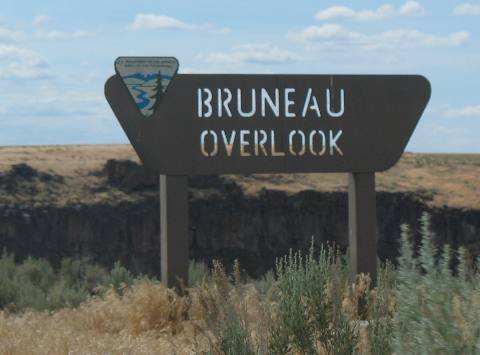
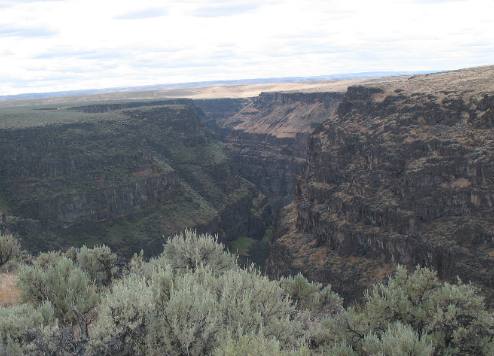
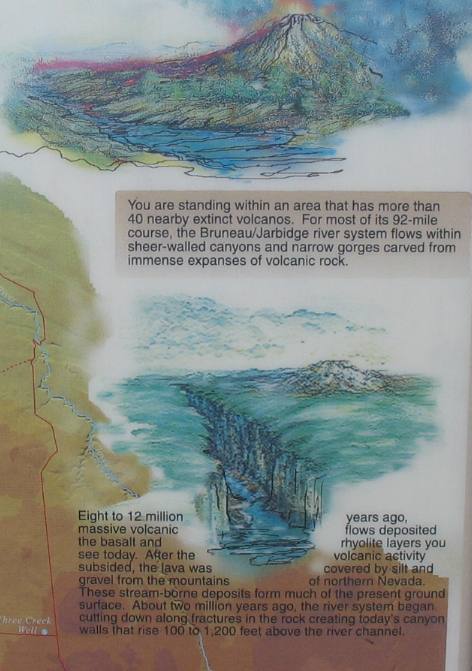
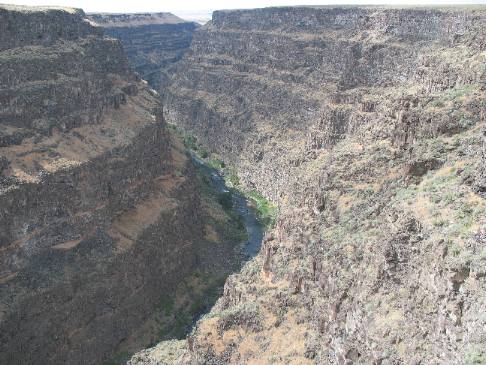
We have been driving down a gravel road for over 10-miles when low and behold we see the Bruneau Canyon Overlook. It is hard to believe there is a canyon out here but here it is. From here one can see the dark gash in the earth.
Bruneau Canyon in southern Idaho
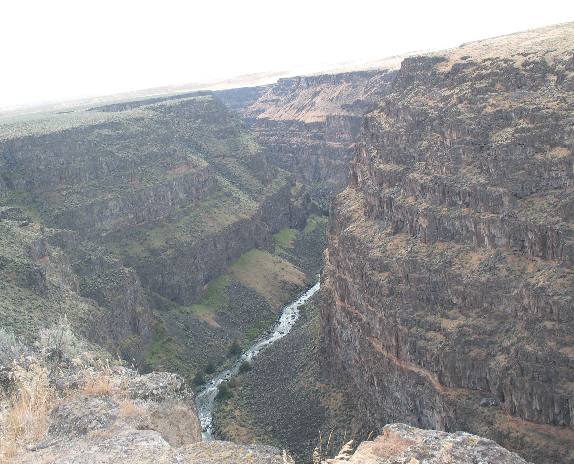
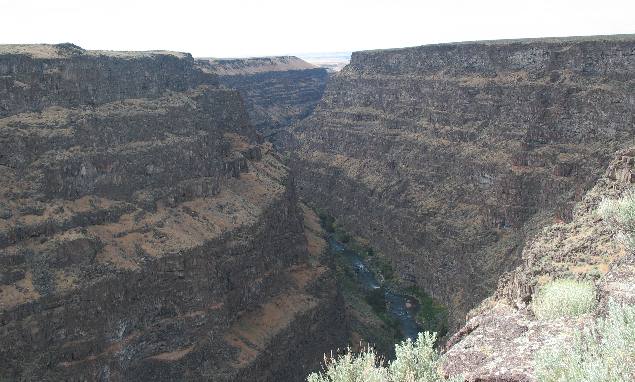
Awesome, is the only word that comes close to describing it. Totally awesome! The Bruneau River has cut Bruneau Canyon through what looks to me to be 600' of hard basalt. Some places are over 1,200' deep but I can't say for certain this overlook is over the portion of the 1,200' deep part of the chasm.
Bruneau Canyon in southern Idaho
One can only imagine the cataclysmic events over thousands of years that created lava flow this deep.
Bruneau Canyon in southern Idaho
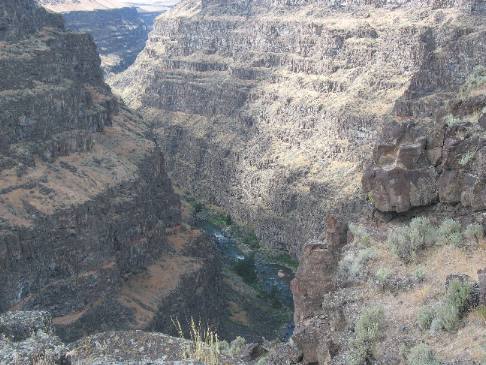
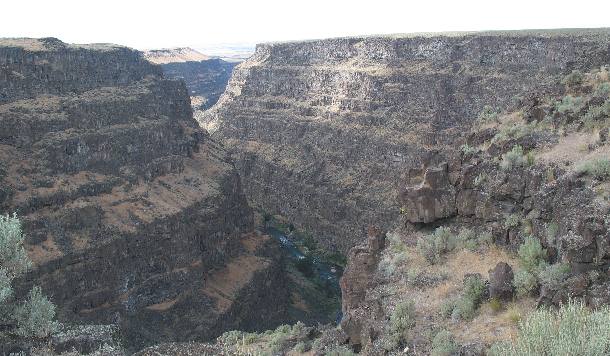
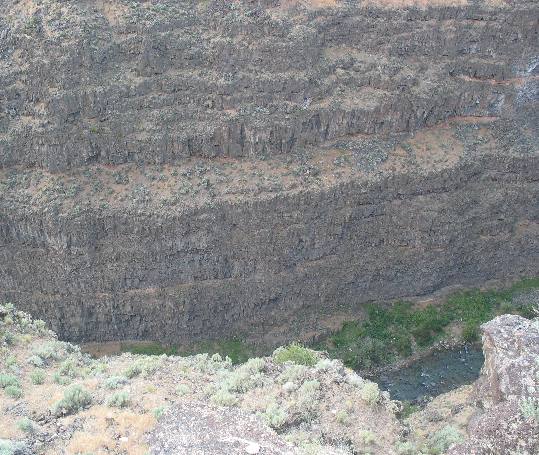
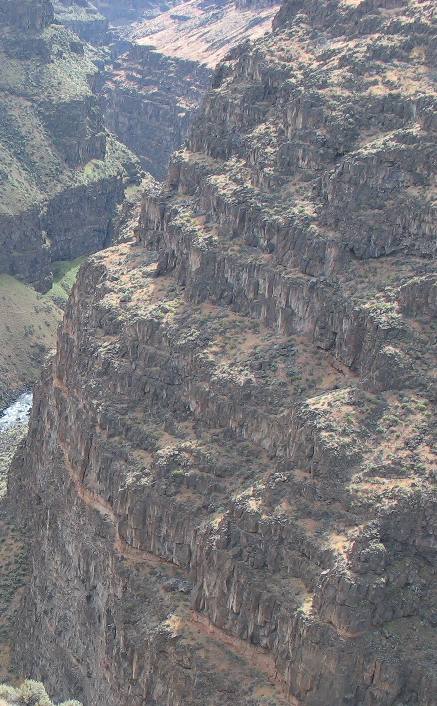
By looking at the strata it is fairly easy to tell that tremendous volumes of lava would spill over this area then none would flow for hundreds of years. When lava was not flowing a layer of ordinary sediment would be laid down. Then lava would flow again covering the old lava and the sediments covering it.
In the picture on the left you can easily see the "bacon strips" clearly showing where the layers of sediment covered one old lava flow then that in turn was covered by yet another round of molten lava.
Bruneau Canyon in southern Idaho
Bruneau Canyon in southern Idaho
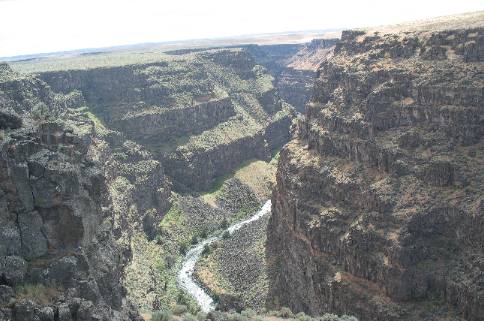
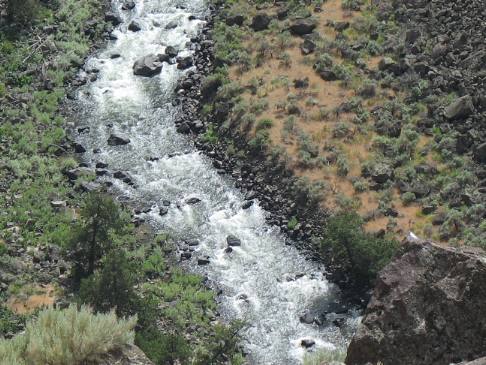
The section of Bruneau Canyon visible from the overlook is known as Five Mile Rapids. During the spring run-off, it is one of the most challenging stretches of white water in the nation for rafters and kayakers.
Bruneau Canyon in southern Idaho
Bruneau Canyon in southern Idaho
While we can not see them, rhyolite canyons dominate the Bruneau/Jarbidge landscape. These canyons are noted for nearly continuous, vertical, monolithic rock walls that rise directly from the river channel, and countless majestic rock spires, called hoodoos.
Bruneau Canyon in southern Idaho
Bruneau Canyon in southern Idaho
The basalt flows that stretch out from here were pushed up through large fissures in the earth's crust. As the flows cooled, they began to shrink and formed vertical fractures. This process is called columnar jointing. Eventually, these columns of rock fractured again horizontally leaving large blocks. Eventually, the blocks break away and tumble to the base of the cliffs or into the river channel, constricting the river's flow and creating narrow, steep-gradient rapids such as those in the pictures.
Bruneau Canyon in southern Idaho
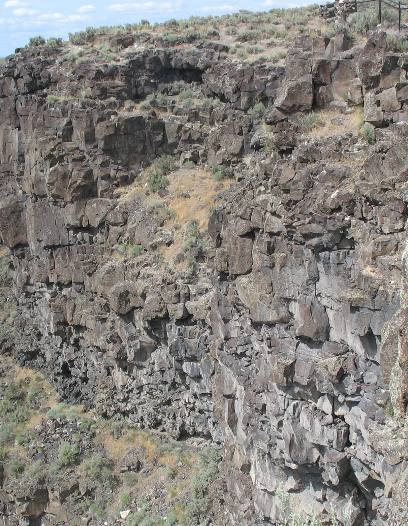
The blocks of basalt that tumble to the base of the cliffs are known as talus thus creating talus slopes at the bottom.
Basalt wall of Bruneau Canyon in southern Idaho
This is a close-up of the basalt wall of Bruneau Canyon.
Basalt walls of Bruneau Canyon in southern Idaho
In the picture to the right it is easy to see where layers of sediment were laid down between successive layers of molten lava.
Basalt walls of Bruneau Canyon in southern Idaho
I included this picture to show at least on thick layer of red sediment about 1/3 the way down this cliff face.
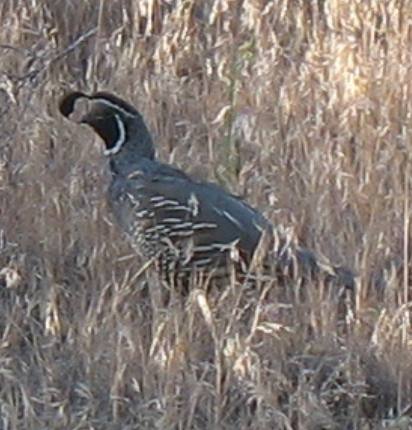
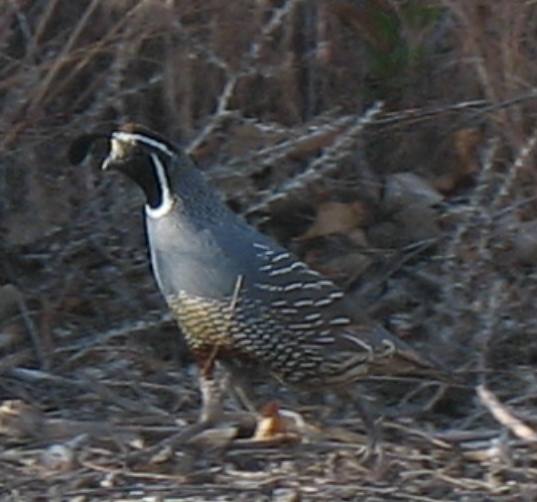
California Quail in Three Island Crossing State Park
Evening around Three Island Crossing State Park is a good time to spot California quail. They are out moving around. During this time of year these birds are paired up. This is one colorful male, his mate is not nearly as colorful.
California Quail in Three Island Crossing State Park
We enjoyed watching the California quail that were all over Three Island Crossing State Park where we were staying.
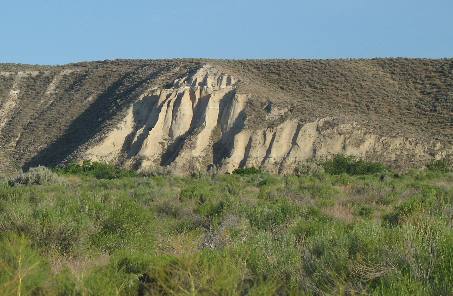
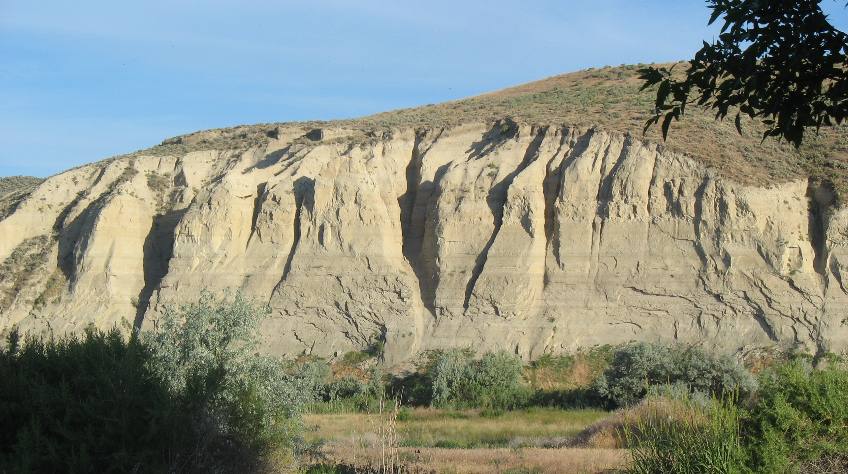
Bluff on the south side of the Snake River Valley of southern Idaho
Evenings is also a good time to take pictures of the setting sun highlighting bluffs on the opposite side of the Snake River Valley across from Three Island State Park.
Bluff on the south side of the Snake River Valley of southern Idaho
This is looking to the southeast across the Snake River Valley from Three Island Crossing State Park in the late afternoon. So much of the geography in southern Idaho is lava rock. Surprisingly along the south side of the river is this large river cut of sedimentary rock.
Click here for more Idaho travellogsUntil next time remember how good life is.
More Idaho AdventuresSome of our Miscellaneous Subjects ** More 2007 Travel Adventures
Mike & Joyce Hendrix
Mike & Joyce Hendrix who we are We hope you liked this page. If you do you might be interested in some of our other Travel Adventures: Mike & Joyce Hendrix's home page Travel Adventures by Year ** Travel Adventures by State ** Plants ** Marine-Boats ** Geology ** Exciting Drives ** Cute Signs ** RV Subjects ** Miscellaneous Subjects
We would love to hear from you......just put "info" in the place of "FAKE" in this address: FAKE@travellogs.us Until next time remember how good life is.
|
|
||

|
|||
|
|
|||
|
|
|||
|
|