|
Los Alamos, Santa Fe, Pujaque, White Rock, Bandelier NM, Jemez Caldera, Jemez Scenic Drive & Jemez Springs in New Mexico Places Visited: New Mexico: Los Alamos, Santa Fe, Pujaque, White Rock, Bandelier NM, Jemez Caldera, Jemez Scenic Drive & Jemez Springs July 7, 2003 We drove 69 Miles to Trailer Ranch RV-Park Santa Fe, New Mexico. This is a top notch RV-Park with concrete pads, 50-amps, cable, pool and a modem for $33.17 per-night. We got up early and got out of Taos. We were happy to see Taos in our rear view mirror. The fire threatening Taos has now consumed 3,000 acres and the radio said as we left town that it was only 2% contained. Our plan was to stop by Los Alamos on the way back to Santa Fe. To accomplish this we drove the motorhome south on NM 68 to Espanola then US 84 to Pojoaque. In Pojoaque we pulled into the Cities of Gold Casino parking lot where we unhooked the Saturn and headed to Los Alamos in the Saturn. We think that the Cities of Gold Casino parking lot offered a good option of dropping off the motorhome while we visited Los Alamos. It worked very well. If you are contemplating a visit to Los Alamos while traveling between Taos and Santa Fe, just exit US 84 at NM 4. Take NM 4 one block to the east where it dead ends into the Cities of Gold Casino. It could not be more convenient. From Cities of Gold Casino it was only 18 miles to Los Alamos. Friends we met in Taos had already told us some of the things to do in Los Alamos and we followed their recommendation. The Bradbury Science Museum does not open on Monday until 1PM so we headed to the Los Alamos Historical Museum where we spent several hours. The history museum is highly recommended. Joyce and I got a kick out of reading memos from the "top-secret" days when the Manhattan Project was developing the Atomic Bomb. Some of you familiar with government and or military memoranda should get a kick out of the two I can remember: To: Sidney Newberger From: Eric R. Jette Subj: Security Clearances I have recently learned that the average time for security clearances on a large number of cases was 63 days. This is the gestation period for a dog. Do you suppose that you might get it down to a rabbit? E.R. Jette --------------------- To: ?????? From:?????? Subj: Mr. Oppenheimer's office Concerning the coat and hat rack issue. I know you provided Mr. Oppenheimer with a coat rack with a place for him to hang his hat. As you remember he requested a nail in the wall. Please put a nail in the wall for his hat. Immediately. ??????????
------------------------------------- There were a dozen others but my pea brain just can not remember them. We really enjoyed the museum. The history preserved in that museum is priceless. If you ever get to Los Alamos make sure you take in the history museum. We ate with locals at the "Hill Diner" on Trinity Drive. We enjoyed eating with the locals and the food was good. The place is highly recommended for lunch. Jimmy and Kathy, our friends from Lawton, Oklahoma had told us about a lady doing a tour of Los Alamos in her van that was real good. They instructed us to meet her in front of the Bradbury Science Museum at 1:30. We did and had a good time. She drove us places we never would have found and told us things we would not have had a clue about otherwise. Thanks to Jimmy and Kathy for putting us on to this tour. It was great. The remainder of our time in Los Alamos was spent in the Bradbury Science Museum. We did not spend nearly enough time in there. It is a place where parents could take children or grandchildren. Not that it is on their level but there is a ton of hands on things that the younger generation enjoy. Plan on spending hours in there. You will not be the same when you leave. From Los Alamos we headed back to the Casino where we got back in the motorhome and headed to Santa Fe. We are back in Santa Fe at a good RV-Park with a modem connection and I am happy once again. Ain't life great? The evening news said that the Taos fire was out of control and threatening Taos. Shifting winds during the day had caused tanker aircraft fighting the fire to be grounded. Things don't look good up there. July 8, 2003 Trailer Ranch RV-Park Santa Fe, New Mexico. This is a top notch RV-Park with concrete pads, 50-amps, cable, pool and a modem. The last time we were in Santa Fe a week ago we were not able to visit the Palace of the Governors. We remedied that today. The first thing we did was head there. The Palace of the Governors is a good New Mexico history museum. Joyce and I have read extensively about New Mexico history and this museum helped solidify and fill in blanks. One thing we really enjoyed was the section covering important Jews in New Mexico history. Many of the early Jewish settlers entered New Mexico as soon as Anglos were allowed into New Mexico and that was after 1821 when Mexico became independent from Spain. Most of the Jewish settlers migrated from the area of Europe that would become Germany (because of religious problems). In New Mexico they became merchants. In many instances the first family members to arrive sent for their younger brothers and other relatives as they became established. The relatives arrived and learned the merchandising business then moved to new areas and established their own stores.
Jewish merchants were financially instrumental in constructing the magnificent St. Francis of Assisi Cathedral in Santa Fe. There was a very good relationship between the Archbishop of the Catholic Dioceses in Santa Fe and the Jewish community. The French Archbishop, Jean Baptiste Lamy, was sent by the Vatican to New Mexico because of the outlaw & Godless reputation the Territory had. Once in New Mexico this cultured French Archbishop was starved for the "culture" he had enjoyed in Europe. He became good friends with the "well-healed" Jewish community where he could converse in Latin and French about subjects other than the wretched conditions in Santa Fe. One of the Jewish merchants loaned money to the congregation for construction of the Cathedral. When it came time for the loan to be repaid the Archbishop had to go to the merchant because they did not have the money to repay the loan. The merchant tore up the note. Because of this act of generosity and the generosity of other Jewish Merchants the Cathedral has the Jewish symbol for the Trinity (letters in a triangle) prominently displayed in stone above the entrance door. One of the neat things we learned in the museum was the difference in the yokes used by Americans and Spanish. The Spanish yoke was a big stick tied to the horns of the oxen while the American yoke had a curved piece of wood that went around the neck of each oxen. According to the display the American yoke allowed oxen to pull much more weight and did not have the disadvantage of accidentally pulling out a horn which seemed to happen frequently using the Spanish yoke. Another thing we learned was that merchants and traders traveling the Santa Fe Trail and the Camino Real (Kings Highway) would throw down blankets and display their goods around the plaza and the Governors Palace. Native Americans still do that with their jewelry to this day. We both want to highly recommend spending the time to tour The Palace of the Governors on the Plaza in Santa Fe. After the Governors Palace we toured the Cathedral Jean Baptiste Lamy had constructed around 1884. Remember this is the Cathedral that was constructed as a symbol of the city's Roman Catholic heritage and to match his refined European tastes.. This is the one stone masons were brought in from France and Italy for. Unbelievably beautiful stained glass windows were imported from France. Inside the Cathedral was patterned after one of the magnificent European Cathedrals. If I would have paid attention in that mandatory art history class in college I might have been able to identify the specific Cathedral. We both want to recommend taking the time to tour the St. Francis of Assisi Cathedral in Santa Fe. Our Scenic Driving New Mexico book had the road from Santa Fe up to the Santa Fe ski area listed as a scenic drive. We drove to the ski area and back. It was OK but I do not think it was all that great. The ski lift takes skiers up to 12,000' the highest lift in New Mexico.
July 9, 2003 Trailer Ranch RV-Park Santa Fe, New Mexico. This is a top notch RV-Park with concrete pads, 50-amps, cable, pool and a modem. While in this area we wanted to visit Bandelier National Monument (just south of Los Alamos), the Valle Grande (Jamez Caldera), Jemez Springs and the Soda Dam near Jemez Springs. This is certainly one of New Mexico's scenic drives. Mentioned in some publications ignored in others, we think it is a mistake to overlook it. The scenic part of the drive starts in Pojoaque about 19-miles north of Santa Fe. From Pojoaque go west on New Mexico 4 through White Rock then Bandelier National Monument. West of Pojoaque you spend a few miles gradually dropping to the Rio Grande Bridge and the green ribbon of trees that hugs the river as it makes its way south. From the river NM 4 starts gaining altitude immediately as it makes its way to the mesa west of the river. West of the river road cuts showcase welded tuff. Tuff is the (rock formed of compacted volcanic ash and cinders). Complete canyon walls are composed of this "tuff" evidence of cataclysmic volcanic action a million years ago. In White Rock locate the overlook from high on the mesa that looks down upon the Rio Grande flowing through the valley below. When heading west on NM 4 turn south on Rover, Rover turns into Meadow LN, from Meadow LN turn on Overlook RD and follow it to the end. White Rock is a SMALL residential community serving the scientific community associated with Los Alamos. From White Rock continue west on NM 4 to Bandelier. From NM 4 it is only 3 to 5 miles to the visitor's center. The drive drops dramatically from the top of the mesa into the canyon where Bandelier National Monument showcases the ancient homes of some of America's earliest residents. Archeologists think that the peoples that occupied this valley came into the region 10,000 to 12,000 years ago. There is a ¼ mile walk from the visitor center to the home sites consisting of a series of caves and adobe structures. Many families with school age children were enjoying crawling through the caves. Leaving the Visitor Center your vehicle has to climb out of the canyon, during that time you can enjoy the view. From Bandelier continue west as you climb steeply through an alpine forest. Then the road emerges on the southern summit or lip of the ancient Jemez Caldera. Spectacular views of mountains that ring the Jemez Caldera peak at us as we wind our way down to the Valle Grande. Valle Grande is 14-miles across. The Valley or caldera was created when the center of the ancient volcano collapsed (after an eruption over 500 times greater than Mount St. Helens) The volume of ash belched out into the atmosphere would cover the entire state of New Mexico under 6-feet of ash. Instead of spreading the ash evenly ash deposits from the eruption are 1,000 feet deep in places. The ash is now referred to as "tuff" (rock formed of compacted volcanic ash and cinders). Earlier on our scenic drive today we traversed miles and miles of terrain of virtually nothing but tuff. Over the past million years erosion has created a landscape of mesas and canyons from the soft tuff. For 5 to 10 miles NM 4 transverses the southern edge of Valle Grande offering totally stunning vistas of the lush valley. The view along this 5 to 10 miles overlooking the valley created when the Jemez Caldera collapsed is the highlight of this scenic drive. On the western edge of the valley as we headed back into the mountains that form the southwestern edge of the caldera, we stopped to watch a group of individuals climbing a sheer rock face not far from the road while others played in a mountain brook (river). Several fly fishermen were standing ankle deep in the brook casting into the "river" that is 6-feet across. I know he is hoping the truck dumped some trout upstream earlier this morning. Then it was up, up and over the mountain before we started our descent into Jemez Springs and the soda dam just north of town. Before we get to the soda dam both of us spot large formations of obsidian high on the canyon wall. Obsidian is black volcanic glass. Indians made arrowheads and spear points out of obsidian. "Obsidian is formed where especially dry, high-silicate lava cools without formation of mineral grains" according to Road Side Geology of New Mexico. The so-called "soda-dam" blocks the canyon and the Jemez River just north of Jemez Springs. According to Roadside Geology of New Mexico "the soda dam is still enlarging. The dam developed where hot-spring water cooled and precipitated calcium carbonate (not sodium bicarbonate as the name suggests)". The term "hot-spring water" is almost an oxymoron. We just naturally think of spring water as cool and refreshing. This one is not "cool". In this area hot rocks are fairly near the surface (remember the areas volcanic past) and groundwater is heated by contact with them and rises to the surface loaded with minerals principally calcium carbonate. The book Roadside Geology of New Mexico does a good job of describing the wide variety of geological features, rocks and minerals along this drive. Joyce and I have learned so much from these Roadside Geology books. We can now recognize many geological features even when the books do not call attention to it. Friends as well as several books have alerted us to the hot baths from the hot springs that are available around Jemez Springs. The temperature today is in the mid-90s and HOT. Anything HOT is not on our list of things to try. The hot springs could be inviting at other times in the year but not today. We stopped to eat in Jemez Springs at Deb's Deli. I can't recall who told us about Deb's Deli but we appreciate the heads-up. If you visit make sure that you admire their unique tables and chairs made from the massive trunk of an ancient cottonwood tree. As we continued out of the Jemez Valley on NM 4 we are amazed at the lush cottonwoods lining the Jemez River. Dramatically the volcanic rock changes to red sandstone. We both comment that this looks like the red sandstone around Sedona, Arizona. As we pass through this red sandstone we also enter the Jemez Pueblo where we stop and purchase a loaf of bread that local Native Americans cook in beehive ovens (hornos) many have in their yards. Native Americans sell several types of bread and other food items from "ramadas" (roadside stands). We are not generally big bread eaters but putting the "taste-test" to this round loaf of bread is something several friends wrote and told us to make sure we tried. It is a lot like a round loaf of French bread, heavy with a hard crust. In San Ysidro we see a strange mountain. It is strange because it contains thick beds of gypsum capped with much harder rock. The gypsum is being mined from the side facing the highway. The cap rock (hard rock) is dark in color while the underlying gypsum is light grey. San Ysidro is noted as the site where the bones of the "large dinosaur" we saw in the New Mexico Museum of Natural History in Albuquerque was excavated. I suppose if you are into dinosaur fossils you could ask around and probably visit the area where this dinosaur was excavated. It was much too hot for us to even contemplate getting out of our air conditioned Saturn. Possibly another day. Tonight Albuquerque television was reporting that the Taos fire was completely out of control. Winds shifted today and the fire started moving to the east away from Taos and residential areas.
Click here for more New Mexico travellogsUntil next time remember how good life is. More New Mexico AdventuresAdventures by State ** 2003 Travel Adventures
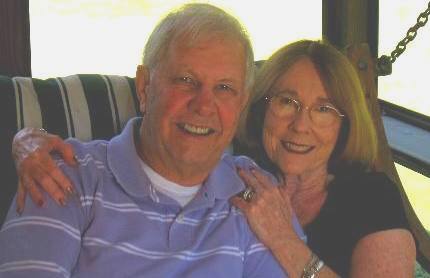
Mike & Joyce Hendrix
Mike & Joyce Hendrix who we are We hope you liked this page. If you do you might be interested in some of our other Travel Adventures: Mike & Joyce Hendrix's home page Travel Adventures by Year ** Travel Adventures by State ** Plants ** Marine-Boats ** Geology ** Exciting Drives ** Cute Signs ** RV Subjects ** Miscellaneous Subjects
We would love to hear from you......just put "info" in the place of "FAKE" in this address: FAKE@travellogs.us Until next time remember how good life is.
|
| ||
|
| |||
|
| |||
|
|