Antelope Island in the Great Salt Lake

Antelope Island in the Great Salt Lake

Home ** 2007 Index ** More Utah Adventures


Antelope Island in the Great Salt Lake

May 30, 2007.

We did not arrive in Layton, UT until after noon. As you will recall we were in Salt Lake City earlier in the day touring Temple Square.

After touring the Temple Square area in Salt Lake City we returned to the motorhome and headed south to a Super Wal Mart located in Layton, Utah at exit 334, where we dropped the motorhome and headed to Antelope Island in our Saturn.

When we returned we moved the motorhome to a strip mall parking area adjacent to Wal Mart because there was more space available for overnighting RV's.

We visited Antelope Island, a Utah State Park located in the Great Salt Lake. The Great Salt Lake, as you may know, is the largest natural lake west of the Mississippi River. The lake is a remnant of pre-historic Lake Bonneville, which covered more than 20,000 square miles during the Ice Age. Four distinct shorelines from the lake may be seen from Antelope Island and include, Bonneville, Provo, Stansbury, and Gilbert.

Currently Great Salt Lake is 75 miles long by 28 miles wide covering 1,700 square miles. At this level, maximum depth is about 33 feet. Size and depth vary greatly with seasonal evaporation and precipitation.

Water flows into the lake from four river drainages, carrying 2.2 million tons of minerals into the lake each year. Great Salt Lake has no outlet; water leaves only through evaporation. Because of this, high concentrations of minerals are left behind. Salinity level ranges between four and 28% compared to the ocean at 3%.

Salinity is too high to support fish and most other aquatic species. However, brine shrimp, brine flies, and several types of algae thrive in the lake. Brine shrimp and brine flies tolerate the high salt content and feed on algae. Brine flies and brine shrimp are primary food sources for millions of migrating birds.

Nearly 80% of Utah's wetlands surround Great Salt Lake, making its ecosystem one of the most important resources in North America for migratory and nesting birds. The area hosts 250 bird species each year, which represents a significant part of the six to nine million migratory birds passing through the Pacific Flyway.

The lake and its marshes provide resting, nesting, and staging areas for these birds.

Oolitic sand is a unique feature of Great Salt Lake. These round grains of sand are formed when mineral grains or brine shrimp fecal pellets are coated by concentric layers of aragonite, a form of calcium carbonate. This is similar to how pearls are formed. I did not have time to find and closely examine this unique form of sand. This will have to wait until our next visit.

With that as background it is time for us to head across the causeway connecting Antelope Island with the mainland.


View from causeway to Antelope Island in the Great Salt Lake

Antelope Island in the Great Salt Lake


Access to Antelope Island State Park is from SR-108 (exit 335 on I-15) via a very long causeway. There is a State Park fee to get on the causeway leading to Antelope Island.


Joyce took this picture from the causeway looking south at the south end of Antelope Island with mountains around Provo in the background.


View from causway to Antelope Island in the Great Salt Lake

Antelope Island in the Great Salt Lake


This was taken from the causeway looking to the southeast toward Salt Lake City. The water is part of the Great Salt Lake. The Wasatch Mountains are in the background.


Chukar on Antelope Island in the Great Salt Lake

Antelope Island in the Great Salt Lake


Once on Antelope Island we immediately spotted these chukar hiding in the shade of picnic tables.

Chukar are exotic birds that have been introduced to the area as game birds. They are thriving throughout Utah and especially on Antelope Island.


Chukar on Antelope Island in the Great Salt Lake

Antelope Island in the Great Salt Lake


Causeway to & from Antelope Island in the Great Salt Lake

Antelope Island in the Great Salt Lake


This picture is looking east from the visitor center on Antelope Island. We have just completed the drive from the mainland across this causeway. The water is the Great Salt Lake. It is only inches deep in this area.


Antelope Island is the largest of Great Salt Lake's ten islands. Protected by the lake, the island's relative isolation has helped preserve its unique environment, which appears today much as it did when Mormon pioneers first arrived in the Salt Lake Valley.

The Great Salt Lake is one of the most important avian breeding and migratory staging areas in the United States. Officially designated as a Hemispheric Shorebird Reserve, the lake is an important stopover for long-distance migratory birds and a home for many other species. The lake's waters and shores provide plentiful brine shrimp and brine flies, two important sources of food. In addition, more than 400,000 acres of contiguous wetlands around its shores provide prime nesting habitat, food, and cover for many species.

Great Salt Lake supports over 160,000 California gulls, more than anywhere else in the world.

Over 600,000 Wilson's phalaropes have been counted in a single day at the lake representing more than half the total U.S. population of these birds.

Over 250,000 American avocets nest on Great Salt Lake. This is more than the rest of the western United States combined.

Over 1/2 million eared grebes, more than 30% of North America's population, mass on the lake during fall migration. We saw thousands of eared grebes feeding in the shallow water north of the causeway as we made our way to the Island. They are shy birds and stayed out of camera range so seeing them and getting a decent picture of one is a different matter.

Great Salt Lake is considered the single most important nesting area for white-faced ibis in the United States. We did not see the first white faced ibis while in the Great Salt Lake area but we did see many glossy ibis when visiting Bear River Migratory Bird Refuge which we will do tomorrow.

Gunnison Island on Great Salt Lake is one of the largest white pelican rookeries in the United States, supporting between 5,000 and 18,000 birds. I suppose the white pelicans raised in that rookery are the ones that we see all over the western states. We saw a few white pelicans but not that many on our Antelope Island visit.

Over 30,000 marbled godwits have been counted in a single day. Great Salt Lake is the largest interior staging area in the United States for this species. We looked for marbled godwits but didn't see the first one.

We did not see many of these species because we were not there long enough to tour the entire island and many of them only migrate through the area. If you are not here when they are migrating through you are not going to see them.

We looked for long-billed curlew while on Antelope Island but didn't see any even though we did see them the next day when visiting Bear River Migratory Bird Refuge north of here. However, Antelope Island has been called the last stronghold of the long-billed curlew on Great Salt Lake. Coyotes keep foxes, the curlew's primary predator, off the island. The island's high quality grasslands provide ideal nesting habitat for curlews.

We didn't see any snowy plover but they are here we just didn't get in the right location. Snowy plover are perhaps the only bird that will nest on the desolate salt flats (playas), the snowy plover is well camouflaged. Over 10,000 nest on Great Salt Lake, the largest inland population in the United States.

We missed the Wilson's Phalarope that migrate through here. Wilson's phalaropes are long-range migrants who fly nearly non-stop from North to South America. Gorging themselves on brine flies and brine shrimp, these amazing birds nearly double their weight during their short stay at Great Salt Lake.

Magpie on Antelope Island in the Great Salt Lake

Antelope Island in the Great Salt Lake


We weren't expecting to see a magpie at this altitude but this one posed for us. We don't usually see magpie until we get to much higher elevations. I think I recall the Great Salt Lake being around 4,000 feet in elevation.


By 1890, the teeming buffalo herds that once roamed the Great Plains of America had been reduced to less than one thousand animals. William Glassman, an Ogden, Utah, resident visiting friends in Texas, became enthralled by the sight of a small bison herd. Recognizing the need to preserve these fascinating animals, Glassman purchased a number of bison for a planned zoological garden on the south shore of Great Salt Lake. He sold four bulls, four cows and four calves to the owners of Antelope Island. In early 1893 they were barged to the island, and turned loose. They became the foundation of the present-day Antelope Island bison herd.

As a result of William Glassman and the owners of the ranch on Antelope Island, Antelope Island is a refuge for one of the oldest and largest public herds of bison in the United States. Those bison introduced in 1893 now numbers over 700 animals. Each fall, the bison are rounded up and some are sold to limit the size of the herd with the carrying capacity of the Island.

Large herds of bison are primarily comprised of cows, calves and young nonbreeding bulls. Older bulls stay to themselves most of the year in "bachelor" groups. Typically, only during breeding season (July-August) do older bulls join the big herds. A 9-month gestation period leads to calving season in late spring.

On Antelope Island most bison give birth to their calves high up on the east slope of the island. At higher elevations, there are more nutritious native grasses, more water and it is cooler. They may also travel to these high elevations to get away from people. The east slope is closed to people, to preserve it forever as a refuge for bison and other wildlife.

The signature scene, the dangerous buffalo hunt, from the movie "The Covered Wagon", was filmed on Antelope island. Released in 1923, it was one of the most successful films of the silent era and the first epic western ever produced.

At the time the buffalo herd numbered close to 200 buffalo. Cowboys from the Island Ranch hired on to stampede the buffalo in front of the cameras. Even then it took three day before the buffalo would cooperate.

The film was wildly received by the public playing to capacity audiences for months. When the film opened with much excitement at the Paramount Theater in Salt Lake City, the theater served buffalo burgers at the front door. Now, only the location's name -- Camera Flat -- is left from when Hollywood came to Antelope Island.

Later, the "Last Great Buffalo Hunt" of 1926 that included heavyweight boxing champ Jack Dempsey eliminated nearly all of the herd that had grown to over 400 head. Fortunately, enough survived that the herd was able to perpetuate itself. I find it remarkable that as late as 1926 even national heroes were actively trying to eliminate this species.

The island's forty springs afford buffalo and other wildlife plenty of fresh water.

After the entire island was purchased for a state park in 1981, management of the island's bison herd became the responsibility of the state. A concerted effort was begun to improve the rangeland used by the herd. In 1987, the Division of Parks and Recreation initiated a bison management program. Each year, the otherwise free-roaming bison are rounded up, weighed, vaccinated against disease, and checked for pregnancy. Outside animals have been introduced to the herd to provide genetic diversity.

If you are interested, Antelope Island's bison roundup occurs in late October, and can be viewed by visitors. Bison corrals are located on the north end of the island near near park headquarters.

We did not see any of the Islands buffalo in our short visit but we did see pronghorn antelope near the visitor center. The buffalo must have been further south than we were able to get.


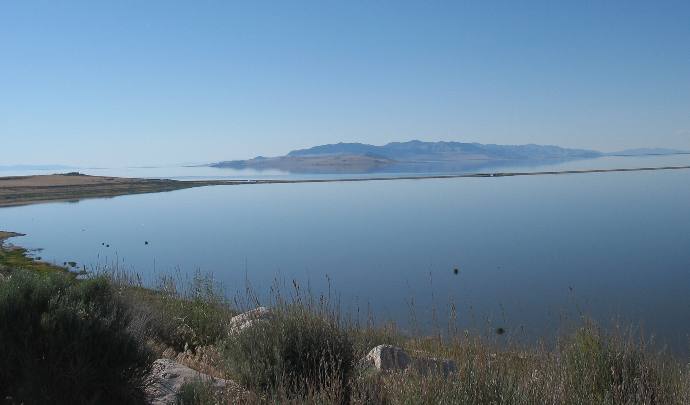
Causeway connecting Antelope Island in the Great Salt Lake to the mainland
Antelope Island in the Great Salt Lake


Joyce took this picture from Antelope Island about 5-miles south of the causeway looking north.


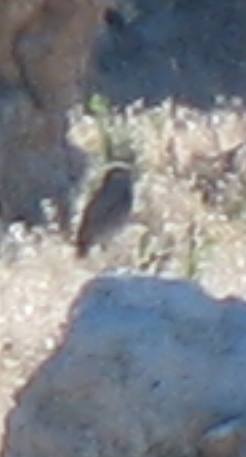
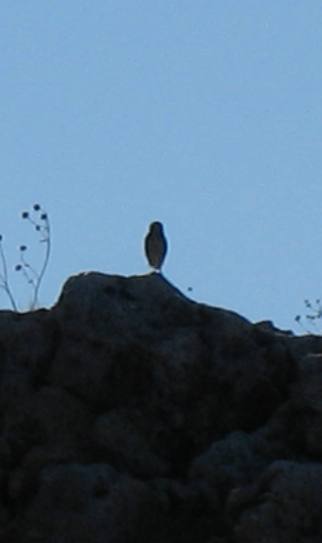
Burrowing owls of Antelope Island in the Great Salt Lake
Antelope Island in the Great Salt LakeAntelope Island in the Great Salt Lake


Typically, burrowing owls make their nests in open grasslands using abandoned burrows of prairie dogs or ground squirrels. However, since Antelope Island has no prairie dogs or ground squirrels, the owls utilize abandoned badger dens. Feeding primarily on grasshoppers, burrowing owls are the only subterranean owls in North America.


If you are visiting Antelope Island stop at the Visitor Center and look for these small owls perched on large boulders east of the Visitor Center. These aren't the best pictures but they were at a distance and looking into the sun. I share them with you so that you will know what to look for when you visit Antelope Island. Once you know where to look you can spot them fairly easily. They can be seen both from the visitor center and from the road that runs south to the Ranch where the road passes east of the visitor center.


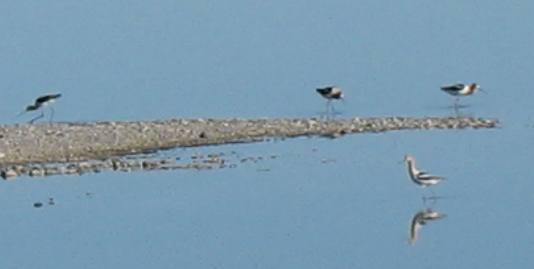
Shore birds feeding along causway to Antelope Island in the Great Salt Lake
Antelope Island in the Great Salt Lake
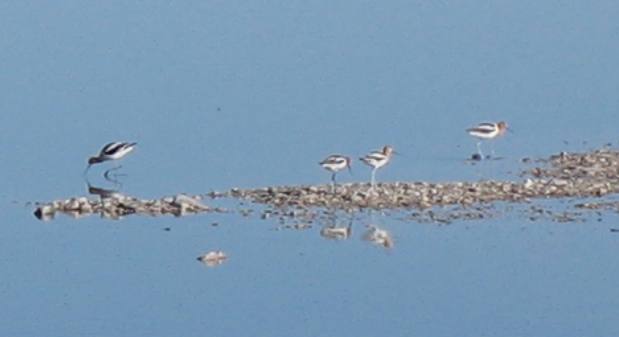


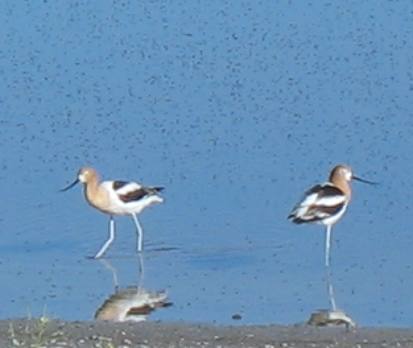
Avocet were visible by the hundreds along the shore where they were feeding on brine shrimp.


Shore birds along causeway to Antelope Island in the Great Salt Lake
Antelope Island in the Great Salt Lake

American Avocet.


American Avocet
American Avocet

American Avocet.


You can clearly see brine flies that provide food to several migrant species that stop by here on their way to other places.


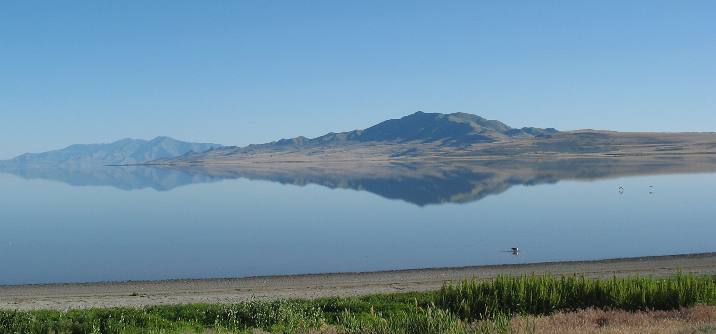
Antelope Island in the Great Salt Lake viewed from the causway
Antelope Island in the Great Salt Lake


The highest and most rugged portions of Antelope Island are home to a variety of species. The rocky slopes provide nesting habitat for rock wrens. The cliffs and air currents near them are home to golden eagles and other raptors. In addition the craggy topography makes ideal habitat for bighorn sheep.

The rugged portion of Antelope Island is that part in the center of this picture taken from the causeway looking to the southwest.


Click here for more of our Utah Travel Adventures

Does it get any better?

Until next time remember how good life is.

Mike & Joyce Hendrix


   Passport America, Save 50% on Campsites
 
 
     Passport America, Save 50% on Campsites