Sumpter Valley Gold Dredge
June 17, 2007.
We are staying at Mountain View Travel Park in Baker
City, Oregon. $24.79 FHU, shade and a nice enough RV-Park.
It must be a former KOA (Keep On Adding) since they charge extra for
everything, $2 extra for wifi, $2 extra for larger sites, you get
the picture Keep On Adding.
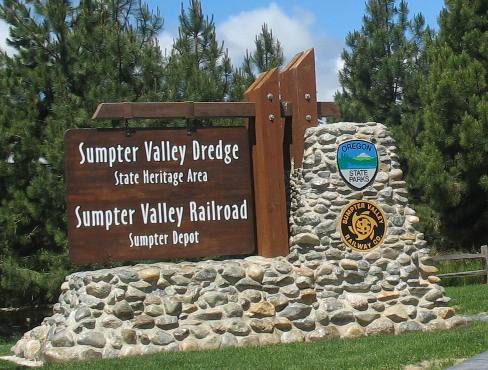 When
we located the old gold dredge we also found the Sumpter
Valley Railroad station.
When
we located the old gold dredge we also found the Sumpter
Valley Railroad station.
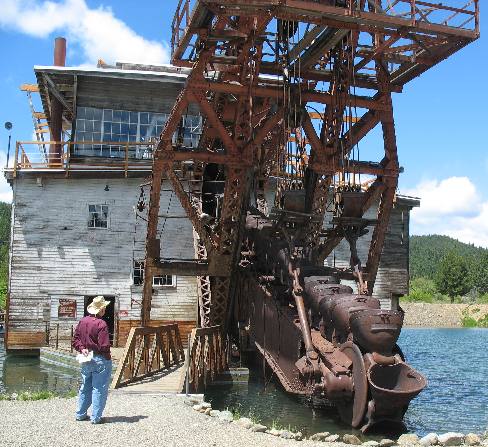
Next to each other is this monstrous dredge sitting idle and the
Station for the Sumpter
Valley Railroad.
For about 100 years, the glint of gold drew many thousands of people
to this valley. Sumpter
became a boom town almost overnight. There were more than 90 businesses
-newspapers, stagecoach lines, blacksmiths hotels, brothels, saw mills,
churches, assayers, banks, schools and more including parades on the
Fourth of July.
At times streets were hot and dusty. Sometimes they were chest-deep
in snow. But the bustling economy seemed to produce most of what the
4,000 residents wanted. At least it did until the town burned down
and it got too expensive to mine for what gold remained.
This dredge dug up thousands of acres of Sumpter
Valley during the 19-years it operated here. It extracted
about 9-tons of gold (about one cubic yard). At current gold prices
of say $350 an ounce that would be 9-tons of gold worth, by my calculations,
$100,800,000.
A gold dredge is basically a giant shovel mounted on the deck of
a boat. Instead of one bucket, this dredge had 72, each weighing a
ton (as much as my Saturn automobile). The assembly of buckets was
called the digging ladder.
This dredge was built on dry land (for about $300,000) and launched
like a boat into a hand-dug pit filled with water. The digging ladder
could scoop out 25 buckets per-minute of earth, rock and minerals
as the dredge chewed its way forward, floating on the pond it created.
The excavated material was transported up the ladder and dumped into
a series of screens inside the dredge.
Massive amounts of electricity were needed to operate a dredge. Long
before any of the surrounding farms got electricity, a 12 mile, 23,000
volt line was strung to the dredge overland from a hydroelectric power
plant.
Joyce wasn't
the least bit interested in this old dredge but did take pictures
and allow me to spend time inspecting this huge machine from the past.
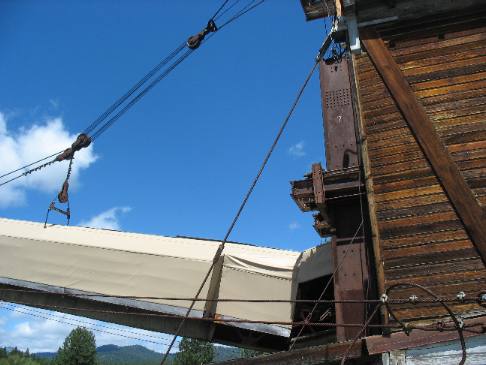
Every rock larger than 3/4 of an inch emptied out the back of the
dredge. The 96 foot "stacker" to the rear of the dredge
was like a conveyor belt, carrying out the largest rocks and creating
the "tailings
piles" we see throughout the valley.
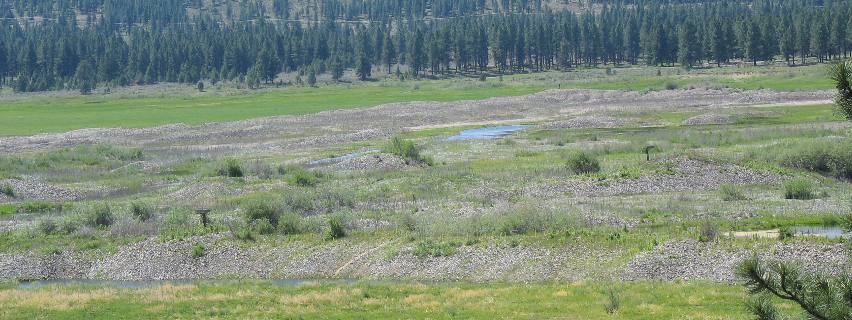
Tailings
from Sumpter Valley gold dredging operations
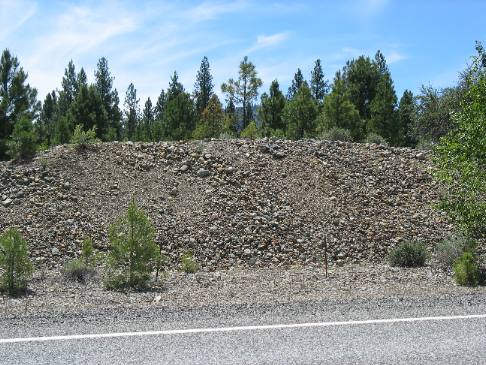
Tailing piles
like this have marred Sumpter
Valley for over 50-years and will probably mar the valley
for hundreds of more years.
According to the inscription on his gravestone, Henry H. Griffin
first discovered gold in eastern Oregon.
Griffin came with other prospectors in 1861 (8-years before the transcontinental
Rail Road was completed). A few miles from Sumpter
in a place they still call Griffin Gulch, he hit pay dirt. Over 30,000
men flooded in to stake claims. The town of Sumpter
grew a short distance away.
For 20-years, miners panned and sluiced the rivers and hillsides
to bedrock. Then, a railroad built to Sumpter
Valley from Baker
City brought pneumatic drills and compressors. Mining shafts
were sunk deep into the mountains following veins of gold in quartz.
Development boomed. Mills were built, that could crush 100 tons of
ore per-day.
Volcanoes and earthquakes are evidence that the earth's crust is
constantly changing. Terribly strong and often violent, these forces
created the mountains of eastern Oregon. They are also responsible
for the mineral riches found here.
The shifting, thrusting earth created intense heat, which turned
rock to molten form, called magma. As it pressured its way to the
surface through older rock, the magma melted some minerals in the
rock, forming a watery metal-rich liquid. As the magma cooled, vein-like
cracks developed in the surrounding rocks. It was here in these cracks
that quartz and metals, including gold, crystallized. These deposits
are called "lode veins."
During the Ice Age, glaciers scoured away mountain tops exposing
the veins of gold. Further erosion and gravity brought the gold tumbling
down the mountain sides, eventually settling in creeks and washing
out into the Sumpter
Valley.
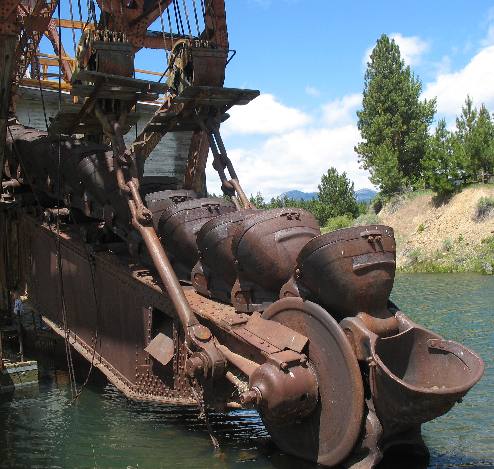
As each bucket came over the top of the digging ladder, its material
was dumped into a large hopper. From there, everything fed into a
cylindrical screen --6 feet across by 35 feet long -- that continuously
tumbled the material. High pressure water--3,000 gallons a minute--rushed
over the screen and its contents. Gravity and water forced the material
down the length of the screen.
The material, including gold, fell out into a catch pan below, while
the larger rocks and gravel were carried to the rear of the dredge
and dumped into tailing piles by the stacker.
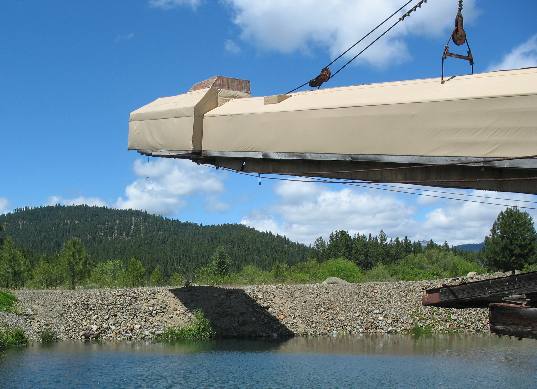
This is the "stacker" that carried larger rocks and gravel
out and staked this useless rock into tailing piles like the one in
this picture.
Inside, water continued to wash the finer sands, pebbles and precious
minerals from the catch pan through a series of sluice boxes. Just
about the whole back of the dredge was covered with sluices. In each
one, there's be a number of "riffles," kind of like a washboard.
The sand and gravel were washed away while the heavier gold was trapped
in the riffles.
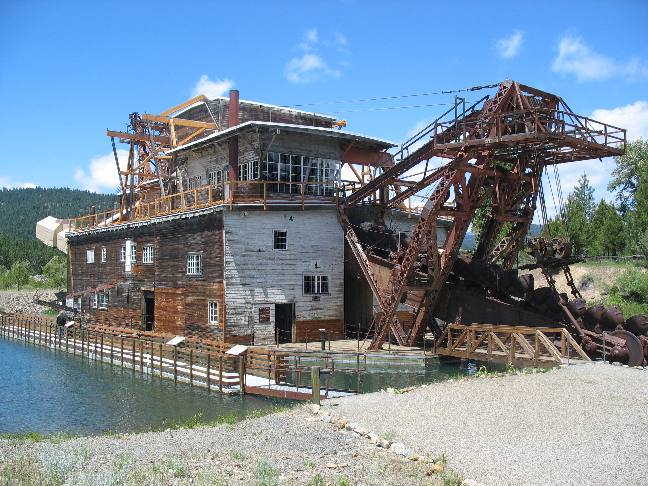
As years passed, more efficient means of trapping the gold were developed.
They added a box-like contraption--called a jig--partly filled with
round metal balls, like B-Bs. Sand escaping from the riffles would
drop into the jigs---where the balls would pulverized the material.
Mercury added to both the riffles and the jigs would attach itself
to gold in the fine sands. This method was far more efficient at removing
gold.
Very few people had access to the gold, at least officially. Though
there are tales of embezzlement, the security of the gold became tighter
as the years went by. After separating the gold from the mercury,
it was poured into bricks for shipment to the US Treasury.
Three gold dredges operated in the Sumpter
Valley, on and off, from 1913 to 1954. Periods of dredging
activity were influenced by the fluctuating prices of gold, the Great
Depression, the Second World War, and equipment breakdowns. The dredges
dug up 2,500 acres of farmland extracting approximately $10,000,000
in gold.
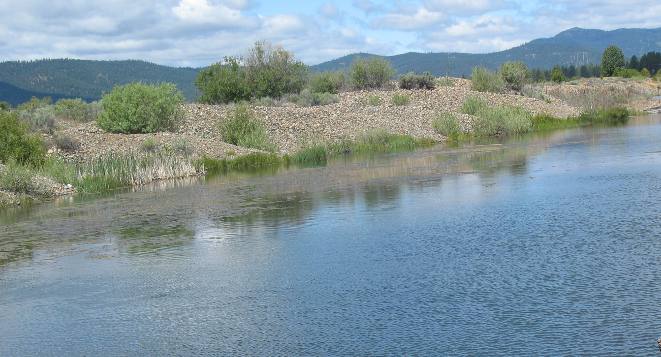
Dredging ended when profitable land for mining became scarce-----in
other words they dug up the entire valley.
These rock piles have been exposed since dredging activity ceased
in 1954.
Mike & Joyce Hendrix

Mike
& Joyce Hendrix who we are
We hope you liked this page. If you do you might be interested in
some of our other Travel Adventures:
Mike & Joyce Hendrix's home
page
Travel Adventures
by Year ** Travel
Adventures by State ** Plants
** Marine-Boats
** Geology ** Exciting
Drives ** Cute Signs
** RV
Subjects ** Miscellaneous
Subjects
We would love to hear from you......just put "info" in
the place of "FAKE" in this address: FAKE@travellogs.us
Until next time remember how good life is.
