Baker City, Oregon & Oregon Trail Interpretive Center

Home ** 2007 Index ** More Oregon Travel Adventures


Baker City, Oregon & Oregon Trail Interpretive Center

June 16, 2007.

We are staying at Mountain View Travel Park in Baker City. $24.79 FHU, shade and a nice enough RV-Park. It must be a former KOA since they charge extra for everything, $2 extra for wifi, $2 extra for larger sites, you get the picture.


Oregon welcome sign on I-84

Oregon welcome sign on I-84


We are traveling from Idaho into Oregon on I-84. As we crossed over the Snake River we were in Oregon.


Desert scene on I-84 in eastern Oregon

Desert scene on I-84 in eastern Oregon


The desert continued into Oregon as you can see.


Farewell Bend State Park in Oregon

Farewell Bend State Park in Oregon


This is Farewell Bend State Park in Oregon. It was given the name because it is where emigrants on the Oregon Trail left the Snake River that they had been following for over 300-miles. Emigrants had grown fond of the Snake River. At Farewell Bend emigrants were compelled to walk or die since certain death lay ahead in any descent of Hells Canyon which lay ahead for those that contemplated following the Snake River.

Their good-bye to the Snake was heart felt.

The Burnt River canyon was equally unforgiving. Purposeful burning of the hillsides by Indians helped ensure fine grass for livestock, but the path twisted around the river, and heavy brush slowed progress. For four or five days, emigrants wandered back and forth across the riverbed, braved the slopes, and struggled with overturned wagons. Their reward? Virtue Flat --- and more sagebrush!


Lime, Oregon

Lime, Oregon


As we passed through a small town called Lime we spotted limestone on this hill.


Desert scene on I-84 in eastern Oregon

Desert scene on I-84 in eastern Oregon


Note that we are still in a desert. That is a train tunnel on the left side of the interstate.


Cement plant in Lime, Oregon

Cement plant in Lime, Oregon


On the other side of that large hill was this cement plant obviously taking advantage of the limestone in this area.


Red Neck Cafe sign I-84 exit 327 in eastern Oregon

Red Neck Cafe sign I-84 exit 327 in eastern Oregon


Joyce was quick with the camera when she snapped this advertisement on I-84 as we were moving the motorhome to Baker City, Oregon.


National Historic Oregon Trail Interpretive Center

National Historic Oregon Trail Interpretive Center


National Historic Oregon Trail Interpretive Center Baker City, Oregon

Joyce Hendrix Oregon Trail Interpretive Center Baker City, Oregon


One of the big tourist attractions in Baker City is the National Historic Oregon Trail Interpretive Center. This is a world class Interpretive Center really explaining the whole phenomena of the great movement of people from the eastern United States to western Oregon.

Needless to say Joyce and I spent several hours absorbing all the information presented.


Mike at National Historic Oregon Trail Interpretive Center

Mike Hendrix & Buffalo


I wonder which one of us looks best, me or the buffalo? VBG


Oregon Trail Ruts Baker City, Oregon

Oregon Trail Ruts Baker City, Oregon


Beginning in 1843, thousands of Oregon Trail emigrants trekked through this region toward new lives in the West. This epic journey indelibly etched the landscape with wagon ruts such as these.

Of the 2170 miles of the Oregon Trail, approximately 300 miles of ruts remain. Swales created by thousands of wagon wheels and the trampling of draft animals are deep in some areas, shallow in other places. Much of the trail has disappeared due to natural erosion, and development of farms, highways, cities and towns. In some places, the Oregon Trail, or Emigrant Road as it was generally called in the 1800's, was later used by automobiles.


Oregon Trail Ruts Baker City, Oregon

Oregon Trail Ruts Baker City, Oregon


As you might suspect, the Oregon Trail route followed the easiest grades whenever possible. These ruts came from the southeast across Virtue Flat as it headed northwest towards Baker Valley and the divide in the low hills to the north. In any place where level open ground permitted wagons spread out rather than follow single file to give livestock more access to grazing and to minimize the dust. In places like this they would follow one another thus creating these ruts.


Oregon Trail Ruts Baker City, Oregon

Oregon Trail Ruts Baker City, Oregon


Emigrants generally traveled through this area sometime between mid-August and late-September. At the time of the migration, this site was NOT known as "Flagstaff Hill', but was referred to as a high ridge or divide in pioneer diaries that read something like this: "...after leaving camp. We crossed the divide and camped at the lone pine tree..." James W. Nesmith, 25 September 1843


To begin with emigrants on the Oregon Trail came west searching for good farmland. Later, gold was one of the greatest lures for people to move west.


Baker Valley Baker City, Oregon

Baker Valley Baker City, Oregon


In the 1840s (early years of the migration), those seeking land observed the lush fields of the Baker Valley and Powder River Valley as they traveled the Oregon Trail to western Oregon. With no settlements, weary emigrants had to pass up the agricultural potential for the security of supplies and markets in the Willamette Valley.


The discovery of gold at Sutter's Mill in California in 1848 escalated the great migration across the continent, and opened up the need for supplies and food for the rapidly growing population of miners. Oregon's economy flourished; shipping produce, cattle and timber south. As the gold fields of California played out, prospectors looked for fortune in other regions. Strikes in Nevada, Colorado, Montana, Idaho, British Columbia and Oregon generated new trail routes, new settlement and new trade patterns as miners followed the rumors of gold.

Some miners considered the story of the "Lost Blue Bucket Mine". In 1845, a wagon train looking for a short cut through central Oregon became lost and wandered through the hills and desert country. At one campsite, some shiny yellow pebbles were found, and allegedly, most of the rocks were left behind in a blue bucket. The story and a few samples however were saved, and after news of the find at Sutter's Mill it was recognized that the lost pioneers had found gold - but they could not remember the location of their find.

In 1861, prospectors searching the mountains of eastern Oregon for the Lost Blue Bucket location found gold in a gulch about seven miles south west of present day Baker City. The news started a stampede, with an estimated 15,000-30,000 gold seekers coming into the Blue Mountains in the next year and over 1,700 mining claims filed. It became the county seat of newly formed Baker County, and for a short while was the largest town in Oregon - two years later it was headed for oblivion with less than 150 residents.


Baker Valley Baker City, Oregon

Baker Valley Baker City, Oregon


Emigrants on their way to the Willamette Valley in the early 1860s shared the trail with eager gold miners. Some decided to cut off the trail and stay in Baker County, starting farms and businesses to supply the bustling mining trade. As Auburn became overcrowded , prospectors followed other leads, finding gold at Canyon City, Prairie City, Sumpter, and Granite, south at Mormon Basin and Rye Valley, and east to the Boise Basin.


As early methods of placer mining gave way to lode mining, the need for supplies - especially heavy equipment - led to changes in the economic life of communities supporting the mining business. Freighters developed routes to haul goods from Columbia River ports to the mountains around Baker Valley. A railroad route was developed, and completed in 1884. A stamp mill built on the Powder River in 1864 became the starting point for the town of Baker City, which soon became the county seat, and a hub for suppliers of hardware and heavy equipment. Lumbermen started mills to supply timbers. Ranching and farming expanded to meet the growing market for produce, beef and draft animals. Hotels and banks accommodated the investors, engineers and businessmen as mining changed from the work of lone prospectors into corporate ventures. Churches and schools developed for families; saloons and more carnal entertainment establishments were constructed for the single miners. Civic and fraternal organizations, libraries, and musical bands appeared in even the most rudimentary and temporary mining camps.

Settlement patterns chased gold finds throughout the West, encroaching on traditional Indian lands. Treaties and reservations reduced Indian territory. The lust for gold created a mobile society, able to quickly relocate, establish governments and communities, and then leave when the gold became scarce and new rumors lured restless miners away.


View from Flagstaff Hill east of Baker City, Oregon

View from Flagstaff Hill east of Baker City, Oregon

Early Oregon Trail emigrants crested this hill (Flagstaff Hill) east of Baker City, and with the Blue Mountains looming to the west, saw a solitary tree in the valley below. Called I'arbre seul (the lone tree) by French-Canadian fur trappers, this large tree, possibly ponderosa pine or Douglas-fir, towered majestically above the floor of Baker Valley about 3-miles distance from here.

For many years -- perhaps centuries -- the Lone Tree served as a landmark for Indians, trappers, missionaries, and Oregon Trail emigrants, until felled in 1843 by what explorer John Fremont called, "some inconsiderate emigrant ax."

Others remembered that solitary ponderosa pine flourishing on the banks of the Powder River, as it welcomed emigrants to the Baker Valley. It stood entirely alone "in the midst of an immense plain." Medorem Crowford, writing in 1842, believed it to be "respected by every traveler through this almost Treeless Country." But that was not the case.


Story of I'arbre seul (the lone tree) named by French-Canadian fur trappers for the lone tree in the Baker Valley

Story of I'arbre seul (the lone tree) named by French-Canadian fur trappers for the lone tree in the Baker Valley


In 1843, Peter Burnett looked west toward the pine as he passed Flagstaff Hill. One moment he saw the tree; the next it was gone. "That brave old pine ... has fallen at last by the vandals --- hands of man. Some of our inconsiderate people had cut it down for fuel, but it was too green to burn ... Had I been there in time I would have begged those woodsmen to spare that tree."


Baker Valley viewed from Flagstaff Hill

Baker Valley viewed from Flagstaff Hill

Emigrants camping in this valley often met traders from Willamette who walked through offering food and good news. They told of the bountiful harvests, the fertile soil, and the gentle winters in Oregon. The promised land seemed so close, but several enemies still barred the way; weather, mountains, rivers, and lack of supplies.

Hailstorms and iced-over water buckets reminded the travelers that winters came early in the mountains. Axing their way through thick timber and hauling wagons up seemingly vertical inclines drained their small stores of energy and patience and supplies.

Beyond the Blues, travelers heading for Willamette had to decide between two unappealing routes: the Columbia River or the Barlow Road. Whether they chose the river or the road, they risked losing everything. Fortunately, moments of joy and relief flickered brightly as they neared their goal: friendly Indians still provided fresh food and the land itself more than fulfilled their hopes.


Baker Valley viewed from Flagstaff Hill

Baker Valley viewed from Flagstaff Hill

The Baker Valley spread out before you changed rapidly in the years after the Oregon Trail. Placer and lode mining, and the spread of farming and stock raising changed the face of Baker Valley forever. A mixed population including Chinese laborers, Basque shepherds, and recent European immigrants scrambled for the land. They washed gold and irrigated their fields. They erected handsome buildings, planted trees, and called the place home. By 1890 Baker City had 4,500 residents.

The valley drew trade, logging and lumbering, and tourists. The arrival of the railroad in 1882 created more prosperity by linking northeastern Oregon to the nation. At the same time, grazing, new plant species, and mining upset the region's ecological balance. Fluctuating world markets brought agricultural depressions, growth in booming Baker Valley gradually slowed, and a more modest stability took hold.


Abandoned gold mine on Flagstaff Hill near Baker City, Oregon

Abandoned gold mine on Flagstaff Hill near Baker City, Oregon


When Henry Griffin, a prospector from California, discovered gold eight miles southwest of present-day Baker City in 1861, the emigration pattern changed radically.

Eastern Oregon quickly became a destination for gold-seekers and settlers--many arrived from the Willamette Valley reversing their initial journey along the Oregon Trail to settle in this area.

Mining camps sprang up with the prospect of gold and many boomed into towns. By 1862 the nearby town of Auburn, which no longer exists, had a population over 5,000 and was among Oregon's largest cities. Local settlers established farms and stores, providing hay and produce to miners, and for much of the 1860s large wagon trains loaded with freight were a common site along this segment of the Oregon Trail.


Placer deposits of gold sparked Oregon's gold rush boom, but lode mining became an industry. Placer miners worked from sunrise to sundown. They panned, cradled, rocked and ground-sluiced the paydirt. They invested in crazy contraptions called " gold machines," and hoarded their precious gold in leather pouches and fruit jars. They also helped found towns like Auburn, Baker City, Eldorado, Sumpter, and Granite.

The opening of rich lodes like the Virtue Mine in the 1870s poured more money into the Baker Valley. Load mining required months of labor with hammers, drills, and dynamite. Dust clogged the men's lungs, stamp mills deafened them, and the cyanide plants exposed them to all kinds of hazards. But mining was work and work meant meals, a place to bunk, and maybe even a paycheck.


Abandoned gold mine on Flagstaff Hill near Baker City, Oregon

Abandoned gold mine on Flagstaff Hill near Baker City, Oregon


Eastern Oregon today is still marked with remnants of mines large and small, of tailing piles, abandoned shafts and placers, rock walls built by Chinese laborers, empty ditches which brought water to placer operations, abandoned buildings and cabins where gold once was the center of life and activity. Gold production since World War II has been considerably less than the boom years of the late 19th and early 20th century when Baker County was a leading producer of gold in Oregon. As with many regions in the West, the roots of present day communities reach back to the quest for gold.


Abandoned gold mine on Flagstaff Hill near Baker City, Oregon

Abandoned gold mine on Flagstaff Hill near Baker City, Oregon


This picture captures several of those old mines.


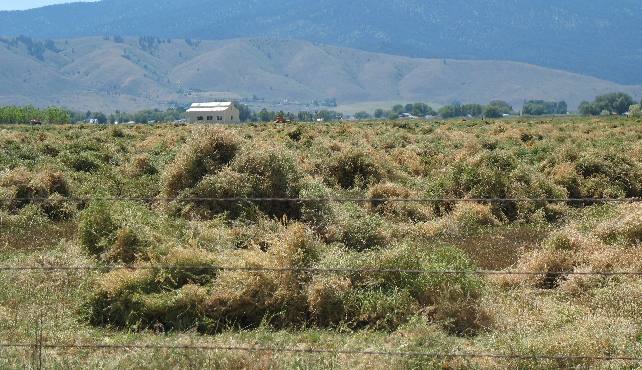
Baker Valley hay field

Baker Valley hay field


The Baker Valley produces thousands of acres of hay. This alfalfa field has been mowed and raked into rows of hay that is drying. Within a few days a bailing machine will move down the rows creating giant bales of alfalfa.


At the turn of the century, Baker City was known as the "Queen city" of the Pacific Northwest, the cultural center between Salt Lake City and Portland, resplendent with several exquisite hotels and restaurants, ballrooms for dancing, an opera house and neighborhoods of elaborate homes.

Today, Baker City boasts one of the largest commercial national Register Historic Districts in the state of Oregon with over 110 buildings in the district.


Geiser Grand Hotel Baker City, Oregon
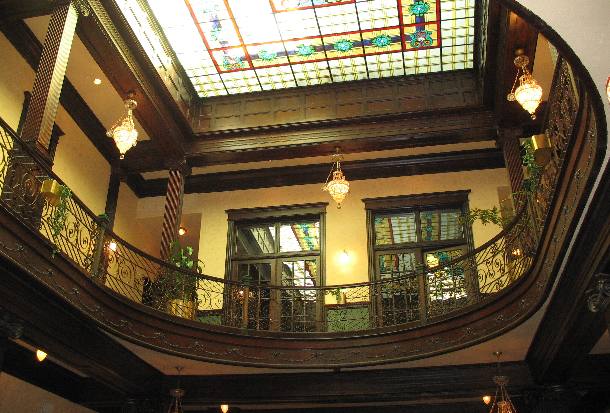
Geiser Grand Hotel Baker City, Oregon


This is the Geiser Grand Hotel constructed here in Baker City in 1889. Originally the Warshauer House, the Geiser Grand Hotel was built by local merchants Harry and Jake Warshauer for the then magnificent sum of $65,000. The hotel was a gathering place for business travelers from across the nation - and even Europe - many of whom had interests in area gold mines. Local mine owner Al Geiser purchased the hotel and extensively remodeled it at the turn of the century. The hotel was closed for almost thirty years before being restored and reopened again in 1997.


Geiser Grand Hotel Baker City, Oregon
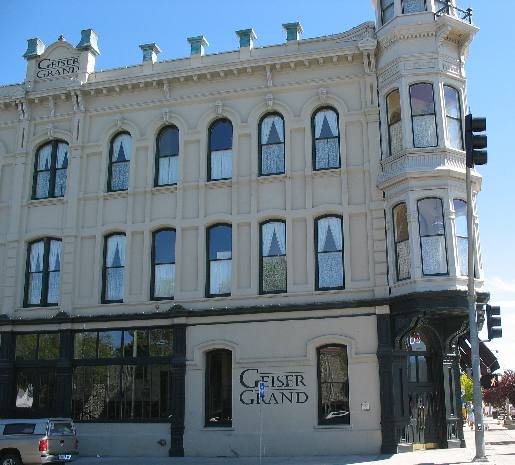
Geiser Grand Hotel Baker City, Oregon


Gold display in U.S. Bank of Baker City, Oregon
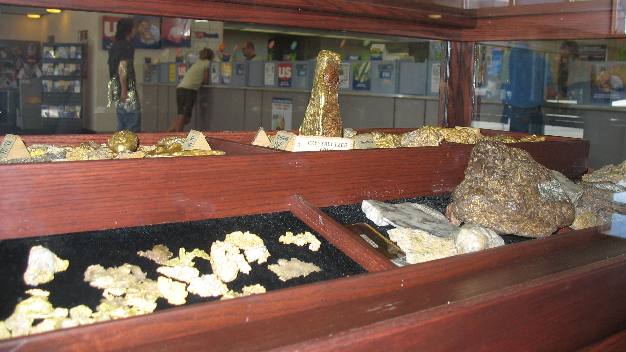
Gold display in U.S. Bank of Baker City, Oregon

One of the stops on our walking tour of historic homes and businesses in Baker City was the U.S. Bank where they have a gold display. Among trays of gold flakes and gravel-sized nuggets on display is a heart-stopping specimen that was pulled from a muddy stream in 1913.

The miner's name was George Armstrong, and he spotted the hunk of gold as he followed his son out of a placer mine near Susanville in Grant County.

The nugget weighed 80.4 ounces --that's 6 and 3/4 pounds --- and was worth more than $1,400 at the 1913 gold price of $17.50 an ounce. That's more than $25,000 in today's dollars.

The nugget sits front and center in the bank's gold display that features metals mined from the Baker Mining District.


Luther B. Ison home Baker City, Oregon
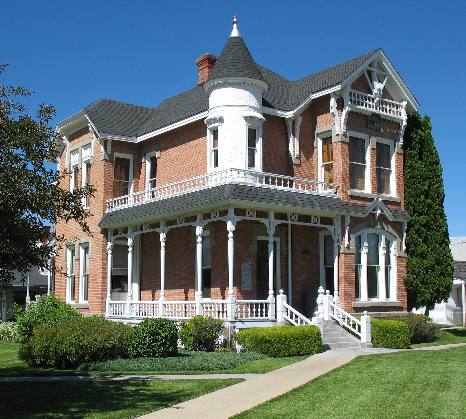
Luther B. Ison home Baker City, Oregon


When Luther B. Ison built this home in 1887 he directed that only the finest materials be used. The bricks were freighted from Portland, the fireplaces came from Holland and Alaskan white cedar was used for woodwork. Ison, who was a district judge at the time, died in 1889, just two years after the home was completed, but his widow lived there for the next 50 years. The house has been renovated for use as a bank.


Bowen Home Baker City, Oregon
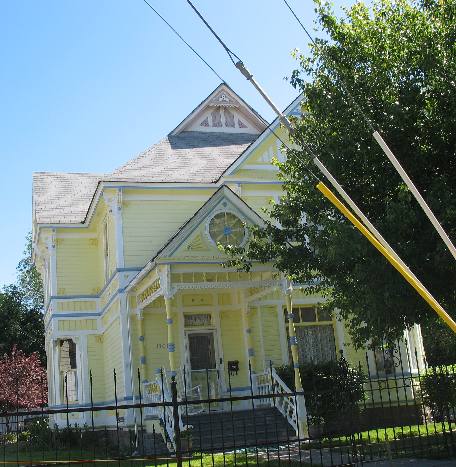
Bowen Home Baker City, Oregon


This is the Bowen Home built in 1895 by the publisher and editor of Baker City's "Bedrock Democrat" newspaper. The house was a traditional all-white Victorian with a park-like yard that was much larger than it is now. The Bowens were pioneers in Baker County arriving in 1862 with their parents.


St. Francis Cathedral Baker City, Oregon
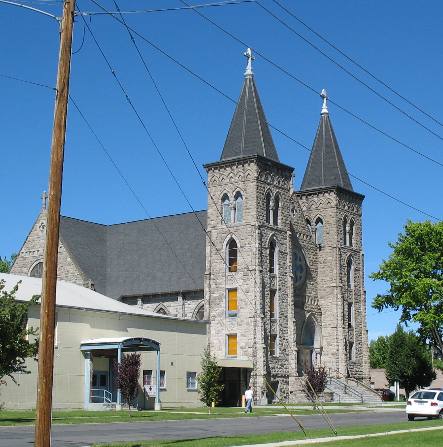
St. Francis Cathedral Baker City, Oregon


St. Francis Cathedral was constructed in 1908 of volcanic tuff stone quarried about 12-miles east of Baker City. Many other prominent buildings erected in the city during the 1900s were constructed of this same volcanic tuff stone. The Catholic Diocese of Baker, established by the Pope in 1903, included all of Oregon east of the Cascade Mountains.


Click here for more Oregon Travel Adventres


Until next time remember how good life is.

Mike & Joyce Hendrix


   Passport America, Save 50% on Campsites
 
 
     Passport America, Save 50% on Campsites