Kennecott's Bingham Canyon Copper MineUtah: Kennecott's Bingham Canyon Copper Mine (largest open pit mine
in the world actually the largest man made hole in the world) located
25-miles southwest of Salt Lake City. May 29, 2007. We spent the night with Cabella's I-15 exit 287 Lehi, UT about 25-miles south of Salt Lake City. Free with a dump station! We stopped in this area so that I could visit Kennecott's Bingham Canyon Mine. Kennecott Utah Copper's Bingham Canyon Mine is one of Utah's most popular tourist attractions. There is a Visitors Center inside the mine that features informative exhibits and videos. Outside, from a viewing area, you can observe the operations of the world's first open pit copper mine. Known as "The Richest Hole on Earth," this gigantic operation has yielded more than 17 million tons of copper metal, as well as vast quantities of gold, silver and molybdenum. It is the largest man-made excavation in the world. Since open-pit mining began in 1906, more than 7 billion tons of material have been removed, creating a pit more than 3/4 of a mile deep and 2.5 miles wide. To put this in perspective the world's tallest building, the Sears Tower, 1454' tall, would reach only half way up the mine. The mine was designated as a National Historic Landmark in 1966 by the United States Department of the Interior and in 1972 by the National Park Service.
Overburden from Kennecott's Bingham Canyon Copper Mine
This huge pile of rocks is "overburden," useless rock that has been removed from the mine to get at the ore bearing rock. Fully 2/3 of the material removed from the mine is this overburden that has to be removed to access valuable ore bearing rock.
Back in 1906 when the Utah Copper Company and Boston Consolidated Mining Company began hauling ore that contained only 2% copper from Bingham Canyon to concentrators near the Great Salt Lake, they were ridiculed by mining men of the era who thought they could never make a profit mining such low-grade ore. Today, the companies that eventually became Kennecott Utah Copper hold a unique place in mining history. They created the world's first open-pit mine, and showed the mining industry how to make a profit mining low-grade ore.
Overburden from Kennecott's Bingham Canyon Copper Mine
More copper has been produced by Bingham Canyon than any mine in history. More than six billion tons of rock have been moved since the open pit was first started in 1906. What you see here is the waste rock removed from the mine in order to reach the ore bearing rock. Folks, that is a mountain in itself and that is only a portion of what is visible from where we are taking this picture.
Overburden from Kennecott's Bingham Canyon Copper Mine
Turning the camera to look straight ahead and yet another mountain of waste rock is visible.
Overburden from Kennecott's Bingham Canyon Copper Mine
To the right of this large mountain of waste rock is other mountains of waste rock that continue for miles.
More overburden from Kennecott's Bingham Canyon Copper Mine
Overburden from Kennecott's Bingham Canyon Copper Mine
More Overburden from Kennecott's Bingham Canyon Copper Mine
We have now entered the front gate to Kennecott's mine and are climbing up the side of this huge pile of waste rock to the lip of the mine. I say lip because at one point the road starts falling into the open pit that is the mine.
Overburden at Kennecott's Bingham Canyon Copper Mine
Here we are continuing our climb up to the lip of the mine.
Kennecott's Bingham Canyon Copper Mine
We have passed over the lip and we can see where the mountain has been removed and the hole has begun. Remember, this is an open pit mine where all rock on top of the valuable ore bearing rock is removed in order to reach the ore bearing rock instead of tunneling into the mountain to the ore bearing rock.
Kennecott's Bingham Canyon Copper Mine
A view of the other side of the "hole" from where we crossed over the lip. Remember there used to be a mountain here. Now there is a hole, a BIG hole.
Kennecott's Bingham Canyon Copper Mine
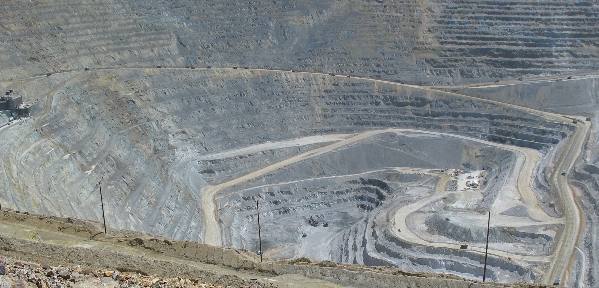
A mountain once stood where this huge bowl is now located. Over 6-billion tons of material have been removed since open-pit operations began in 1906. Over 2/3 of all Utah mineral production has come from this Bingham Canyon Mine. Bingham Canyone ore has yielded more than 17-million tons of copper, 23 million ounces of gold, 190 million ounces of silver and 850 million pounds of molybdenum, whose cumulative value far exceeds the yields of the Comstock Lode, Klondike and Canifornia gold rushes combined. It is 2 and 1/2 miles across the top of this hole that used to be a mountain.
Kennecott's Bingham Canyon Copper Mine
This is a closer look at the far side of the mine. Visualize, if you can, that this is what the side of this great hole looks like where for a hundred years miners have removed layers and layers of rock in order to access the valuable ore. Totally awesome is the only way I can describe it.
Kennecott's Bingham Canyon Copper Mine
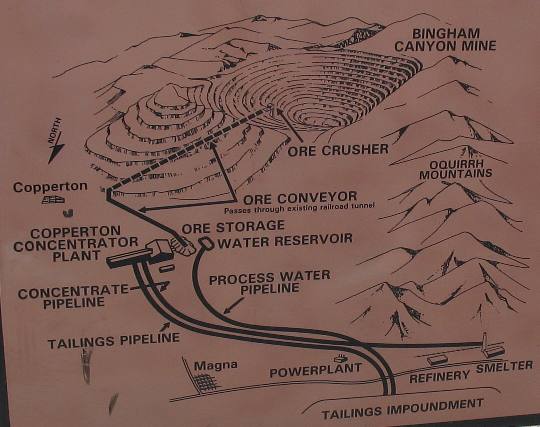
The building in the picture to your right is an oar crusher located deep within the mine. The snout snaking its way out of that building toward the bottom of the picture is a 5-mile ore conveyor system that transports ore bearing rock to the "Concentrator" facility.
Kennecott's Bingham Canyon Copper Mine
In the picture to the left a large shovel is loading ore onto those huge trucks to be transported to the "in pit" oar crusher. These trucks and that shovel are almost 3/4 of a mile deep in this hole.
Kennecott's Bingham Canyon Copper Mine
The tall "drilling rig" on the right is drilling holes for explosives.
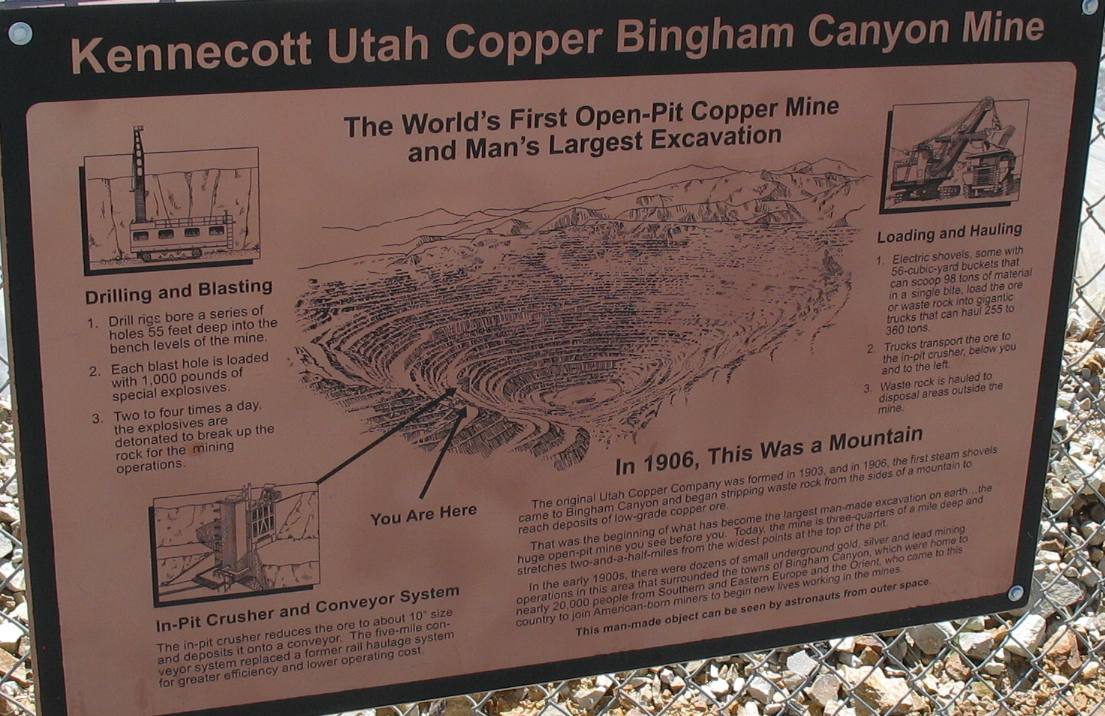
In this picture a large shovel is loading ore onto a huge truck transporting ore to the "in pit" oar crusher. These trucks and that shovel are almost 3/4 of a mile deep in this hole. In addition to that large shovel in the picture to the right is a drilling machine. Drill rigs like this drill a series of 55' deep holes into the levels of the mine called "benches." Each hole is filled with 1,000 pounds of ammonium nitrate (explosive). Two to four times a day the explosives are detonated. After the rock is blasted and broken, it can be picked up by the huge shovels like the ones in both of these pictures.
Trucks carrying overburden deep in Kennecott's Bingham Canyon Copper Mine
Kennecott's Bingham Canyon Copper Mine
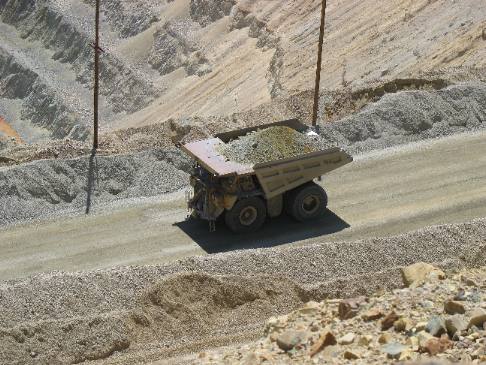
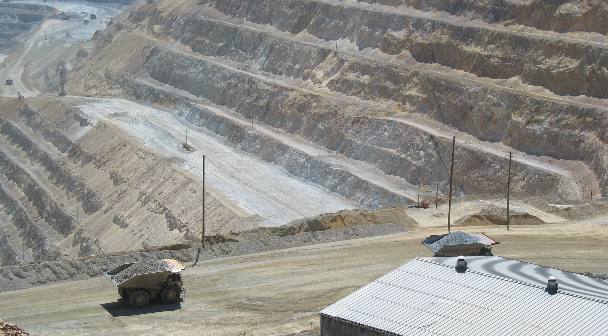
Only a portion of the trucks in the mine are hauling valuable rock. Remember 2/3 of the rock is overburden that must be removed to access the valuable ore bearing rock. Trucks in the picture to the left are removing overburden from the mine. This rock is having to be hauled out of the mine to be disposed of. Trucks transporting ore bearing rock have a much shorter distance to travel to that "in-pit-crusher" than the trucks having to carry their loads out of the mine. Bottom line many more trucks are involved in removing overburden than in hauling valuable ore. You can see the "in-pit-crusher" in the extreme left side of the picture on the right. It is not even 1/2 way up the wall of that huge hole. Look closely at the picture on the right and pick out the huge trucks hauling rock, some of it waste rock headed out of the mine others hauling ore bearing rock destined for the crusher. In the picture to the left you can see four of those huge trucks carrying waste rock out of the mine, look behind the 2nd truck at the white pick up truck for something to gauge size with. These trucks are already above the in-pit-crusher where the ore bearing trucks are depositing their load, and these trucks still have a long way to go to exit the mine where they continue to the disposal site possibly a mile away.
Removing overburden from Kennecott's Bingham Canyon Copper Mine
Trucks like this remove 450,000 tons of material daily. Of this about 1/3 is ore that contains the valuable metals, and 2/3 is waste rock referred to as overburden.
Kennecott's Bingham Canyon Copper Mine
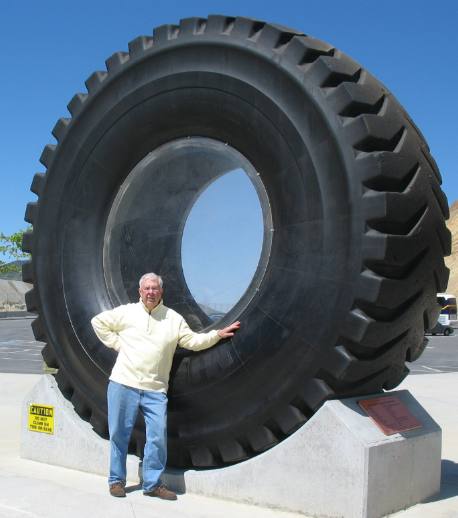
Massive tire used on overburden haulers at Kennecott's Bingham Canyon Copper Mine
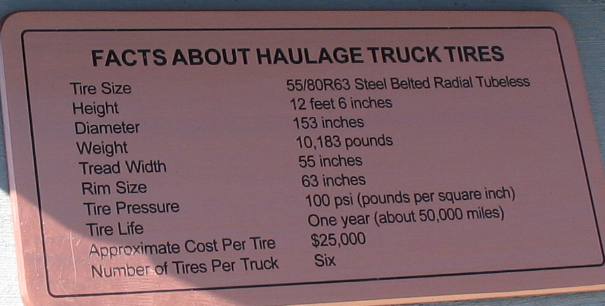
This is a tire used on one of those huge haulage trucks you see in the mine.
Truck Tire Facts at Kennecott's Bingham Canyon Copper Mine
Kennecott's Bingham Canyon Copper Mine
These two trucks are transporting overburden (waste rock) out of the mine.
Kennecott's Bingham Canyon Copper Mine
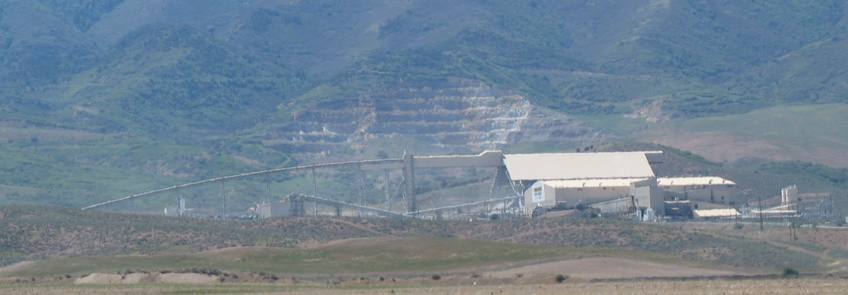
This is the Concentrating facility. That 5-mile conveyor belt from the "in-pit-crusher" ends at this building. The "in-pit-crusher" reduced ore bearing rock to pieces no larger than basket balls. When these basket ball size rocks reach this building they are fed into huge cylinders filled with massive steel rollers. In this cylinder the ore, which contains only 0.6% copper, is mixed with water and ground to a consistency of face powder. Then through a flotation process, the ore is "concentrated" to 28% copper by removing unwanted materials. Three products come out of this process: 1. The concentrated copper (silver, gold & molybdenum) and 2. A valuable by-product, molybdenum, is recovered and sold to steel manufacturers as a hardening agent. 3. The unwanted material (crushed ore that remains after the valuable metals have been removed). This is called tailings. The unwanted material (tailings) is transported, as a slurry, in another pipe to a $500-million tailings impoundment around 15-miles from the mine. The concentrated copper is transported, as a slurry, 17-miles through a large pipeline to the smelter located near the Great Salt Lake where I-80 and SR 201 intersect.
Smelter for Kennecott's Bingham Canyon Copper Mine
The 28% copper concentrate is heated to a molten state in this smelter. Additional impurities (primarily iron and sulfur) are removed producing 98% copper that is poured into forms called "annodes". All smelting processes, at one time, would belch terrible gasses into the atmosphere --- causing bad problems. New regulations, require smelters to trap and treat those gasses.
Sulfuric acid from Kennecott's Bingham Canyon Copper Mine
Sulfuric acid is one of the main things removed in this "scrubbing" process. Kennecott now sells this sulfuric acid to industry. These are tanker cars filled with sulfuric acid. Can you imagine that this was once belched into the atmosphere as a normal occurance?
Refining-facility at Kennecott's Bingham Canyon Copper Mine
The copper-anodes produced during the smelting process are transported to this "refining-facility" next door. The anodes are subjected to an electrolytic process where the copper is refined to a purity of 99.99%. During this process, precious metals such as gold and silver are also recovered or separated. The finished copper "cathodes" are then shipped to industrial users who will manufacture copper sheeting and wire, as well as other copper, brass and bronze consumer products. The gold and silver and other trace metals are also recovered and sold as well.
Remember that Bingham Canyon's ore contains an average of only 0.6% copper. It takes a ton of ore to produce 12-pounds of copper. Yet Kennecott Utah Copper produces approximately 320,000 tons of refined copper annually plus significant quantities of molybdenum (a metal used to strengthen steel), gold and silver. The numbers are staggering, as is that hole in the ground.
Great Salt Lake State Park Marina
On the Great Salt Lake, across I-80 from the smelter, is the Great Salt Lake State Park Marina.
We were looking for birds in the Great Salt Lake State Park but this must have been the wrong time of year. Instead I took this picture of a power glider motoring aling the shoreline scarcely 10-feet above the water.
Click here for more of our Utah Travel AdventuresUntil next time remember how good life is. Mike & Joyce Hendrix
|
|
||
|
|||
|
|||