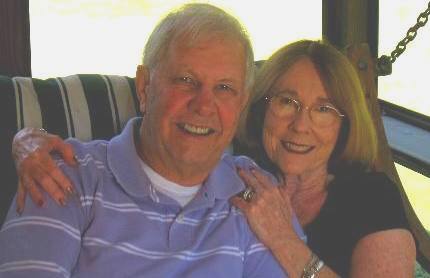
El Paso, TexasApril 28 and 29, 2007. We are staying with friends at the SAEM (Spanish American Evangelistic Ministries) facilities in east El Paso. Our friends, Harry & Sue, are volunteers at the mission. The mission has 6 or 8 FHU spots for volunteers. Harry & Sue, took us to view Missions on the Mission Trail east of downtown El Paso. Our first mission was in San Elizario not far from the Rio Grand River.
San Elizario Chapel in San Elizario, Texas
This is San Elizario Chapel (CAPILLA DE SAN ELZEARIO) It is named for the 13th-Century French Patron of the Military, St. Elzear, Capilla De San Elzeario Military Garrison of presidio De San Elzeario. It was moved to this site in 1789 from its original location 37-miles to the southeast after Rio Grande Floods damaged the original Chapel. The present chapel was built with new adobe bricks and bricks from the original Presidio walls. It is a fine example of the Spanish Colonial Revival Style and is a tangible reminder of the Hispanic and Catholic heritage of this region.
Don't let that date of 1789 slip by without putting it in perspective. That is when this Chapel was constructed AFTER their other one was destroyed in a flood. Can you think of things that were going on back east with "the colonies" back in 1789? 1781--The British surrender at Yorktown marking the end of the American Revolutionary War. 1787--The United States Constitution is approved by the Constitutional Convention and ratified by the states the following year. 1792--British Captain George Vancouver, a veteran of Cook's expeditions, begins a survey of the Pacific coast. 1793--Alexander Mackenzie, a fur trader with the North West Company, becomes the first white man to cross the North American continent. 1795--The Treaty of San Lorenzo establishes the border between the United States and Spanish territories along the Mississippi and gives U.S. merchants the right to ship goods through New Orleans duty-free. 1799--Daniel Boone leaves Kentucky for "elbow room" in
the Spanish territories west of the Mississippi, settling near St.
Charles on 1800--The secret Treaty of San Ildefonso transfers the Louisiana
Territory from Spain back to France, on the condition that France
1803--Jefferson asks Congress for an appropriation to send an expedition
up the Missouri River and on to the Pacific, in order to discover
whether a Northwest Passage or water route across the continent exists
and to lay the groundwork for extending American fur trade into the
region. None of this territory is part of the United States when Jefferson
makes his request in January, but even then he is negotiating secretly
through James Monroe to purchase the whole vast region from France. I provided this information so that you could better appreciate the historical significance of this Chapel.
Almond trees planted in honor of each family represented in the church
Church Parishioners told us about these almond trees planted by the Church, in the town square, across the street from the church. The trees were planted in honor of each family represented in the church, a living memorial if you will.
Yes, that is an almond tree and those are almond nuts. Some almond trees had fruit while others did not. One of the elderly gentlemen said something about male and female trees.
Ancient door on ancient building
This set of doors are on a building facing the church but on the opposite end of the town Square. The building directly to the left of this picture is described below and it dates from 1855. I wonder how old those doors are? If you haven't already, pay close attention to the unique construction of these doors. I particularly like the diagonal cross members.
Los Portales
This building was located on one side of the town square with the church on another side and the above building with those unique doors on the other side. Note that these buildings date from 1855. And what was happening elsewhere, in the United States, when this structure was being constructed. 1850--California enters the Union. 1850--Levi Strauss begins manufacturing heavyweight trousers for gold miners, made of the twilled cotton cloth known as "genes" in France. 1852--Uncle Tom's Cabin, by Harriet Beecher Stowe, galvanizes public opinion against slavery. 1853--Mexico agrees to the Gadsden Purchase, selling a strip of land running along Mexico's northern border between Texas and California for $10 million. Again this building and others surrounding it have immense historical significance.
San Elizario business
Not all in San Elizario revolves around the Church as this business attests.
San Elizario jail
This Old County Jail was built about 1850 of adobe bricks (sun-dried mud and reeds) and cottonwood logs around steel cell blocks. It served as official county jail from 1850 to 1873. It housed both jail ("carcel" in Spanish) and courtroom 9"juzgado"). According to legend, William Bonney, famed outlaw Billy the Kid, freed the only man ever to escape from this jail, his cohort Melouiades Sequro.
1850--Is the year California enters the Union and these people constructed a jail that is still standing.
San Elizario murals
Murals on this building in San Elizario were interesting. Note the flags, the San Elizario Chapel, agrarian scene, mountains could be in Mexico or the U.S. Is that a Texas Star on the mountain? Is that Mary the mother of Jesus?
San Elizario murals
This mural was on the side wall of a local bar. That appears to be Billy the Kid on the left. A shooting is taking place in the middle and finally a scene in front of the San Elizario Chapel.
Bright colored adobe building
This bright orange building caught our eye.
Socorro MissionSocorro Mission.
During the Pueblo Revolt of 1680, Governor Don Antonio De Otermin and Father Francisco De Ayeta led Piro Indian and Spanish refugees out of New Mexico into this region, establishing a settlement they named Socorro after the home they had left. The town's first permanent adobe church was built in 1691 and was called Nuestra Senora De La Limpia Concepcion De Los Piros Del Socorro (Our Lady of the Immaculate conception of the Piros of Socorro). Construction on the present structure began following a destructive 1829 flood and was completed in 1840. That flood changed the course of the Rio Grande from north of Socorro to south of the townsite. When the river was declared the U.S.-Mexico Boundary, Socorro became part of the United States. Under the administration of Franciscan Monks for 172 years, the church was later governed by Diocesan Priests as well as by Italian and Mexican Jesuits. Its history spans the time of the region's occupancy by Spain, Mexico, and the United States. Although Socorro Mission La Purisima, as it is now know has been overshadowed by urban growth in nearby El Paso, it remains one of the oldest continuously occupied settlements in the southwest. Put this construction date 1829 to 1840 into perspective: 1830--Jedediah Smith and William Sublette, now partners in the successor to William Ashley's trading company, lead the first wagon train across the Rocky Mountains at South Pass and on to the Upper Wind River. 1835--The Texas war for independence (1835-1836) 1836--Santa Anna leads a force of 5,000 troops into San Antonio to put down the Texas rebellion. On March 6, in a brutal show of force, the Mexicans overwhelm 187 Texans at the Alamo. The Camino Real passed this way on its way to northern New Mexico settlements of Santa Fe and Taos. If you have forgotten your history the Camino Real (Royal Road) was for more than 200 years the major route for transporting commercial goods from Mexico City and Chihuahua to Santa Fe and Taos. First traveled by Juan De Onate during his 1598 expedition to New Mexico, the Camino Real followed the San Elizario, Socorro, and Ysleta Road. It crossed the Rio Grande west of present downtown El Paso, and continued north into New Mexico. When the Rio Grande was established as the U.S.-Mexico Boundary in 1849, this section of the Old Camino Real became part of the United States as did the Missions and towns of San Elizario, Socorro and Ysleta. If your history is a bit blurred it was the Mexican war that set the U.S.-Mexico boundary as the Rio Grande.
Viga construction in Ysleta Mission
Viga construction in Ysleta Mission looks like this. Vigas are the long logs/beams spanning across the top of walls to form the ceiling structure. Once the vigas are in place much smaller poles or limbs are placed diagonally across the vigas Next comes a layer of whatever vegetation is available like palm fronds, or a thick matting of reeds then a layer of adobe.
Mission Ysleta
Mission Ysleta's shining dome is a familiar local landmark that has served for years as a shining reminder of the rich southwest traditions begun in the 17th and 18th centuries, still alive today in this community. The mission was established after the most sweeping retreat by colonists and soldiers from Indians in the history of North America, the great Pueblo Revolt of 1680. The clash of cultures was a struggle over which ways of life (religion, economics, politics and many cultural traditions) should prevail. The conflict finally led to open rebellion by natives of what is now northern New Mexico and the expulsion of the Spanish. Spanish records show that during the escape south, some Christian Indians joined Governor Antonio de Otermin in flight to the Pass of the North. History as recorded by Tigua oral tradition maintains that Indians were forced to accompany Otermin. In any case, on October 12, 1680, Father Juan de Zavaleta held the first Catholic mass on soil that eventually became part of the State of Texas. In 1682, the Spaniards, founded the mission entitled Corpus Christi de la Yesleta del Sur (Body of Christ of the Island of the South) for the Tigua Indians. Father Zavaleta, a Franciscan, preached mass in both Spanish and Tigua in a hut which served as a temporary church until an adobe structure was completed in 1691.
Ysleta del Sur
Mission churches were destroyed by floods and fire many times. (The present church was constructed in 1851.) Nevertheless, Ysleta has been relatively unaffected by political changes. Before the establishment of an international boundary between Mexico and the United States, Yesleta was part of the Republic of Texas, before that, part of Mexico, and, of course on both sides of the Rio Grande as the river changed capriciously in 1829. The community of Ysleta del Sur, with its founding traced to 1682, is the oldest town in modern-day Texas. Ysleta and Mission Socorro are considered to be the two oldest continuously active missions in the United States. Mission Ysleta, sacred ground to the Tigua Indians, is the remaining legacy of the original mission community of Ysleta. This area of the United States was dominated by Spain in the 1500's and 1600's. They are the ones that wrote what we know about the history. In order to understand what was going on you need to understand the world according to Spain at that time. Spanish explorers of the 16th and 17th centuries were driven by three ambitions. 1. finding precious ores, metals and gems 2. "Christianizing" native peoples 3. colonizing far-flung frontier regions North of the Rio Grande, the Spaniards were far more successful at evangelizing for their faith than at discovering material riches. Spanish churches and missions dot the landscape of the southwestern United States, reflecting the breadth and staying power of the Catholic Church's impact. Here, in the Paso del Norte region, the Rio Grande gave life to these missions, sometimes caused their destruction, and always touched the lives of travelers and residents in the mission communities. Spanish missions near El Paso del Norte (pass to the north) were built largely by Tigua, Piro, and Marso Indians, under instructions from the Fanaciscan priests who evangelized them. Missions, with floorplans in the shape of the cross ("cruciform"), were usually built on the edge of a community, and became the center as the community grew. All the churches are constructed of hand made, sun dried adobe bricks, covered with white stucco. Occasionally the walls must be renovated as water permeates the stucco, deteriorating the adobe. The missions of Ysleta and Socorro face east toward the rising sun, in deference to native religious beliefs as well as ancient Christian traditions. San Elizario church in the center of the San Elizario cimmunity, built for settlers and community residents, faces west. Through several generations of buildings have replaced destroyed or deteriorated structures on or near these sites, they have been active places of public worship continuously since their origins. As living reminders of the blend of cultures which commenced more than three hundred years ago, the churches deserve our respect and reverence. Some regional history is important. In 1598, Don Juan de Onate claimed the present-day El Paso area for Spain and called the pass "Paso del Norte." (Pass to the north) Franciscan priests came to the area and built missions in San Elizario, Socorro, and Ysleta. Ysleta, now part of El Paso, is the oldest continuously occupied community in Texas. While we were in El Paso a controversy was raging over a statue of Onate that some group was trying to dedicate at the airport. The local Native Americans were up in arms about a statue memorializing Onate. It seems the Native American Community doesn't think as highly of Onate and his place in history as others do. It seems that Onate treated the local Indian population harshly. I don't know the whole story but it seems that Onate ordered that a large number of Indians have their foot cut off. One news report had a Native American spokesman saying that erecting a memorial to Onate was like erecting a statue of Osama Bin Laden in New York. Then he suggested--- if they just had to have the statue that it should include his sword cutting off a Native American's foot. And with a large washtub of severed feet at the base of the statue. What was happening in the rest of the "New World" while Onate was traveling up what is now referred to as "Camino Real"? 1607--Jamestown founded in Virginia, first permanent English colony on the continent. 1608--Quebec founded in Canada, first permanent French colony on the continent. The point being that this part of what is now the United States was being colonized by Spanish at the same time the English and French were establishing colonies on the east coast.
Farmland in Rio Grande Valley east of El Paso near Fabens, Texas
This picture was taken from SR-20 (Alameda) looking south across an irrigation canal and a huge newly planted cotton field. A pecan orchard is in the distance as are a mountain range in Mexico. I think we were near Fabens approximately 40-miles east of downtown El Paso.
Onions and Pecans in the Rio Grande Valley east of El Paso, Texas
An onion field in the foreground with a pecan orchard in the background. Those mountains are in Mexico. The Rio Grande River flows between where we stand and the Mountains. As you know the Rio Grande River is the international border between the U.S. and Mexico.
Onions and Pecans in the Rio Grande Valley east of El Paso, Texas
Again looking south from SR-20 somewhere around Fabens across onion fields and pecan orchards in the background. Somewhere between the pecan orchard and those mountains the Rio Grande River flows forming the international border between the U.S and Mexico.
Onions in the Rio Grande Valley east of El Paso, Texas
More onions.
Onions in the Rio Grande Valley east of El Paso, Texas
Close-up of onions.
Pecan orchard in Rio Grande Valley east of El Paso, Texas
Close-up of pecan orchard.
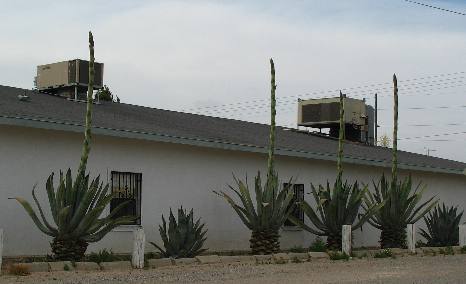
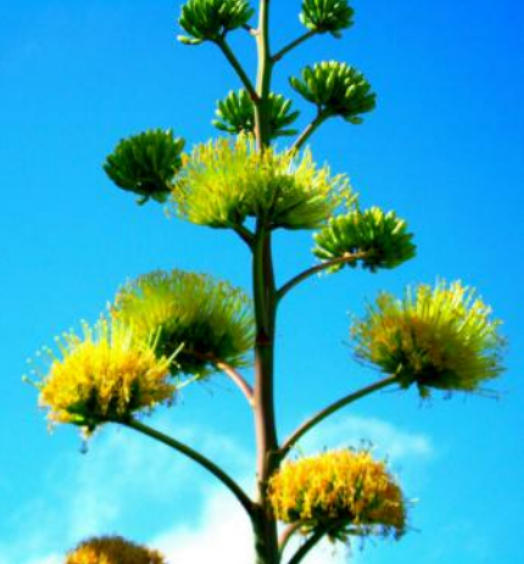
Century plants
Century plants sending up their blooming stalk. The plants do this only once.
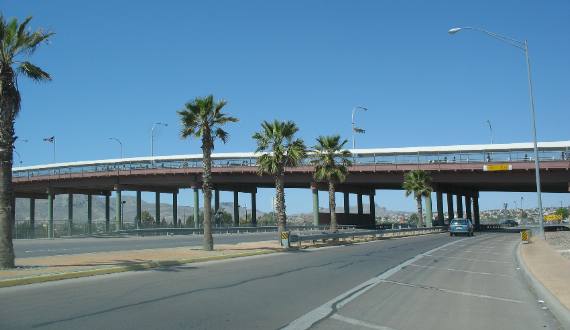
Overpass connecting Juarez, Mexico with El Paso, Texas
This was taken in the downtown area of El Paso very near the border with Juarez, Mexico. The overpass is one of the connecting links between El Paso and Juarez. Many people walk across the border on this bridge.
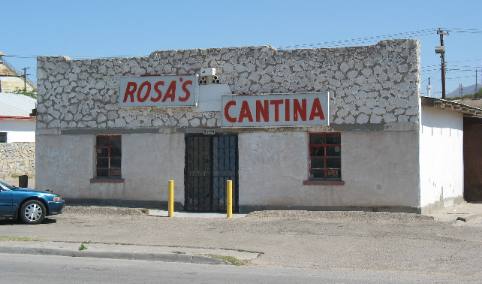
Rosa's Cantina made famous by Marty Robbins' song from the late 1950's
Everyone has heard the country ballad Rosa's Cantina. Well, this is the Rosa's Cantina made famous by that song. It is located in northwest El Paso a bit north of the abandoned copper smelting operations with those huge smoke stacks. This is the place that inspired Marty Robbins to write his tale of love, and the gun fight--- all for the sake of Felina, a charming senorita. Marty Robbins wrote and sang the song and took it to the top of Billboard Charts in the late 1950's. If you still can't place the song see if this will help: Out in the west Texas town of El Paso I fell in love with a Mexican girl Nighttime would find me in Rosa's Cantina Music would play and Felina would whirl Blacker than night were the eyes of Felina Wicked and evil while casting a spell My love was deep for this Mexican maiden I was in love, but in vain I could tell One night a wild young cowboy came in Wild as the West Texas wind Dashing and daring, a drink he was sharing With wicked Felina, the girl that I loved So in anger I challenged his right for the love of this maiden Down went his hand for the gun that he wore My challenge was answered in less than a heartbeat The handsome young stranger lay dead on the floor Just for a moment I stood there in silence Shocked by the foul evil deed I had done Many thoughts raced through my mind as I stood there I had but one chance and that was to run Out through the back door of Rosa's I ran Out where the horses were tied I caught a good one, it looked like it could run Up on its back and away I did ride Just as fast as I could from the West Texas town of El Paso Out to the badlands of New Mexico. ---------------- There is more, much more but you should get it by now. VBG
Rio Grande River near El Paso
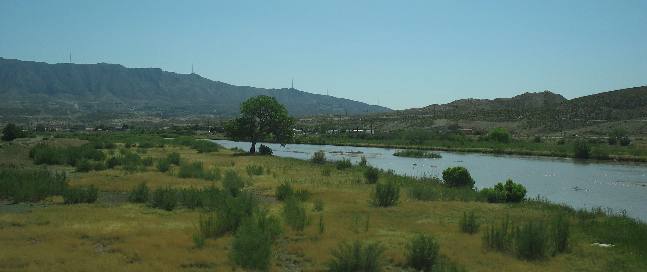
This is the Rio Grande River a few miles north of down town El Paso looking south toward El Paso. New Mexico is on the other side of the Rio Grande.
View of Rio Grande Valley from Franklin Mountains
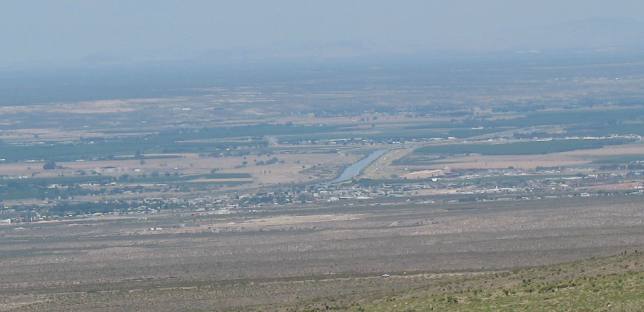
This picture taken from the west side of the Franklin Mountains looking west into New Mexico. The Texas-New Mexico border is the Rio Grande River seen in the center of this picture. (Texas is nearest us while New Mexico is on the other side of the river. I-10 is the straight line you see running from the left to right about 1/3 of the way up the picture. Along this stretch I-10 is running north and south (from El Paso to Las Cruces. The dark green patches you see are pecan orchards.
Tilted Fault Blocking evident in this Franklin Mountains roadcut
This piece of geology was in a road cut on SR-375/Woodrow Bean Transmountain Drive somewhere near the summit of the Franklin Mountains a few miles north of El Paso.
Tilted Fault Blocking evident in this Franklin Mountains roadcut
This is another picture of that same roadcut near the summit of the Franklin Mountains.
El Paso landscaping
We like the way El Paso landscapes with flowering desert plants.
I-10 in El Paso, Texas
El Paso gets its name because it is the pass that gets travelers by the Franklin Mountains the southern tip of which you see here. I-10 literally curves around the mountains and abruptly heads north along the western edge of those mountains. The large smokestack you see is a familiar landmark in western El Paso. It once was a copper smelting facility that closed when copper prices fell. There is some talk about reopening the plant now that copper is fetching a good price.
I-10 in El Paso, Texas
I-10 squeezes through downtown El Paso and makes for an exciting drive in the motorhome. Thankfully, it is not rush hour.
Click here for more Texas Travel AdventuresUntil next time remember how good life is. Mike & Joyce Hendrix
|
|
||
|
|||
|
|||