Mike & Joyces Travel logs

Home ** 2007 Travel Logs**


Places Visited:

Oregon: John Day and a scenic drive from Baker City to John Day

June 19, 2007.

We are staying at Mountain View Travel Park in Baker City. $24.79 FHU, shade and a nice enough RV-Park. It must be a former KOA since they charge extra for everything, $2 extra for wifi, $2 extra for larger sites, you get the picture.


This was a slow day for us and we got a late start. At first we were undecided about what we wanted to do but finally settled on heading out to John Day since we had not been out that way. So John Day it was. By the way John Day is the name of a small east Oregon town.


We left Baker City on SR 7 which is the same road we took to Sumpter the other day. Near Sumpter at the east end of Phillips Reservoir we stopped to look for eagles. The eagles and Canada geese we had seen earlier in the week were no where to be seen. Such is life, nothing remains the same.

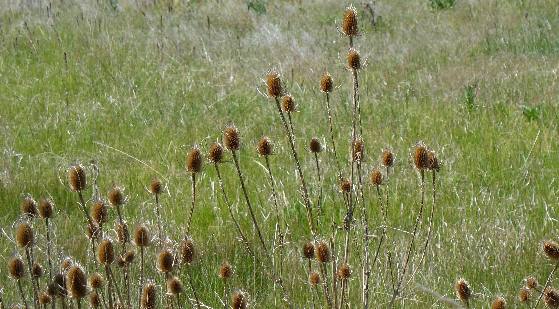
While there Joyce attempted to get some pictures of the brown flower heads we have been seeing in wet areas generally with cat tails.


I think she took a good picture of them in this shot. Does anyone recognize what this flower is? Reader, Gene Carpenter wrote to tell me these are common teasel a weed found in much of the southwest that some people dye and use in flower arrangements. Much thanks to Gene.


Between 5 to 10 miles past Sumpter on SR 7 we enter a beautiful valley with lush green grass and many old buildings like this barn.


Houses were in the valley also but this is another of the old barns lingering from a much more prosperous era.


We have stumbled upon a ghost town. The town was Whitney. It was a rail road town. When the railroad stopped running the town was abandoned.


After looking around I would say the town was "all but abandoned".


Someone was living in this old place. Note that there is no electricity running to the place. There is no sign that electricity has every been in the town. Each house has an outhouse so there probably isn't any running water either.


The Sumpter Valley Railway is the one that operates out of the State Park in Sumpter. Where on summer weekends tourist can ride on this narrow gauge train pulled by a steam engine.


This is another old house in the ghost town of Whitney that someone was actually living in. Note again there is no electricity and you can see the outhouse out back.


If you look closely you can see firewood neatly stacked on both sides of the door behind the wooden lattice.


This is a picture of those rock fence post that we are seeing all over this area of Oregon.


This is another old barn. This one might actually be being used.


Ah, look at this geology. It is a perfect anticline. The rocks here make a perfect arch like it had been drawn with a protractor. It takes awesome forces to bend rock like this.


SR 7 ends when in meets US 26 halfway between Sumpter and John Day. We continued toward John Day on US 26.


We crossed over a mountain pass (Dixie Pass) and down into another valley not far from Prairie City.


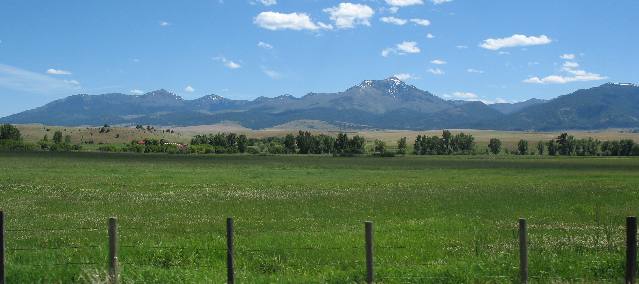
The mountain to the south is probably Strawberry Mountain.


Again, I am guessing that this is Strawberry Mountain south of Prairie City.


One of the things we thought we would visit in John Day was the Kam Wah Chung & Co. Museum.

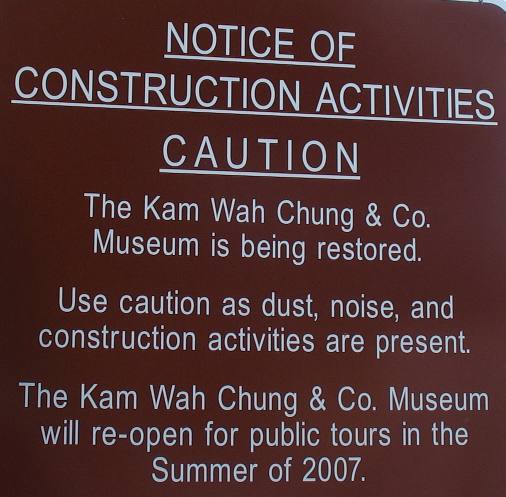
When we arrived this is the sign we found.
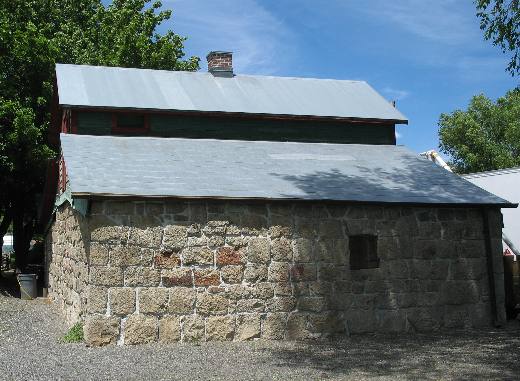


The Kam Wah Chung & Co. Museum (this building) was constructed as a trading post on The Dalles Military Road in 1866-67. It served as the center for the Chinese community in Eastern Oregon until the early 1940's.

This is the original building and it now contains thousands of artifacts and relics that illustrate the many former uses of the site. It was: a general store, run by Lung On; an office for the famous herbal doctor, Ing (Doc) Hay; a Chinese temple; a gathering (and gambling) place for Chinese people throughout the region; as well as home to the proprietors.

There were hundreds of thousands of Chinese people that came to this country seeking relief from famine, overpopulation, and the loss of industry due to cheap goods from the West. By the time of the 1879 census, there were 960 whites and 2468 Chinese inhabitants of the gold mining region of Northeastern Oregon.


This is Kam Wah Chung's home and store, as seen from the side.


In 1887, two young immigrants, Ing Hay and Lung, purchased this building. They lived there from 1948 and 1940 respectively. They were an important part of Eastern Oregon history. The development of the economy and culture in the region is still represented in the Kam Wah Chung & Co. Museum. Originally, the building was intended as a trading post on the main East-West highway of the period. Doc Hay and his partner Lung On sold large amounts of mining supplies and staple foodstuffs to the miners, both white and Chinese. As the community changed, the men sold canned goods, notions, tobacco, cigars, and cigarettes. Many of the goods were imported from China. There is evidence that Chinese money was exchanged between the immigrants and it was probably used to purchase goods from their former homeland. During the prohibition, Lung On sold "bootleg" whiskey. Examples of these types of goods are still in the Museum.


The building served as the office of Doc Hay. He was the most famous Herbalist between San Francisco and Seattle in his day. He was a master of pulse diagnosis. Doc Hay could tell his patients what was wrong with them just by feeling the pulse in their arm. Then he would prepare an herbal mixture from local plants and herbs from China. Doc Hay was blind. When he shut the building up in 1948 to go to the nursing home, Doc Hay left behind over 500 different herbs, many that have never been identified.


This is what the building looks like from the back side.


When we saw that sign saying the museum was closed we thought we had missed everything but on our way out of the parking lot we spotted a state park building on the other side of the street that was housing most of the information ----that saved the day for us since we have driven 90-miles.

In the State Park building we were able to read and see many displays that helped us understand about the Chinese population in the northwest in the 1800 and into the 1900s. Chinese of this era did all manner of work even owning stores. In 1904, Jim Low opened a general merchandise store in McDermitt, Nevada. While Jim traveled the High Desert country selling supplies to isolated ranches, his wife Chew Fong ran the store. Customers ranged from buckaroos and miners to Paiute Indians. The Paiutes called Chew Fong, "Bee Duh," meaning "auntie," as a token of their regard.

The migration of Chinese to the American West was driven by the lure of opportunity. Initially, it was hoped-for quick riches of the gold rush, later the opportunity for steady wages working on the region's railroads, and in the agricultural, manufacturing and fishing industries. However, after arrival and initial employment in these low paying jobs, many enterprising individuals began to go into business for themselves, providing goods and services within Chinatown, as well as to the community at large.

Typically, the businesses operated by Chinese entrepreneurs included stores selling Chinese goods and supplies, restaurants, laundries, small farms, and woodcutting enterprises. "China bosses," individuals who spoke English and had a sharp business sense, often accumulated considerable wealth contracting with western industries to provide Chinese labor. Chinese medical practitioners, such as Ing Hay of John Day, Wing Luke of Seattle, and ah Fong of Boise, often made the transition from treating only Chinese laborers to being successful and respected within the entire community.

Some Chinese became fishermen. By 1857, Humboldt Bay, California had a Chinese fishing village. In the 1880s, Chinese shrimpers exported more than a million pounds of shrimp meat and shells to China and Japan, making California the most productive of America's shrimp-producing states.

Because of immigration laws, there were very few Chinese women allowed into America. Many Chinese males lived and died as bachelors. Any Chinese marriage was a major cause for celebration.

I wonder what kind of laws we had that only allowed men into the country? Do these laws still exist? It would seem that thousands of men with no women would be a problem that could be seen by those making the laws. What am I missing? Was this no women law applied to all nationalities applying to enter America? Questions, Questions, so many questions. There are so many things you do not learn in history classes formulated to teach "jaded" history.

The values that the Chinese immigrants brought with them to the new world facilitated the passage of their descendants into mainstream America. Although small numbers of tenacious, elderly Chinese men continued to reach their goal of returning to China after years of labor in the West, younger generations began to look upon the region as their home. Children of first generation immigrants were American educated, upwardly mobile, and assimilated rapidly into western communities.

Initially, Chinese who died were buried for a brief period, then their bones were shipped to ancestral burial grounds in China. However, as more Chinese chose to remain in the West, their permanent resting place was often the corner of a community cemetery equipped with a brick altar for burning funeral offerings.

The Pacific Coast was the entry point for most of the Chinese immigrating to the American West. The first Chinese to labor on the Pacific Coast arrived in 1788. By the mid-1800s, significant numbers of Chinese had entered ports in California, Oregon, Washington, and British Columbia. Many Chinese immediately followed the rivers inland to the mining regions. Other Chinese stayed on the coast and plied familiar maritime trades. Chinese-style "junks" fished off California shores for abalone in the 1850s. By 1870, there were Chinese fishing villages scattered along the entire length of the the Pacific Coast from British Columbia to Baja, California.

Chinese laborers were in high demand in the coastal industries. They were prevalent in canneries in British Columbia. Oregon and Washington, shingle mills and coal mines in British Columbia, and cigar factories in San Francisco. Until anti-Chinese labor unrest forced time from their jobs in the 1800s, they labored in the logging camps and lumber mills throughout the Puget Sound region. Almost no industry and no part of the economy on the Pacific Coast was left untouched by the resourceful Chinese laborers.

As the inland valleys of the West developed, Chinese labor became critical. Chinese laborers were recruited and managed through a "China boss," who had to speak passable English, in addition to several Chinese dialects, and above all, be a shrewd businessman. It was his job to provide Chinese labor crews to employers.

By the 1800s, 75% of the seasonal labor in California agriculture was Chinese. In the Sacramento Valley, Chinese laborers built levees and cleared the tule swamps to create one of the West's richest agricultural regions. They cleared land and planted the vineyards and orchards that established the California wine and fruit industries. Both the Oregon and Washington hop fields depended on Chinese labor.

Inland cities and towns relied upon enterprising Chinese farmers who marketed vegetables to local households, restaurants and groceries. In the Willamette and Rogue River valleys of Oregon, Chinese laborers cut dense brush and hauled stone from the fields to create productive farmland. The many existing, neatly stacked stone walls in these regions are ever-present reminders of their work.

One temporary Chinese community complete with tents and outdoor kitchen equipment followed the construction of the Central Pacific Railroad as it progressed through California's Sierra Nevada Mountains and eastward across the deserts of Nevada and Utah.

While the Chinese labored in America, cut off from the comfort of marriage and family by immigrations laws, most Chinese lived in anticipation of their eventual return home. During their sojourn, they did their best to reconstruct the familiar elements of their traditional society in this new land.

Their exclusion from western communities fostered the development of both urban and rural Chinatowns. Within these "Chinatowns," there developed a communal spirit that assisted them in maintaining their cultural identity.

A critical element of any culture, and particularly of Chinese society, is its foods. Therefore, it was natural for the Chinese to raise or import traditional vegetables, fruits, fish, and poultry. Wherever they went, the Chinese took with them their stir-fry utensils, woks, and ceramic jars of sauces and spices.

The Chinese adapted their lifestyles to the varied climates and terrain of America. In the gold fields, they often lived communally in dugouts or tents. In the Snake River Canyon of Idaho, they lived in crude stonewalled huts dug into the ground along the river banks and roofed with canvas. However, they continued to favor traditional clothing and personal items of daily life, holding fast to these remnants of their distant homeland while working in the most remote corners of the American West.

In many western communities the Chinese laundry was a familiar and, no doubt, welcomed sight in the West.

A few Chinese families existed. Those were the extremely fortunate ones. Many sizable Chinatowns grew and died without ever having a Chinese child born in them. I still wonder about the emigration laws that created this situation. I hope someone can explain this to me.

Some Chinese became cooks. At the turn of the century, the ZX was one of eastern Oregon's largest ranches. Throughout the era, a number of Chinese cooks presided over this cookhouse and the outfit's chuck wagon on roundups and trail drives.

The Chinese and Indians had disagreements just as did the Americans and Indians. In 1864, over fifty were massacred by Paiutes while on their way to the Owyhee mines on Jordan Creek, near Jordan Valley, Oregon. The place is known as the Chinese massacre site.

While some Chinese worked as Chuck wagon cooks occasionally, they also worked as cowboys on ranches, such as "Buckaroo Sam" who worked on the Sproul Ranch in eastern Oregon.

Chinese laborers operated "hydraulic giants," high pressure water hoses for washing away earth to expose gold-bearing rock. The devices were cheap to operate and moved a great deal of soil, but were inefficient. Other Chinese often picked over the "leavings" and recovered much more gold than was recovered in the initial process.

We all know about the Chinese laborers contribution to constructing the transcontinental railroad. After more than two years of labor the Central Pacific Rail Road reached the community of Winnemucca, Nevada. Then, on April 28, 1869, a Chinese track crew with the Central Pacific laid ten miles of track in twelve hours, beating the old Union Pacific record by two miles.

In Astoria Chinese worked in a Salmon cannery. Chinese were introduced to the Oregon salmon canning industry in 1871, and turned it into a major industry. Salmon canning in Washington state was second only to wheat as a moneymaking industry.

As we might expect some Chinese worked as household servants. A Chinese servant, especially a cook, was a valued and prestigious part of many upper-class urban American households.

From the earliest days of western exploration and settlement, the Chinese labored with skill and energy in a wide variety of occupations. In 1788, sea trader John Mears brought 30 Chinese to Nookia Sound, in British Columbia, to construct the sloop (Northwest America,) the first sizable ship built on the Pacific Coast. Individual Chinese were present in Spanish California in the early 1800s. However, it was the discovery of gold in 1848 that attracted the first large migration of Chinese to America.

In the early days of the gold rush, Chinese miners worked the streams alongside forty-niners from throughout the world, but hostile discrimination soon forced them from their claims. Soon large gangs of Chinese were working as contract labor construction untold miles of ditches to bring water to dry diggings and working hydraulic mining operations.

Outside the mining regions, they built levees, drained swamps and cleaned fields to create the region's prosperous agricultural industry. They labored in shoe factories, iron foundries, lumber mills and the garment industry.

For over half a century, they worked in fish canneries of California to Alaska. They constructed the western half of the first transcontinental railroad through the Sierra Nevada Mountains and the deserts of Nevada as well as the subsequent rail routes and roads that created the region's transportation network.

Other Chinese worked as garment workers. The first Chinese garment worker was hired in San Francisco in 1859. by the 1870s, 70% to 80% of the garment workers were Chinese. In 1876, there were two thousand Chinese in the "sewing trades" in San Francisco.

Until Chinese labor diked the river and drained the tule swamps beginning in 1850, the Sacramento Delta, now one of the world's richest agricultural areas, was an uninhabitable marsh. By the late 1860s, thousands of Chinese agricultural workers labored in the area.

Gold had been discovered in California in 1848. By 1870, many of the miners in California and the majority of those in Oregon and Idaho were Chinese. As we all know the discovery of gold throughout the West spurred economic development. Chinese labor was in demand in the growing, lumber, fishing and construction industries. Soon Chinese labor was building the great transcontinental railroad which tied together the North American West. As this project ended, Chinese railroad workers migrated deeper into America, building smaller rail lines throughout the region. They went into other industries, ranging from garment making, cigar manufacturing, lumber milling, borax and quicksilver mining to salmon canning and glass blowing, as well as into agriculture on farms and ranches throughout the West.

Between 1876 and 1890, steamships brought an estimated 200,00 Chinese to American west coast ports. Most immigrants were poor and had to borrow the money for their voyage through the "Credit Ticket System."

Passage one-way to America was around $50, but with the high rate of interest, it cost the immigrant about $120. One estimate suggests that American and British steamship companies made $11 million in steerage fees paid by Chinese laborers. The immigrants, like many newcomers, were often swindled. The money they had borrowed for their journey created a form of virtual slavery to the firms which advanced their passages. In 1852, Chinese aboard the ship Robert Brown bound from Amoy discovered that they had been brought aboard under false pretenses, killed the ship's officers and returned to China. By 1862, American law forbade American ships from engaging in the infamous coolie trade because of the many abuses.

Upon their arrival at Pacific Coast ports, the Chinese found local employment, or began a second journey to the railroad camps, mining regions and industries in the inland valleys, mountains and deserts of the West.

Initially welcomed for their labor, the Chinese soon began to meet prejudice and discrimination. Between 1852 and 1880, an increasing number of laws and local restrictions had limited the civil rights and job opportunities for Chinese in the West. Between 1885 and 1965, a series of laws restricted Chinese immigration. During this period the journey to America was limited to a privileged few. However, in recent years, more equitable treatment during immigration has tempered the experience of Chinese newcomers, who have come to America in search of opportunities in the West.

Chinatowns were established in San Francisco by 1850, Portland by 1851, Seattle by 1860, and Vancouver by 1870. Soon Chinatowns could be found throughout the West.

By 1880, as the Western development era slowed, the demand for Chinese laborers waned. The smaller remote Chinatowns slowly died out as many Chinese withdrew to the urban Chinatowns in fear of anti-Chinese violence. In addition to greater security, the Chinatowns offered many obvious advantages to the Chinese: familiar supporting institutions, a hope of marriage and family life, and opportunities to pursue familiar pastimes. These communities were generally dominated by successful China bosses and merchant families.

Chinatowns often provided services for the surrounding communities. Chinese gardens produced fine vegetables for local housewives. Gambling halls contributed such familiar American pastimes as keno, which began as the Chinese game, "white pigeon ticket." Restaurants were popular destinations for visitors. Chinatowns, because of their exotic nature, held a special allure for outsiders.

In the Western deserts Chinese worked at many occupations from mining to building railroads to farming. Signs of their presence remain throughout the West in numerous place names like the ubiquitous China Creek found in most states of the region.

Traditional Chinese agricultural techniques proved useful in this hostile and intractable environment. In the desert outside Winnemucca, Nevada, is a fold in the low hills called "China Gardens" where Chinese took advantage of run-off waters to grow vegetables to sell in the local settlements.

The desert also had unique industries related to surface mining which came to depend on the familiar Chinese labor gangs. They were also employed by many of the ranches in the High Desert, cooking for the buckaroos both at the ranch and from the back of a chuck wagon.

By the closing years of the 19th century, the Chinese population centers in the desert began migrating to the large urban Chinatowns, changing the rural communities significantly. What had been lively centers of Chinese miners, railway workers, and laborers became isolated pockets of aging bachelors.


Ok, enough of the Chinese influence on western history. It was time to leave John Day and head back to Baker City. The route takes us through beautiful valleys such as this one between John Day and Prairie City.


Irrigation makes these valleys so lush and beautiful.


Prairie City has a large lumbermill.


We stopped so I could watch operations but virtually nothing was happening.


The mill is obviously an operating mill but no machinery is operating and no employees can be seen.


Lumber mills create huge piles of scrap bark and sawdust.


We have seen large 18-wheel trucks hauling finished lumber from this mill on the way over here today. We have also seen logging trucks delivering huge ponderosa pine logs to this mill. We just don't see any at the moment.


For those interested Prairie City had a small museum and a connecting RV-Park.


After leaving Prairie City US 26 heads up and over Dixie Pass. Whatever you do in this area is going to involve climbing a pass ever 15 to 20 miles.


This basalt outcropping is in the process of creating a line of hoodoos.


In this area basalt outcrops have already created a field of hoodoos.


No sooner than we pass one of those desolate hoodoo fields than we round the corner and a beautiful valley unfolds before us.


Until next time remember how good life is.

Mike & Joyce Hendrix


   Passport America, Save 50% on Campsites


Home ** 2007 Travel Logs