Beaver Slide hay stackers of Avon, MontanaJuly 28, 2007. We are staying in Lincoln Road RV-Park Helena, MT less than a mile west of I-15 at exit 200. Lincoln Road RV-Park is about 10-miles north of downtown Helena but in a very good position to access everything in the area. $25.04 with Good Sam discount plus-taxes for FHU in nice gravel pull thru sites with some shade. Free wifi was available but no cable TV.
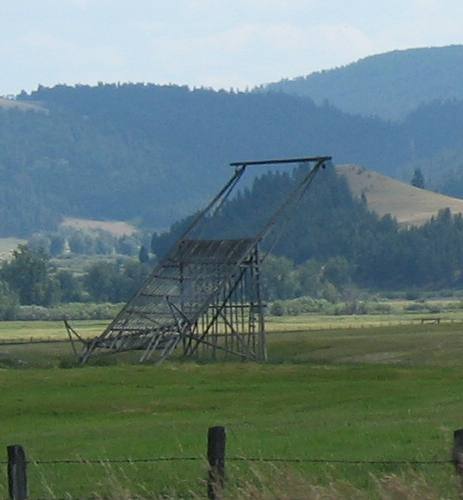
Beaver Slide hay stacker near Avon, Montana
Then as we near the intersection of US 12 we started seeing hay fields again. Except these fields were not bailing their hay in the normal method. Take a look at this contraption. It is a piece of equipment used to create monster piles of hay.
A virtual friend, "Mike" that lives in the area, wrote to give me some additional information on this thing. They are Beaver Slides and are driven by a tractor PTO - they used to be horse driven. ( My guess is that the farmer would use the PTO (Power Take Off) to winch the loaded hay to the top of the rig. The hay forms a crust that makes it pretty weather proof and I am told it will last for several years. Hay is stacked on a fork at the bottom, then the fork is raised to the top and lifted vertically so the hay slides off onto the stack.
I guess an advantage would be that you don't have to bale it and
have the associated costs of buying a baler (~$70k for some). You
also would not have to spend the time to rake it into rows to bale
so some labor/time savings there. I would think a big disadvange
would be when you go to feed in the winter. The ranchers all have
an attachment on their tractor that spears those big round bales
and unwinds them - I would think it would be a lot more labor intensive
to have to go to the big stacks and grab a bunch and travel to wherever
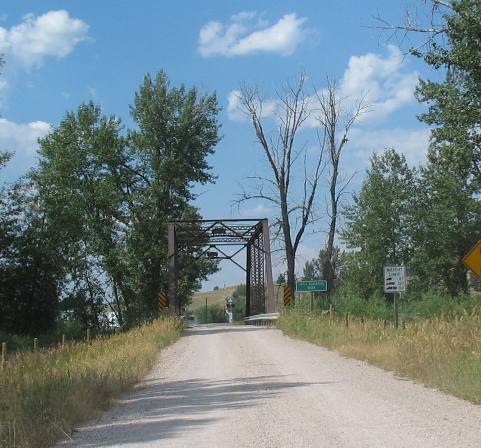
you wanted to put it. But what do I know? Many thanks to "Mike" for providing this information. Anyone that can add to this information is certainly requested to provide it. I will update this travelogue with that additional information. Keep in mind that we are driving south on SR 141 approaching Avon. Old Bridge near Avon, Montana
At the intersection of SR 141 and US 12 we spotted this gravel road leading off SR-12 across a creek on that one land bridge that must have been constructed when Moses was a baby.
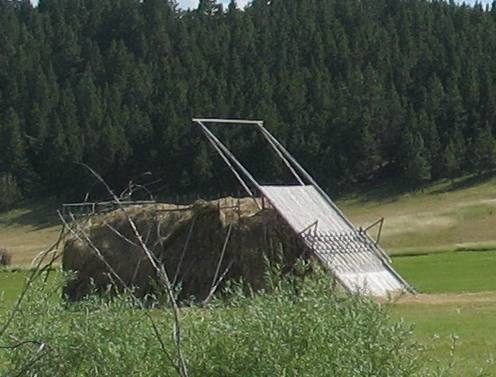
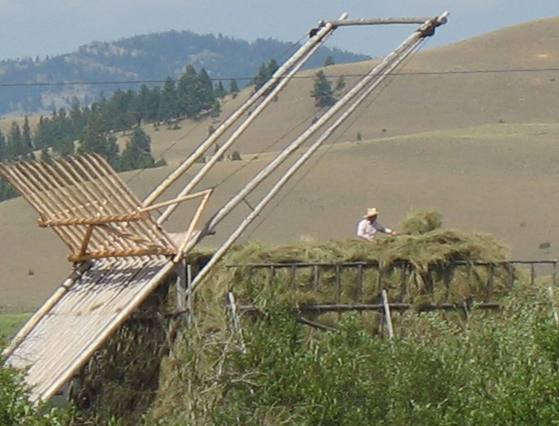
Beaver Slide hay stacker near Avon, Montana
This is another look at that "beaver slide contraption" farmers are using to stack hay in large piles. In this picture you can see a hay pile in progress. Hay is stacked on that fork contraption you can see near the bottom of the ramp. Then the fork is raised to the top and lifted vertically so the hay slides off onto the stack. I would really like to see this devcice in operation. From what I understand there is a temporary makeshift fence surrounding the hay stack now so that wind does not scatter the loose hay. Supposedly after the stack is complete the siding is no longer needed.
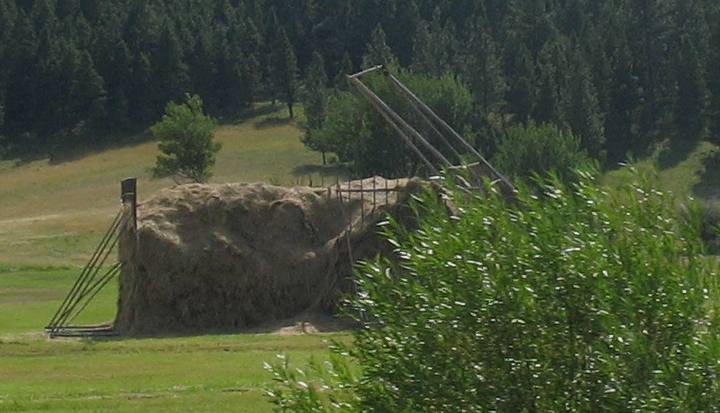
Beaver Slide hay stacker
This is another look at one of those beaver slide devices. This time more infrastructure is evident. Some of this infrastructure is moved from hay pile to hay pile.
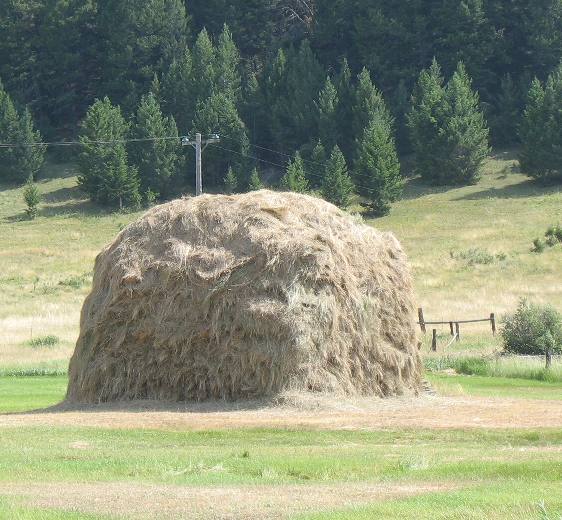
Hay stack made by a Beaver Slide Hay Stacker
This is a pile of hay that was "constructed" with that "beaver slide contraption". For this pile the "beaver slide apparatus" used to construct this "smaller" mound has been moved. I say "smaller" because most of the mounds are at least twice this size.
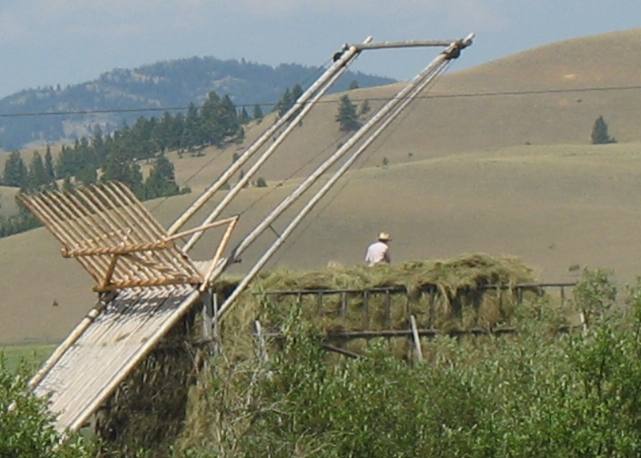
Beaver Slide hay stacker near Avon, Montana
In this picture a farmer is on top of the hay with a pitch fork. Hay is placed on that wooden slide then pulled up the ramp. If you look closely you can see rope leading from that wooden thingee to pulleys located on the ends of the long poles. When I see the "forks" on this slide I can better understand how these beaver slides work. It even looks like this rancher/farmer is utilizing a wooden ladder for that "termporary" siding used when stacking the hay.
Beaver Slide hay stacker near Avon, Montana
We have never seen hay being stored in this manner. This method of storing hay was being used on 8 to 10 farms/ranches all located near the intersection of SR 141 and US 12. I can see rope and pullies attached to the fork on that slide.
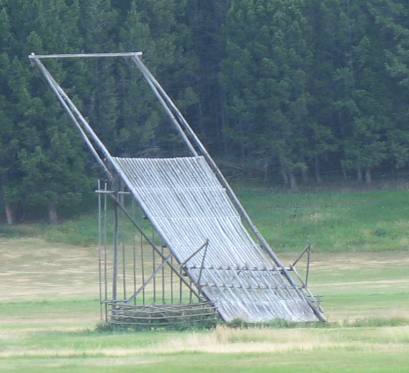
Beaver Slide hay stacker near Avon, Montana
This is another picture of one of those "beaver slide contraptions" that is not in use. Beaver slides seem to vary in size. This is a smaller one.
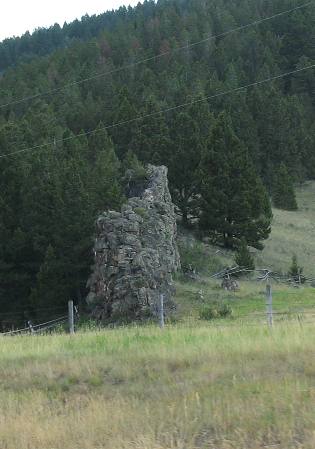
Dike of igneous rock exposed by erosion
Not long after turning east on US 12 we passed this strange rock "fin". This rock is obviously harder than the surrounding rock as it has not eroded away like the softer rock has. This is a dike that was created by an intrusion into the limestone by molten rock from deep in the earth.
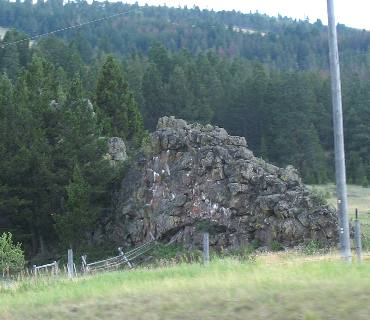
Intrusion of ingneous rock or dike
This is another picture of that dike or strange formation. It is obviously an intrusion of igneous rock into a crack in the overlying sedimentary layers or what geologists call a dike.
More Montana AdventuresSome Exciting Drives** More 2007 Travel Adventures
Mike & Joyce Hendrix
Mike & Joyce Hendrix who we are We hope you liked this page. If you do you might be interested in some of our other Travel Adventures: Mike & Joyce Hendrix's home page Travel Adventures by Year ** Travel Adventures by State ** Plants ** Marine-Boats ** Geology ** Exciting Drives ** Cute Signs ** RV Subjects ** Miscellaneous Subjects
We would love to hear from you......just put "info" in the place of "FAKE" in this address: FAKE@travellogs.us Until next time remember how good life is.
|
| ||

| |||
|
|
|||
|
| |||
|
|