Wildlife Canyon Scenic BywayWildlife Canyon Scenic BywayToday we were enjoying the Wildlife Canyon Scenic Byway then stopped at the Plaza Fruit Ranch in Emmett for fresh cherries. While our motorhome is back in Nampa we spent last night in a motel in Stanley, Idaho so that we could enjoy several scenic drives that otherwise would have been impossible. In this travellog we are returning to Boise from Stanley via the Wildlife Canyon Scenic Byway. June 15, 2007. Our motorhome is in Garrity RV-Park in Nampa 10-miles west of Boise. It was $21 per-night for FHU & Cable while every place else in the area seemed to start at $26 and rapidly go up. Garrity was just fine. It was clean, well managed, the sites were close but we were not there and didn't go outside except when heading to and from the automobile. There was a good number of permanent or long term in the campground but they were being managed properly thus were no problem. We would stay at Garrity again but those that like to spend the day and evening under the awning sipping cool ones might rather be in one of the other area parks. N43° 35.245' W116° 31.592'
On the way down from Galena Summit Sawtooth Mountains of Idaho
Earlier today we drove south on SR 75 checking out that portion of the Sawtooth Valley. We drove to the top of Galena Pass before turning around and returning to Stanley through the Sawtooth Valley.
Back in Stanley we stopped for breakfast before heading back to Nampa.
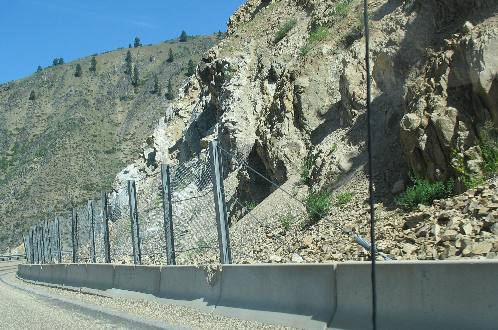
While falling off Galena Summit we navigated through a mile or more of steep roadcuts where the road was protected from falling rocks. These huge fences were actually doing their jobs because we could see evidence where they had captured falling rocks. The concrete barriers were also dinged up by falling rocks.
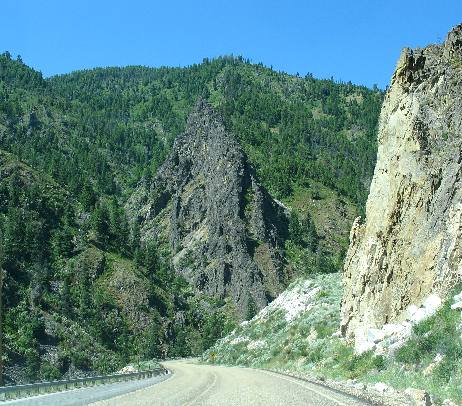
Spectacular igneous intrusion
While falling off Galena Pass we saw this fascinating igneous intrusion. I was fascinated with that igneous intrusion in the center of this picture. The grade was awesome, the roadcut was stunning but what is the story on this extremely hard intrusion. One day, 100,000 years from now it will be on the peak of a new "Sawtooth Range". My guess is that this intrusion is part of the igneous bubble that thrust up this entire area and created the Sawtooth Mountains.
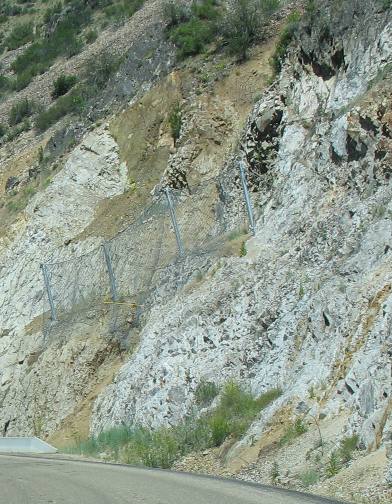
I suspect this some of the Galena rock that Galena Pass was named for
Here is more of that steel netting designed to stop falling rocks from rolling onto the highway. It appears to be holding back some of that Galena rock. In case you are interested galena is the natural mineral form of lead (II) sulfide. Think of it as the most important lead ore mineral. And in case you are wondering we are dropping off Galena Pass between Sun Valley and Stanley, Idaho.
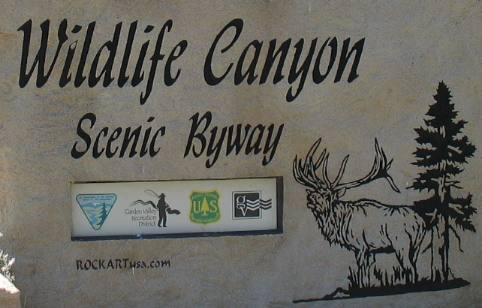
Wildlife Canyon Scenic Byway, Idaho
We are following the Payette River. The Payette River and its tributaries play a critical role in the local and regional economies. Black Canyon (located west of Horseshoe Bend), Deadwood and Cascade Reservoirs, and several smaller impoundments work in concert to store water, regulate flows, and generate electricity for the Pacific Northwest. Increasing demands for all uses of water create difficult choices. Today, many water use decisions are being made through the legal system. Managing the Payette River system will continue to be a "balancing act," providing for ecosystem health as well as the desires of local, regional and national users. Water stored in the Payette's reservoirs irrigate over 155,000 acres of grains, vegetables and fruits in southwestern Idaho and eastern Oregon each year. Worth nearly 100 million dollars annually, these crops represent almost one-fifth of Idaho's crop value. Apples grown with Payette River water are shipped to Mexico, Taiwan and even Saudi Arabia. Falling water at the Cascade and Black Canyon dams can generate over 20,000 kilowatts of electricity --- enough to light more than 30,000 homes each year in Idaho and other western states. A dam was constructed near Grimes Pass in 1904. A year later, the earthen dam washed away during high water. In 1907, dredge owner W. H. Estabrook rebuilt the Grimes Pass Dam and added a powerline to serve mines at Placerville, Centerville, Lightning, and Idaho City. Once again, the powerful Payette washed out the dam in 1943. Today, the South Fork Payette River flows free from its headwaters in the Sawtooth Mountains to its confluence with the North Fork near Banks. Boise Basin was the scene of one Idaho's largest gold rushes. The population of Idaho City exploded to nearly 6,300 in 1863 and by 1865 the boomtown surpassed Portland as the Pacific Northwest's largest city. By 1870, many miners had moved on to other fields in Idaho, Montana, and Nevada. Mining has dwindled from its heyday in the 1800's. Today, recreational miners continue to search for gold in Boise Basin and along the South Fork Payette River. Halfway between Lowman and Banks on the Wildlife Scenic Byway the road goes over Grimes Pass. In that area in 1862, George Grimes discovered gold. As miners exhausted the easy to reach placer gold they looked for other ways to extract the precious metal. Dredges enabled miners to reach placer gold deep in the streambed. The first dredges, in this area, started operation about 1898 and continued until the 1950's.
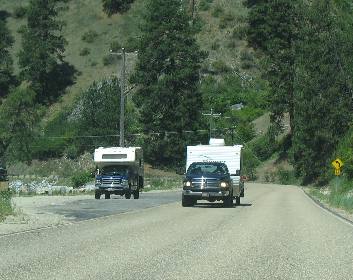
RV'ers headed to Forest Service Campgrounds along the Wildlife Canyon Scenic Byway
This is Friday and weekend RV'ers are heading along the Wildlife Canyon Scenic Byway into national forest campgrounds deep in Idaho's interior.
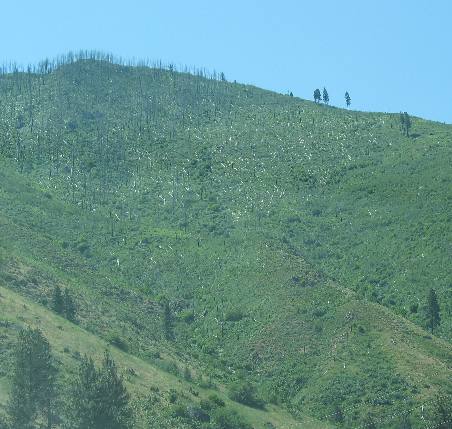
Lowman Fire as seen from Wildlife Canyon Scenic Byway
From time to time we pass by areas effected by the Lowman Fire. Trees are gone but the hillsides have been converted into grazing areas. As we traveled the Wildlife Canyon Scenic Byway the Lowman Fire scars were still visible.
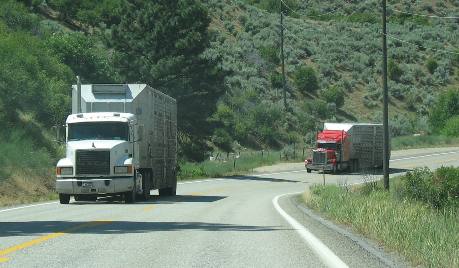
Hauling sheep to pasture in the National Forest over Wildlife Canyon Scenic Byway
Joyce and I have been commenting on how we have not seen any herds of sheep on the mountains in the national forests. After not seeing any sheep in all the time we have been deep in the Idaho mountains these two livestock trucks appear. These trucks have to be hauling sheep over Wildlife Canyon Scenic Byway to grazing land in the national forest.
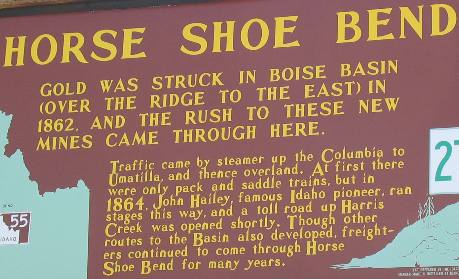
Horseshoe Bend on the Wildlife Canyon Scenic Byway in Idaho
Horseshoe Bend is a small town on SR-55 (Wildlife Canyon Scenic Byway) south of Banks and north of Eagle. Gold and lumber made this town.
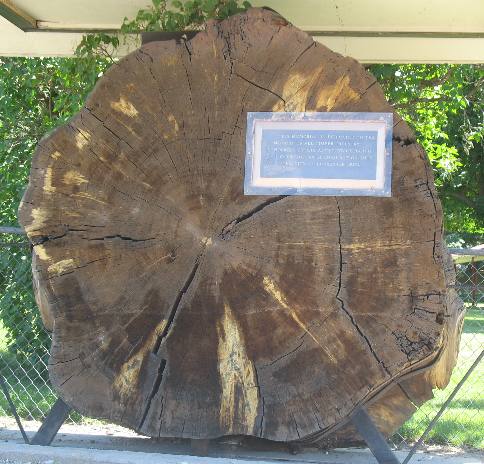
Memorial to timber industry workers in Horseshoe Bend, Idaho
This large piece of timber is on display in Horseshoe Bend as a memorial to all timber industry workers. Horseshoe Bend is one of the small towns along the Wildlife Canyon Scenic Byway.
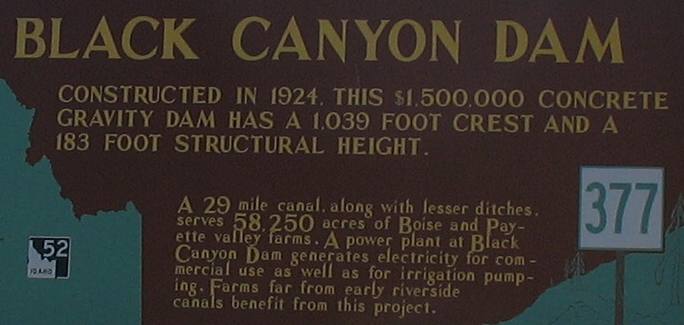
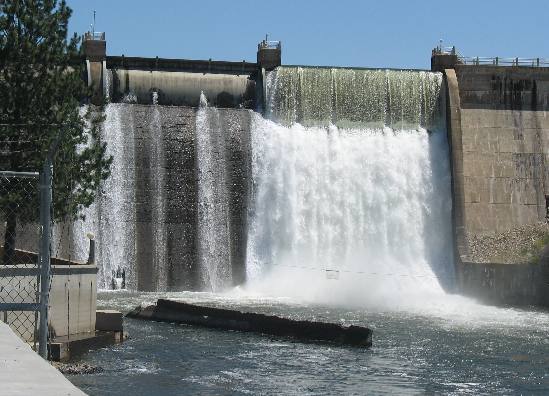
Black Canyon Dam on the Wildlife Canyon Scenic Byway
The Wildlife Canyon Scenic Byway takes you by Black Canyon Dam.
Black Canyon Dam on Wildlife Canyon Scenic Byway
Don't miss Black Canyon Dam when you are cruising on the Wildlife Canyon Scenic Byway.
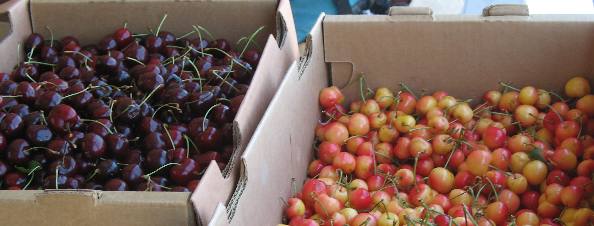
Fresh cherries at Plaza Fruit Ranch
At Plaza Fruit Ranch we could get our cherries out of one of these boxes for $1.75 per-pound or pick them for $1.25.
If you ever find yourself in the Boise/Stanley area make sure you take the time to enjoy the Wildlife Scenic Byway and make sure you stop by the Plaza Fruit Ranch in Emmitt for some fresh fruit.
Click here for more Idaho travellogsUntil next time remember how good life is.
More Idaho AdventuresSome of our Miscellaneous Subjects ** More 2007 Travel Adventures
Mike & Joyce Hendrix
Mike & Joyce Hendrix who we are We hope you liked this page. If you do you might be interested in some of our other Travel Adventures: Mike & Joyce Hendrix's home page Travel Adventures by Year ** Travel Adventures by State ** Plants ** Marine-Boats ** Geology ** Exciting Drives ** Cute Signs ** RV Subjects ** Miscellaneous Subjects
We would love to hear from you......just put "info" in the place of "FAKE" in this address: FAKE@travellogs.us Until next time remember how good life is.
|
|
||

|
|||
|
|
|||
|
|
|||
|
|