Bow Valley Parkway, Castle Mountain & Bow
River
July 8, 2007.
We are staying in the Tunnel
Mountain National Park Campground in Banff, Alberta. Tunnel Mountain Campground
offers no hookups, electricity only and full hookups. We are in one of the $29.70
electricity only sites. I do not know what FHU or no hookups cost but they are
all in the same area. All sites are paved.
Mother
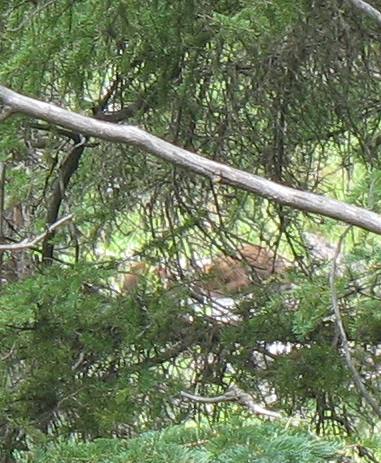
bear & cubs off Bow Valley Parkway
We
are driving from Banff to Lake Louise today on the Bow
Valley Parkway. The fast way to get to Lake Louise is PH 1 but we aren't
interested in speed, we are looking for scenery and wildlife.
On our first
stop on the parkway we stopped to watch a mother grizzly bear with two cubs. An
Oriental family was trying to get closer to the bears. I kept thinking about what
I was going to do if the mother bear charged this family. I could blow my horn
and possibly drive my car in the bears direction but this Oriental family was
walking into the woods to get a better look. There was no way I could drive my
car into the woods. They had two children walking with them. I have no idea what
they were thinking.
The bear did not charge but she certainly could have.
The sow bear is the brown spot in the center while one of the cubs is the
small brown spot to the left of mother.
Mother
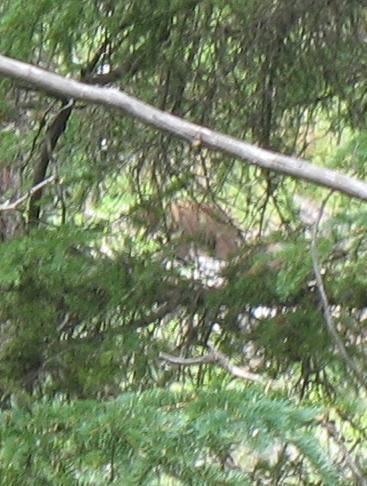
bear & cubs off Bow Valley Parkway
We
weren't real thrilled with this view but know better than to get close to a mother
bear with cubs. Joyce took these pictures from the safety of our Saturn.
Bow
River Valley north of Banff
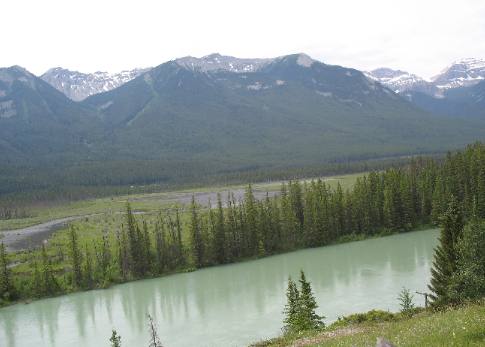
This is the Bow River Valley north of Banff.
Note the "glacial flour" that makes the water seem milky. The color
of the Bow River is caused by very tiny particles of rock, ground up by glaciers
(rock flour). The river transports different amounts of this "rock flour",
in different seasons thus the color is ever-changing.
East of Calgary,
the Bow River joins the Old Man River to form the South Saskatchewan River the
waters of which eventually end up in Hudson Bay.
Bow
River & Canadian Rockies
The
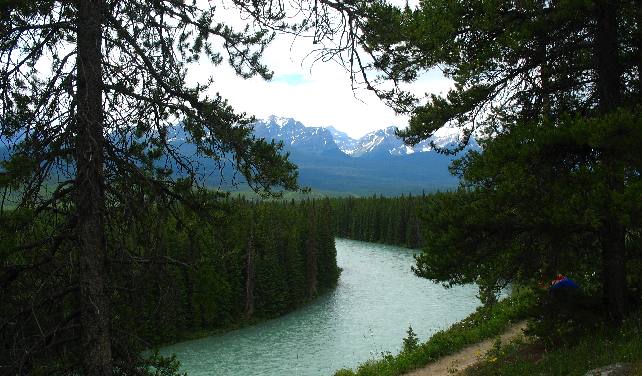
Bow River got its
name from the native people who found wood for their bows along the river's shores.
The
Bow River begins as meltwater from the Bow Glacier, on the Continental Divide.
You can see Bow Glacier above Bow Lake along the Icefields Parkway on the way
to Jasper National
Park.
Bow Valley from Bow Valley
Parkway Alberta, Canada
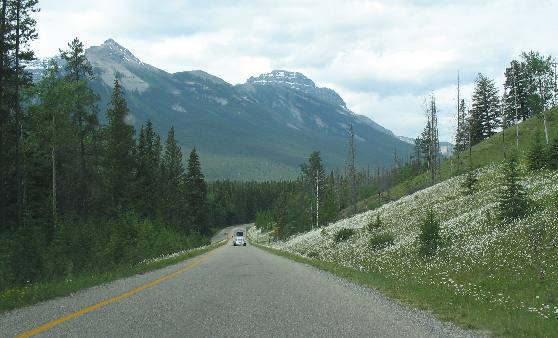
In
this area the Bow Valley separates the Front and Main Ranges of the Rocky Mountains.
The
Front Range mountains, like Castle Mountain are generally made up of softer rock
and are several million years younger than the Main Range mountains to the west.
Front
Ranges can be identified by:
Sloping rock layers, tilted table-top slopes
with jagged ridges, lower elevation peaks and mostly grey colors.
Main Ranges
can be identified by:
Horizontal rock layers, Blocky, castle-like shapes
with bands of cliffs, more browns and reddish colors, higher elevation peaks.
Glacier
Carved mountain
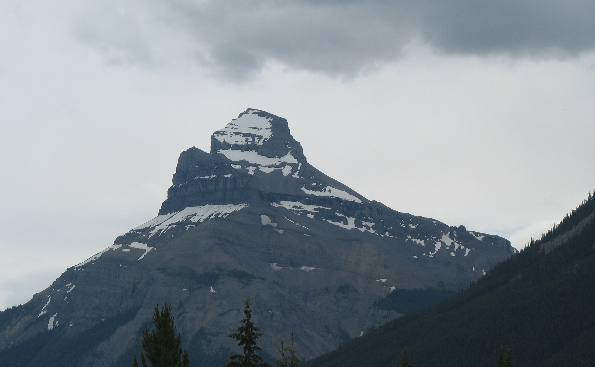
Castle
Mountain Main Range of Rocky Mountains
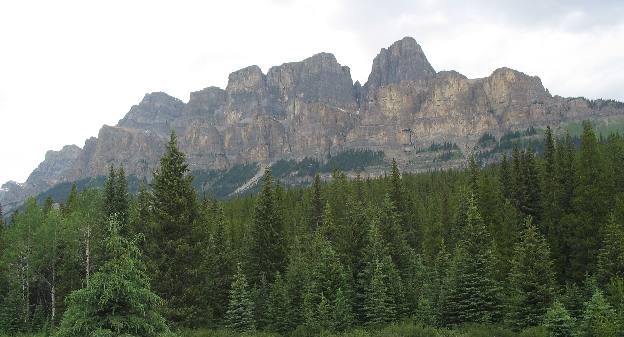
Main
Ranges were pushed eastward with rock layers remaining horizontal like Castle
Mountain.
Each rock layer in the dozens of strata on this mountain
(elev. 9,075') reveals a different chapter in the geological history of the Canadian
Rockies. A recurring cycle of alternating mud and limestone deposits is the geological
theme of Castle Mountain.
Remember that Main Ranges can be identified by:
Horizontal rock layers, Blocky, castle-like shapes with bands of cliffs,
more browns and reddish colors, higher elevation peaks.
Castle Mountain Canadian Rockies
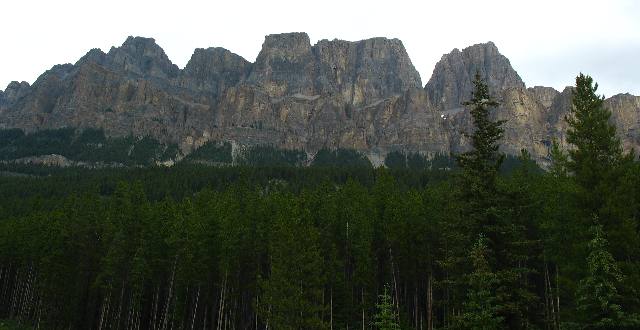
From that information it is easy to identify Castle Mountain as belonging to the
Main Range of the Rocky Mountains.
If that mountain
range could tell a story they tell of tropical currents and life on the bottom
of the sea. They would tell of millions upon millions of years of sediments settling
on the bottom. Some would describe their birth as sand or dirt grains washed into
the warm ancient sea that lay there while more and more grains washed on top of
them. They'd speak of sinking to the ocean floor and of being covered over by
more and more grains and by the crushed bodies and secretions of countless sea
animals.
They'd describe how the ever increasing weight pressed the sand
grains into sandstone, the mud into shale, and lime into limestone.
After
all this they would how they were raised high into the heavens to be reborn as
the Rocky Mountains.
Castle
Mountain Internment Camp

Castle
Mountain Internment Camp Monument
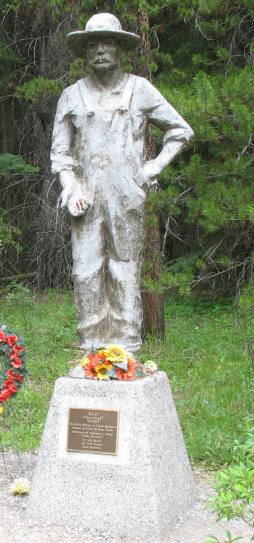
So
much history would be lost without roadside information kiosk and memorials. The
Castle Mountain Internment Camp is one of those moments in history that would
fade from memory without memorials such as this. It seems that Canada wrestled
with the internment camp issue just like the United States did.
This
memorial and the above kiosk mark the site of this internment camp.
Until next time remember how good
life is.
Mike
& Joyce Hendrix
Mike & Joyce Hendrix
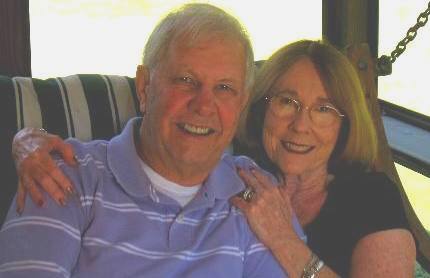
Mike
& Joyce Hendrix who we are
We
hope you liked this page. If you do you might be interested in some of our other
Travel Adventures:
Mike & Joyce Hendrix's
home page
Travel
Adventures by Year ** Travel
Adventures by State ** Plants **
Marine-Boats ** Geology
** Exciting Drives ** Cute
Signs ** RV
Subjects ** Miscellaneous
Subjects
We
would love to hear from you......just put "info" in the place of "FAKE"
in this address: FAKE@travellogs.us
Until next time remember how good life
is.