The Fairmont Banff Springs & Tunnel Mountain
Campground
July 7, 2007.
We are staying in the Tunnel
Mountain National Park Campground in Banff, Alberta. Tunnel Mountain Campground
offers no hookups, electricity only and full hookups. We are in one of the $29.70
electricity only sites. I do not know what FHU or no hookups cost but they are
all in the same area. All sites are paved.
The Fairmont
Banff Springs
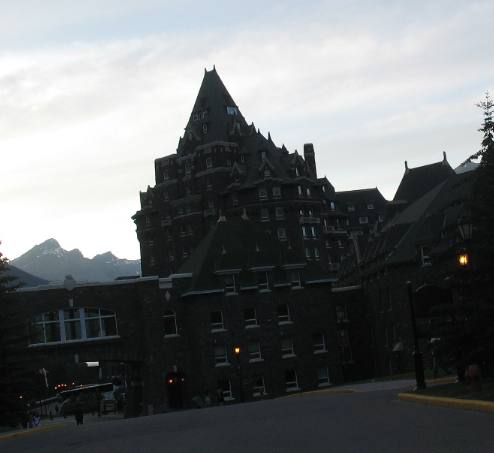
While
staying in Banff one simply must drive across the river and visit Fairmont
Banff Springs Hotel. We didn't stop and tour the inside this time. As
you can see it is getting dark by the time we dropped by. We do like to stop by
and have lunch however, when time permits.
This hotel was constructed
for the VIEW out the back windows.
Bow
River Falls at the Fairmont Banff Springs Hotel
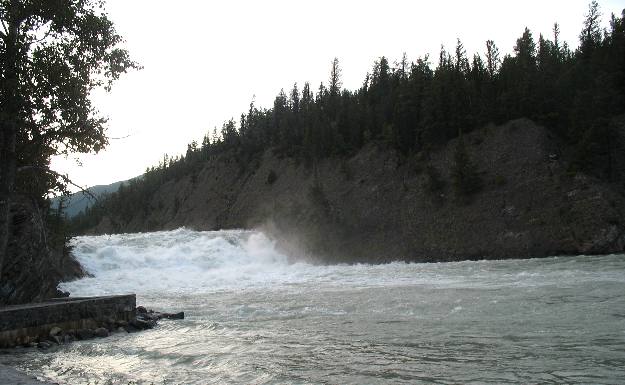
This
is the Bow River as
it flows past the back side of that Fairmont
Banff Springs Hotel.
There is a nice public walkway that follows
the river.
Thousands of people park in the public parking lot at the falls
and walk the river.
Bow
River downstream of the Fairmont Banff Springs Hotel
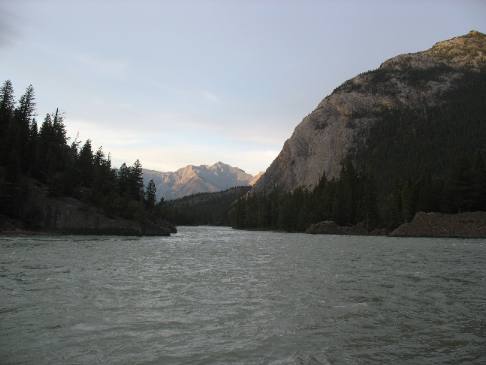
This
is looking down river from just below the falls
on the Bow River. This is the view that guest of the Fairmont Banff Springs
get only they are much higher up.
The
Fairmont Banff Springs Hotel
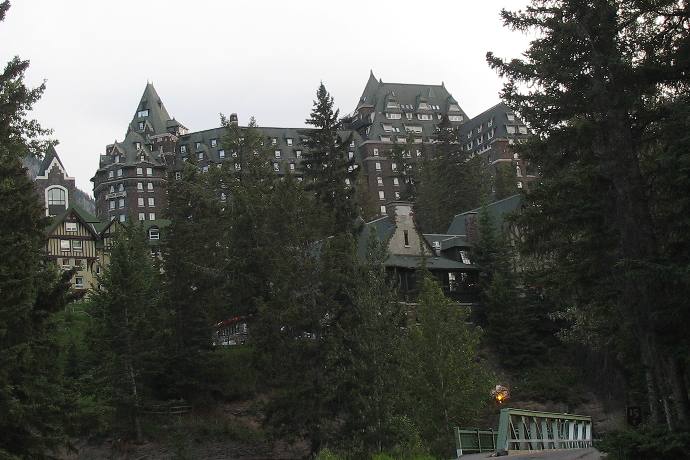
This
is a picture of the back side of the Fairmont
Banff Springs Hotel.
Fairmont Banff Springs Hotel
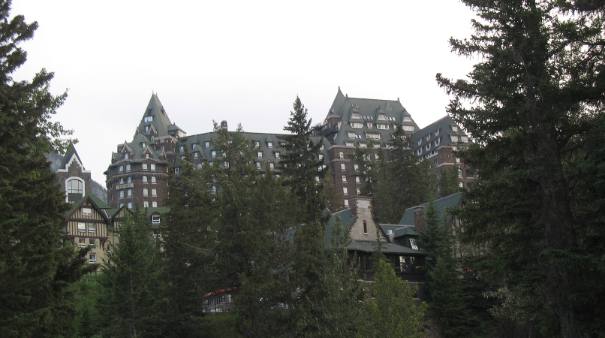
Another
picture of the back side of the Fairmont Banff Springs Hotel.
Large
buck strolling through Tunnel Mountain Campground
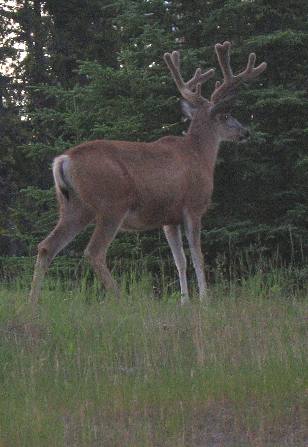
This buck leisurely wandered
through the Tunnel
Mountain Campground several times during our stay, much to the delight
of campground residents.
Tunnel
Mountain in Banff
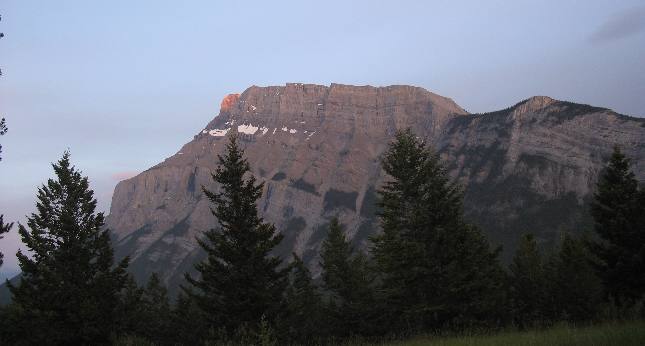
This
is Tunnel Mountain
that the campground, we are staying in, is named for. But there is no tunnel,
what gives? It seems that the original survey for the railroad provided for a
tunnel through this small mountain which appeared to obstruct the Bow Valley.
A subsequent survey rerouted the railway to the north, thus the need for the tunnel
was eliminated. Although the surveying was completed in 1882, the name "Tunnel
Mountain" remains to this day. The railroad played a large part in the history
of this area as the name of this mountain attests.
What did this
place look like 350 million years ago? One clue there were no mountains here.
A warm, shallow sea teeming with aquatic life covered this region. Tiny crystals
of lime produced by floating plankton, the remains of sea creatures, and sediments
eroding from the distant mainland accumulated on the seabed. Over millions of
years these layers grew to be thousands of feet thick. Pressure, heat, and chemical
reactions eventually hardened the layers into limestone and shale.
Between
175 million years ago and continuing for 130 million years, North America drifted
westward, colliding with chains of islands moving toward it from the Pacific.
The collision caused the horizontal laying rock layers created at the bottom of
that ancient sea to slowly crumple into huge accoridon-like folds, and fracture
into great slabs that stacked upward and eastward somewhat like shingles on a
roof. By the end of this process, some 60 million years ago, the seabed had been
thrust into high mountains. This explains why it is possible to find fossils of
ancient sea creatures on the slopes of these mountains.
When this was taking
place the Banff area lay near the western edge of the North American continental
plate. As we all know this area in now well inland.
Bow River
and Banff Springs Geology
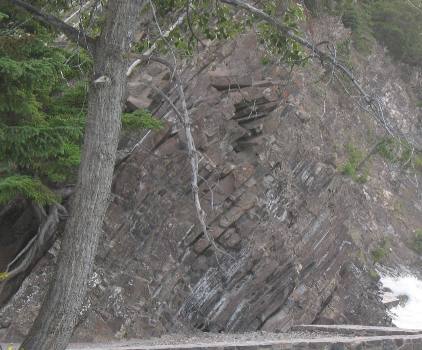
While
Tunnel Mountain is tilted it is not tilted at nearly the angle some of the mountains
are this picture of rocks near the Bow River Falls at Banff Springs Hotel shows
that some were thrust into 50-degree angles.
Mount
Rundle north of Banff, Alberta
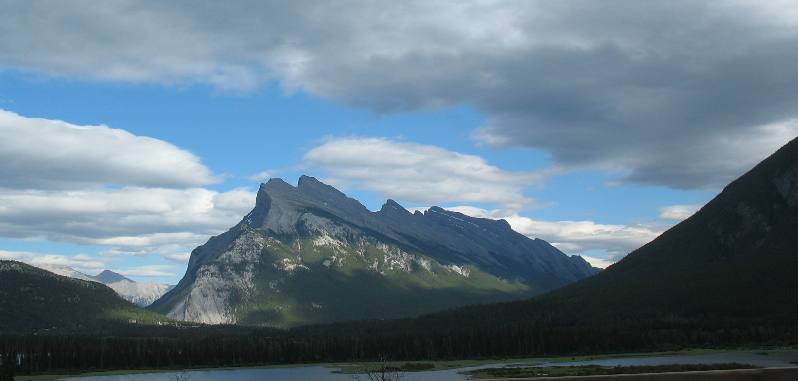
Mount
Rundle, a few miles north of Banff, is probably one of the most photographed
examples of how these sedimentary layers have been thrusted upward. This is part
of the "front range" of the Rocky Mountains.
View
leaving Banff
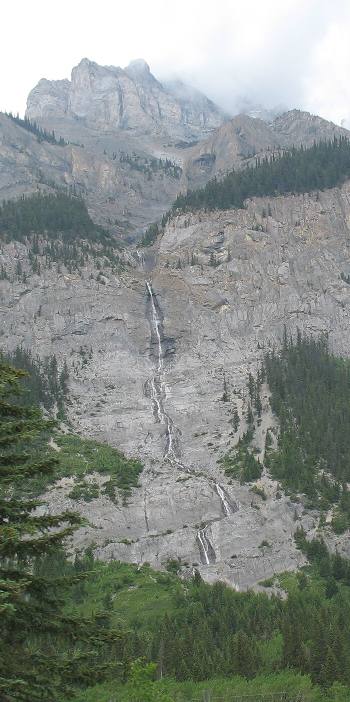
When
leaving Banff on Banff Avenue this is the scene as you approach the Trans Canada
Highway PH 1. That small waterfall is crashing down hundreds of feet from the
top of this imposing mountain.
View
on PH 1 north of Banff
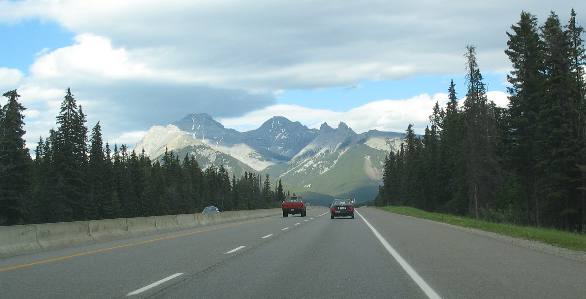
This
is the view heading north out of Banff on Trans Canada PH 1 on the way to Lake
Louise.
We
hope you liked this page. If you do you might be interested in some of our other
Travel Adventures:
We
would love to hear from you......just put "info" in the place of "FAKE"
in this address: FAKE@travellogs.us
Until next time remember how good life
is.