Mike & Joyces Travel logs

Home ** 2006 Travel Logs**


Places Visited: Wyoming: Muddy Gap Junction, Three Forks, Lamont and US-287 over the Continental Divide and into the Great Divide Basin then over the Continental Divide again, Rawlins, I-80 between Rawlins and Rock Springs, US-191 from Rock Springs through Eden to Farson, SR-28 from Farson over the Continental Divide at South Pass and into South Pass City State Park.

July 19, 2006: RV World Campground Rawlins, Wyoming. N41° 47.007' W107° 16.366 $23.25 for full hookup 307-328-1091.

July 20, 2006: KOA Rock Springs, Wyoming. N41° 34.086' W109° 17.642 $28.00 (with a KOA Card) for water & 30-amps with central dump station (full hookups were available with 50-amps for another arm and leg) 800-562-8699. Gravel interior roads and pads, in fact the whole 10-acres is gravel. NOTE: we would not have stayed here but the KOA is the only game in town.

We have been in Casper for over a week, we had a great time, but it is time to continue our journey. Today we headed west on SR-220 with Rawlins, Wyoming as our objective.


About 50-miles west of Casper we passed Independence Rock but didn't stop this time. Then 15-miles further west we passed Devil's Gate where we were able to look across the flat valley and see split rock that was the geographic marker emigrants looked for when they passed Devil's Gate. Split rock resembles a rifle sight to me.

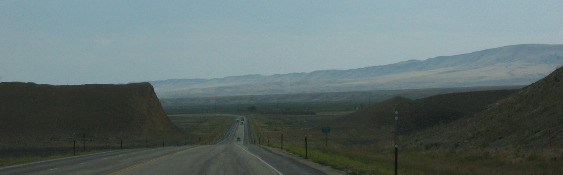
Another 15-miles west and we turned south on US-287 toward Rawlins at a spot in the road called Muddy Gap. From Muddy Gap to Rawlins the topography is interesting to say the least. We cross over the Continental Divide traverse 30 to 40 miles of the Great Divide Basin then cross over the Continental Divide a second time before arriving in Rawlins.


We are on a high desert the whole time. We started our trip today in Casper at 5,300' elevation and only climbed to a little over 7,000' feet each time we crossed over the Continental Divide.


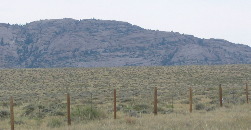
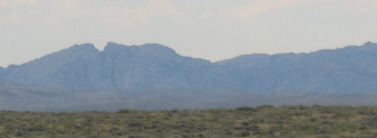
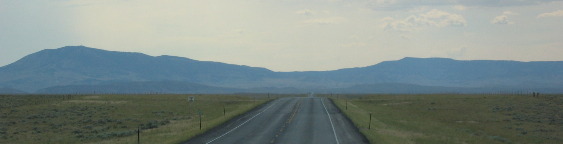
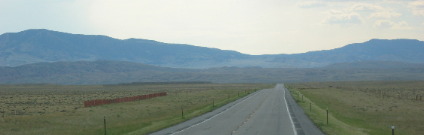
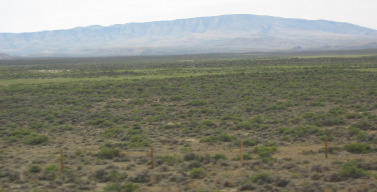
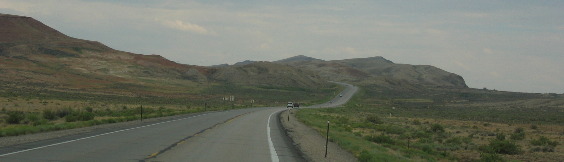
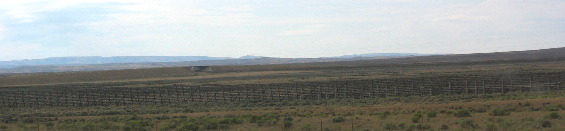
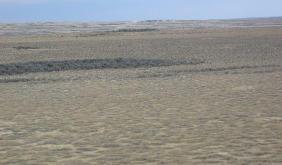
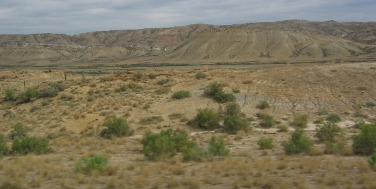
These pictures show the terrain as we head toward the Continental Divide and the Great Divide Basin. Low mountains with vast stretches of inner-mountain plateau is how I would describe the topography. Sagebrush dominates the plateaus.


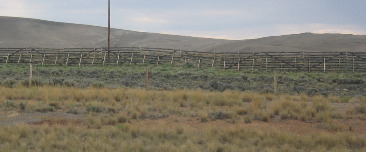
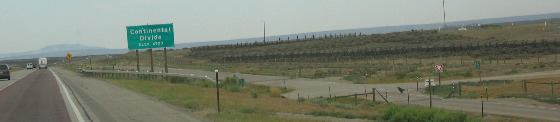
When we cross over the Continental Divide snow fences are there to keep winter snow off the highway.


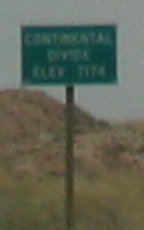
The Continental Divide along here is only 7,174'.

The drop into the Great Divide Basin was only 500' or so. However, there is enough drop so that water does not drain out of the basin.


Sadly we didn't get any pictures of the alkaline terrain in the Great Divide Basin when we were in the basin. Conditions are rather stark with only 12 to 15-inches of rain per-year. Sagebrush is small. While we see evidence of alkaline accumulations we did not see large lakes or flats of alkaline residue.


After spending the night in Rawlins we headed west on I-80 where we cross over the Continental Divide once again and down into the Great Divide Basin.


This unique basin occurs on the Continental Divide. Normally the Continental Divide splits the continent with waters on the west draining to the Pacific and water on the east draining to the Atlantic. That is normally what happens. In Northern Colorado and Southern Wyoming the Continental Divide splits forming a bubble before coming together again. The split in the Continental Divide is around an area known as the Great Divide Basin. A basin is an area where water does not flow out. In the case of the Great Divide Basin all rain and snow melt in the basin evaporates instead of flowing to one of the oceans.


To say the area east of the Continental Divide is dry would be an understatement.


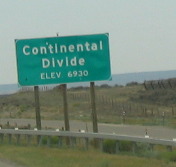
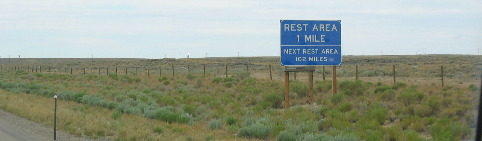
The Continental Divide here is only 6930'. Rest areas are a welcome sight when the next one is 102-miles away and not much of anything in between.


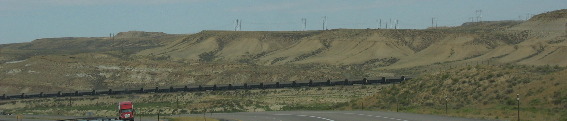
Trains give indication of life in this barren landscape. To the right is a coal train. Coal trains make up the vast majority of train traffic in Wyoming.


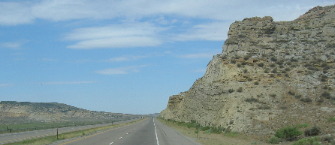
This roadcut was through what appears to be limestone or mudstone. It begins to remind us of I-10 through the Hill Country of Texas.


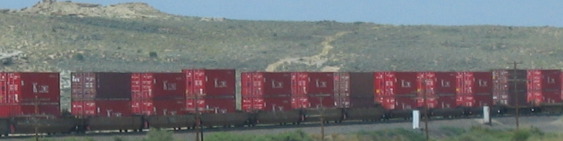
This is an eastbound container train loaded with containers from a giant merchant ship unloaded at one of the west coast ports, probably Oakland, California.


Approaching Rock Springs on I-80 the topography begins to show evidence of uplift and faulting in the sedimentary layers of rock. Many are tilted to the west then dramatically cut or faulted where I-80 and the railroad passes.


This mudstone layer does not show evidence of faulting while the sedimentary layers on the right are tilted to the west.


We stopped for the day in Rock Springs but quickly got in our Saturn and headed to South Pass on the Emigrant Trail. To get to South Pass we had to go north out of Rock Springs for 39-miles through Eden then to Faison where we turned east on SR-28. From Faison to South Pass City is another 48-miles. These distances would scare us back east but out here they are nothing. There are no stop lights and very little traffic. Dodging rabbits with death wishes is about all there is to do except enjoy the scenery.

We stopped at one Emigrant Trail historic site where we inspected trail ruts. This site was 10-miles east of the infamous "Parting-of-the-Ways" site where emigrant parties separated on their journeys to Oregon, California, or Utah.

Where we were is part of the Oregon Trail over which 350,000 to 500,000 people passed on their way West between 1844 & 1869. When we look closely at the ground we can see ridges in the ground, actually trail ruts made by the passage of iron-wheeled freight wagons and stagecoaches on a road that connected South Pass with the Union Pacific Railroad in Green River, to the southwest of where we are. This freight road was used from around 1870 to 1900. In other words this road "freight road" that headed off to Green River was not made until after the decline of the Oregon Trail and after the transcontinental railroad was complete.

Never the less we can still see the ruts in this delicate landscape left here over 100-years ago.


Back in our Saturn the next stop was an interpretive site provided by the US Dept. of the Interior providing a pullout for vehicles and a walkway overlooking South Pass.


One would think that crossing over the Continental Divide would be at the peak of a mountain. While South Pass is situated on the Continental Divide is is a 20-mile wide opening in the mountains where travel across the otherwise impassable Rocky Mountains.


To understand the significance of South Pass to western emigrations one must understand a little history of the area and that leads us back to the early 1800's when demand for beaver pelts led to the exploration and eventual settlement of the American West. South Pass was part of a major thoroughfare through the Rockies. Its Discovery was significant to the fur trade era.

As far as anyone knows South Pass was first crossed by white men in 1812 (Louis and Clark made their famous expedition to the west coast and back between 1803 and 1806 but not through South Pass). The Astorians, a small party of American Fur Company trappers led by Robert Sturart, used South Pass as they traveled east with dispatches for company owner, John Jacob Astor. Even though Stuart noted South Pass in his diary and word of his journey was printed in a Missouri newspaper, it would be another decade before white men "rediscovered" it.

For Jedediah Smith and other mountain men working for fur entrepreneur William Ashley in the winter of 1823-24, the rugged Wind River Range to the North of South Pass was a barrier between them and the beaver-rich Green River Valley further west. Failing to negotiate the Wind River Range to the north, Smith and his men finally reached the Green River by traversing the south end of the Wind River Range. At this point the Wind River Range was reduced to a gradual incline. Traveling west with money and supplies in 1825, Ashley initiated the Rendezvous, an annual event that lasted until the demand for beaver pelts gave out.

Even after the rediscovery of South Pass in 1824, it was years before the route was used extensively. Fur trapper/trader William Sublette brought a small caravan of wagons to South Pass in 1828. While his party did not take wagons over the pass, they demonstrated the feasibility of using them. Captain Benjamin Bonneville took the first wagons over South Pass in 1832. But it was US Government explorer, Lt. John Fremont, who was responsible for publicizing the South Pass route. Freemont was exploring the far west with Kit Carson as his guide/scout. Scattered references to an easy passage over the Rockies had appeared in newspapers for a decade before 1842 when Fremont created enthusiasm for South Pass by explaining that a traveler could go through South Pass without any "toilsome ascents".

As knowledge of South Pass became widespread, a great western migration commenced. Thousands of Mormons and future Orgonians and Californians would use South Pass as their "gate" to lands west over the next 20-years.


From where these pictures of South Pass are being taken South Pass doesn't look all that remarkable. But --------- and it is a BIG but, compared to the rugged Wind River Mountains, it can easily be recognized as a type of gateway.


These are the Wind River Mountains that had to be avoided for there was NO WAY to get wagons across them.


Crossing the Continental Divide into "Oregon Country" was a task for all westward-bound travelers, and many described their feelings about the event.

In 1852 Lucy Retledge Cooke, a young woman with "California Fever" wrote: "...This morn we arrived at the South Pass after which all water we see will be running to the Pacific. So we are now on the other side of the world..."

The trail over South Pass is a corridor which served many purposes. In addition to being the route to Oregon and California, it was used by Mormon pioneers to get to Utah and by the Pony Express.

A great exodus to the Salt Lake Valley in 1847 was only the beginning of Mormon emigrant travel along the Oregon Trail. About 68,000 took the Utah branch of the trail from 1847 until 1869 when the completion of the Union Pacific Railroad ushered in a new phase of overland travel. The community of Zion at Salt Lake offered economic opportunity as well as religious freedom.


Keep in mind that South Pass is 20-miles wide. Emigrants chose to take the route that entailed climbing the least amount of elevation change.


For a brief eighteen months beginning in Aril, 1860, eighty young men carried the nation's mail on horseback for 1,600 miles from St. Joseph, Missouri to Sacramento, California. Riding day and night - regardless of weather, on the fastest horses available, Pony Express riders maintained a vital communication link between east and west at the beginning of the Civil War.

The completion of the transcontinental telegraph line in October, 1861 marked the end of the Pony Express. Though the owners of the Express lost more than a million dollars, the venture captured the imagination of the entire world.

With South Pass behind them, Oregon and California-bound travelers faced the second half of their journey. The roughest travel was yet to come. From Missouri to South Pass, emigrants were able to follow rivers. But from South Pass to Oregon and California, they faced dry stretches such as the high-altitude desert of the Green River Basin. The dry climate played havoc with wagon wheels that kept shrinking wood away from iron rims.

Approximately 20 miles on the trail west of South Pass, emigrants arrived at the Sublette Cutoff, also known as the "Parting-of-the_Ways" that I wrote about earlier. It was there that groups separated, some going to Oregon, some to Utah and others to California. Whatever their destination, every day they struggled with life along the trail.

Lonely graves, most unmarked, are testimony to thousands of lives taken by cholera, accidents - especially at river crossings, and childbirth. Attacks by Native Americans were often feared, but almost never occurred.

It may be hard to visualize the lives of these people, but a short walk into the landscape allows insight into some of the problems they faced.


While standing on South Pass looking north we can see the Wind River Mountains that still have snow on them and it is late July.


Where the road crosses over the Continental Divide the elevation is 7,550'. Where the emigrants crossed over the Continental Divide a few miles south of the current road the elevation is probably 200' feet less.


South Pass is a region rich in history. There was a city about 8-miles northeast of South Pass, a city rich with gold. From 1812 to 1868 this open country at the south end of the Wind River Mountains provided a passage-the only passage-through the Rock Mountain barrier of the Continental Divide for some 500,000 Americans heading west. As you know South Pass saw Mountain Men, fur trappers and traders, explorers, missionaries, pioneers in covered wagons traversing the Oregon, California and Mormon trails, overland stage coaches, military expeditions, and Pony Express riders.

By 1866, however, traffic on the great trails had dwindled with the anticipated completion of the transcontinental railroad. Then, in 1867, gold was discovered on Willow Creek near South Pass. The rush was on. By 1869 more than 30 mines were in operation and some 3,000 people populated the region. The instant towns of South Pass City, Atlantic City and Miners Delight were rip-roaring and wide open for business.

This lusty, male-dominated mining district became the unlikely center of a move for female suffrage when it elected William H. Bright, a South Pass City miner and saloon keeper, to the first Wyoming Territorial Council in Cheyenne. Bright introduced a Female Suffrage Act that gave all adult Wyoming women the right to vote and hold public office. The Act was passed by the legislative body and signed into law on December 10, 1869, making Wyoming the first official government in the country to grant equal rights to women. Now I bet you didn't know that!

The mining boom went bust in the 1870's, and the population moved on to the next bonanza. All three town became near ghosts, although some limited mining activity continued. Today the region is operated as a Historic Mining District by the Bureau of Land Management. South Pass City, is a Wyoming State Historic Site and worth visiting.


Joyce took this picture of South Pass from a high point near South Pass City.


Warning signs and old gold ore processing buildings give evidence to South Pass Cities past glory.


The state has rebuilt many of the buildings in South Pass City and has them furnished much as they would have been in the "glory-years" when gold was king. Touring the buildings and viewing the displays is something that anyone passing by South Pass must take the time to do.


As you might suspect Criminals were numerous in this "rip-roaring" mining boom town. A jail was a necessity so one was built in 1870. The tiny, dark, unheated cells like the one on the left, held prisoners until 1875. It is the oldest jail in Wyoming. Suicide and insanity resulting from detention in cells like these caused the nation to rethink its traditional policy of punishing criminals. After the mid-1800's cells tended to be larger and more comfortable as the intent behind prison sentences began to emphasize rehabilitation.

One of the people locked up in this jail was Polly Bartlett. She was known as "The Murderess of Slaughter-house Gulch". She was shot to death in one of the cells in this jail. Before the law caught up with her, she may have poisoned and robbed more than 20 miners at her family's way-station several miles south of town.

How is that for some history about South Pass City?

Until next time remember how good life is.

Mike & Joyce Hendrix


   Passport America, Save 50% on Campsites


Home ** 2006 Travel Logs