Cimarron, New Mexico
Monday,
June 5 2006: We moved the motorhome 35-miles to Raton, New Mexico (On I-25 on
the Colorado border). We are in Cedar Rail Campground N36° 59.334 W104°
28.951'. Cedar Rail Campground is located on I-25 at the summit of Raton Pass.
It is totally gravel with pull-thru & back in sites (trees are limited) but
they do have several large ones; 50-amps, water and sewer, $11 per-night with
PPA or $23 with Good Sam 505-278-2921
the owners are delightful people. The sunsets are wonderful from the park and
the black chinned humming birds are thick around the feeders. We keep Cedar Rail
Campground in mind when visiting this area since it is a PPA
Campground and we like to take advantage of the PPA
1/2 price for members.

Raton Pass and the campground are at 7,500' so it
is a good climb up and over the pass. We didn't waste any time before we jumped
in the Saturn and headed to Cimarron, New Mexico about 34-miles southwest of Raton.
Cimarron (Spanish for "wild" or "unbroken") is one of those
places that just oozes with history. Cimarron was one of those Wild West towns
like Tombstone, Dodge City, and Deadwood. Situated in northeastern New Mexico
on the Santa Fe Trail where the plains meet the Rockies it attracted famous gun
slingers like bees to honey.
The St. James Hotel
built in 1880 in Cimarron, New Mexico
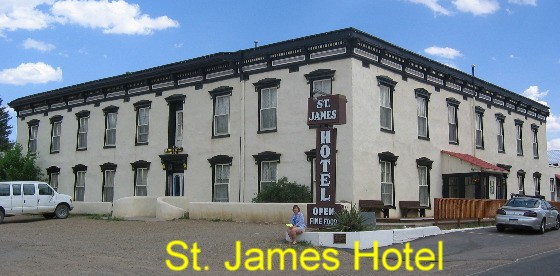
The St. James Hotel built in 1880, when the Santa Fe
Trail was giving way to the railroad, was a magnificent Hotel for those times.
The
St. James Hotel built in 1880 in Cimarron, New Mexico
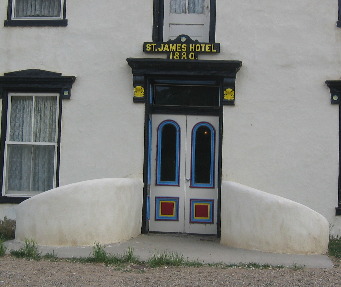
It is still there today and it still operates as a Hotel, Restaurant
and Bar complete with bullet holes in the ceiling. So wild was Cimarron that the
Las Vegas Gazette printed the following in the late 1870's "Everything is
quiet at Cimarron. No body has been killed in three days." Las Vegas is located
about 1/2 way between Cimarron and Santa Fe.
But I am getting ahead of myself. First I have to tell you about the individual
that built the St. James Hotel.
The St. James Hotel was built by Henri/Henry
Lambert who had an interesting background. Henri a young Frenchman was President
Lincoln's personal Chef a job he held until Lincoln's assassination in 1865. From
personal chef to President Lincoln Lambert headed west in search of gold. He quickly
discovered he could make a good living coking for the miners, besides mining was
hard work. As luck would have it Lucien Maxwell, a New Mexico Territory Land Barron
(1.75-million acres) had the opportunity to sample Lambert's cooking. Maxwell
was so impressed he offered Lambert a job cooking for him in nearby Cimarron.
Henry accepted and moved to Cimarron. In 1872 while still working for Lucien Maxwell,
Henry began building Lambert's Saloon. It wasn't long before Lambert's Saloon
became wildly popular with cowboys, traders, miners, frontiersman, and others
traveling this leg of the Santa Fe Trail.
Lobby
of St. James Hotel built in 1880 in Cimarron, New Mexico
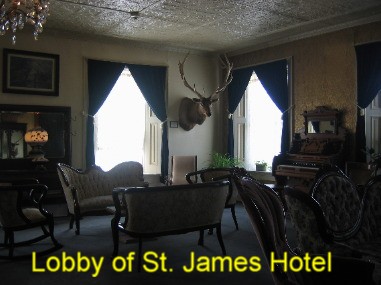
The
Saloon did so well that in 1880 Henri added 30 guest rooms and the St. James Hotel
was born. The Hotel was one of the most elegant, luxurious hotels west of the
Mississippi and soon became as popular as the saloon itself.
Lobby
of St. James Hotel built in 1880 in Cimarron, New Mexico
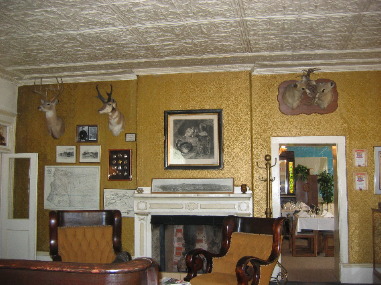
The guest registry is littered with names of legends that
made the Old West;
Jesse James stayed there on many occasions.
Buffalo Bill Cody met Annie Oakley in Cimarron and they both stayed in the hotel
while planning and rehearsing their Wild West Show. They took an entire village
of Indians from the Cimarron area with them when they took the show on the road.
Cimarron is where the idea for their Wild West Show was incubated.
Wyatt Earp, his bother Morgan, and their wives stayed there on their way to Tombstone,
Arizona (of OK Corral fame). After leaving the St. James they made there way to
the small town of Las Vegas, New Mexico about 30-miles southwest of Cimarron where
they met, and became friends with "Doc" Holliday.
Zane Grey
penned his novel "Fighting Caravans" while staying at the St. James.
Lew Wallace, Governor of New Mexico Territory, wrote part of Ben Hur there.
Other famous, and infamous, guests included Doc Holliday, Billy the Kid, Bat Masterson,
Kit Carson and Pat Garret (the Sheriff that shot Billy the Kid).
Bob Ford,
the man who killed Jesse James stayed there also. Bob didn't shoot Jesse James
here in Cimarron; he did that in a small house in St. Joseph, Missouri. Bob was
a confidant of Jesse and even rode with Jesse on raids. Bob Ford was killed by
a shotgun blast at his saloon in Creede, Colorado, in 1892 (His killer, Edward
O'Kelley was sentenced to only two years prison for avenging the man whom even
Theodore Roosevelt called "America's Robbin Hood.")
Bat Masterson,
gunfighter and lawman in Dodge City stayed in the St. James in 1887.
Tom Boggs the grandson of Daniel Boon and friend of Kit Carson spent many nights
at the St. James Hotel. Upon Carson's death Bogs raised Kit's children as his
own.
R. L. Uncle Dick Wootton scout, Indian fighter, rancher and operator
of Raton Pass Toll Road. He was a friend of all the old mountain men. Uncle Dick
was a frequent guest at the St. James Hotel. For those who don't know Raton Pass
runs between Raton, New Mexico and Trinidad, Colorado a distance of around 19-miles.
Gunslinger and lawmen alike stopped in the hotel for the night and
to play poker in the Saloon. Gunslingers like Clay Allison, and Fancisco "Pancho"
Griego who was shot to death in the St. James Saloon frequented the Hotel. Pancho
always bragged that he had killed 20-men. The night he decided to challenge Clay
Allison was the last time he got to be the bully.
Franciso was a pretty
bad dude before crossing Clay Allison --- another bad dude. One evening Poncho
Griego, a deputy sheriff and political cohort of the powerful politicians of the
Santa Fe Ring, killed three soldiers in an argument over a monte game at the St.
James Hotel. Although there were many witnesses, and Poncho was obviously guilty,
he was never indicted for murder.
Reverend Tolby, the fist minister
of Cimarron, was known for speaking out against injustice. Reverend Tolby publicly
told a Judge that he intended to see that Poncho Griego was brought to trial.
A few days later the reverend was found shot in the back.
It was learned
that Cruz Vega, a nephew of Pancho Griego, either was reverend Tolby's killer
or knew who did it. Clay Allison led a group of men to find and question Vega.
Vega would not confess to the murder, nor would he provide any information about
who did. Vega's badly beaten body was found hanging from a telegraph pole.
Shortly after that Griego and Clay Allison met up at the St. James Hotel. "You
looking for me?" Allison asked. Griego nodded. "What do you want?"
"I want to kill you senor." "Let's have a drink first," Allison
said. They went into the hotel and had a drink together. Immediately afterwards,
they set their glasses on the bar at the same time, and with movements so swift
no one could tell who drew first, each reached for his gun. Allison was quicker
and Poncho fell victim Allison's 44-slug. Then Allison shot out the lights in
the saloon. The bar was locked up and Griego's body was not retrieved until the
next afternoon.
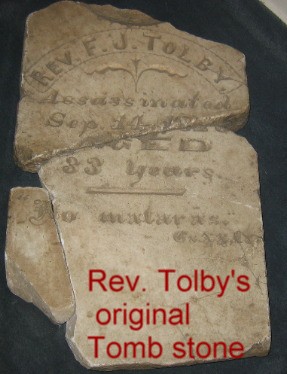
Reverend Tolby's original headstone now
rest in the lobby of the St. James Hotel
Reverend
Tolby was given a proper burial. Over the years, his original headstone was broken
and replaced with a large, modern headstone. The two pieces of the original headstone
now rest in the lobby of the St. James Hotel.
Mace
Bowman "fastest gun in the territory" (remember New Mexico was a "Territory"
until 1912 when it became a state) was Sheriff. In 1879 Bowman made the great
Clay Allison back down. Before Clay's gun could clear leather, Bowman's iron was
pointed at Clay's eyes.
The famous Elfego Baca, Sheriff of Socorro,
New Mexico and a close friend of Fred Lambert, the St. James Hotel's Owner's son,
visited the Hotel. Elfego is best known for the Frisco, New Mexico battle where
Elfego held off 80 Texas cowboys for 36-hours to protect his prisoner. Elfego
was also a lawyer ----One of his clients was Pancho Villa.
One unconfirmed
rumor has it that in 1881 the owner of the St. James was playing cards with some
men in the 2nd floor card room. It was getting late, the men had imbibed a fair
amount of whiskey, and the stakes were high. Confident that he would win, the
owner bet the hotel. However, a guest of the hotel, TJ Wright also felt he had
a winning hand and stayed in the game when all others folded. When the cards were
shown, TJ proved victorious. With his win TJ decided to retire for the night.
As he made his way down the hall he was shot from behind but continued into his
room and bled to death.
To say the least the St. James Hotel had a
violent history. At least 26-men were killed in gunfights at the hotel. The ceiling
of the Saloon (currently the dining room in the Hotel) still has 22 original bullet
holes in it. We saw the bullet holes but did not count them. The ceiling was made
of those stamped tin squares that you see in antique stores. Those who know say
that when Henry built the hotel he added 3-feet of hard wood above the tin ceiling
of the saloon to keep stray bullets from penetrating the floor of the upstairs
guest rooms.
Now it is time to learn about Lucien Maxwell, the Land
Barron (1.75-million acres) that persuaded Henri/Henry Lambert to come cook for
him at his mansion in Cimarron. Lucien was a character of characters himself.
That mansion where Henri went to work was more than just a mansion. This mansion
had high, molded ceilings, deeply piled carpets, velvet drapes, paintings in gold
frames, and four pianos -- two for each floor. It was above all Lucien Maxwell's
home but it was also a Saloon, Gambling rooms, Inn, watering hole on the Santa
Fe Trail, it even had rooms for "women of the trail" to ply their trade.
So Henri wasn't just cooking for Lucien Maxwell and the Lucien Maxwell Mansion
wasn't just Lucien's home. You have the setting now but who was Lucien Maxwell
and how did he come into possession of 1.75-million acres.
Originally
from Illinois, Lucien Maxwell drifted west and became a fur trapper and guide
or Mountain Man if you will. He was friends with Kit Carson. In 1842 he was in
New Mexico working as a guide. During this time he would often stay at the Beaubien-Miranda
Ranch. To make a long story short he married Luz, one of Beaubien's six daughters
in 1842, (some say Luz was 13 years-old others say 15 years-old). To understand
what Maxwell had married into you have to understand a little of the history of
New Mexico.
At one time New Mexico and the surrounding Colorado countryside
belonged to various Indian tribes (Apaches, Utes and Comanches). Then the area
was under the control of Spain as was Mexico, Texas, New Mexico, Arizona, California
and parts of Colorado. Spain's control of the area ended in 1821 with Mexico's
Declaration of Independence. When Mexico was controlling New Mexico Governor Manuel
Armijo was the man in charge of the area. In 1841, just five years before the
US Army arrived (Mexican American War), Charles Beaubien and Buadaloupe Miranda
of Taos applied to Governor Manuel Armijo for a land grant, promising to encourage
new settlers to come to the area and utilize its resources. Beaubien was a French-Canadian
trapper who came to New Mexico in 1832, became a Mexican citizen, married a 16
year-old native girl, and opened a store in Taos. Miranda was a gentleman from
Chihuahua, Mexico who had come to New Mexico on business and stayed; later he
was appointed to several government positions including Governor Armijo's departmental
secretary. Remember, at this time New Mexico was part of Mexico. It became of
Mexico with the Mexican Declaration of Independence in 1842.
It so
happens that the governor supported the grant --- thinking that Mexican settlers
would fend off the encroaching foreigners from the United States, as well as the
hostile Indians. There may have been another reason for this grant since several
years later Miranda and Beaubien conveyed 1/4 interest in the grant to Governor
Armijo. Another quarter was deeded to Taos merchant Charles Bent, in return for
his promise to work on developing the grant. Whatever the reasons might have been,
Armijo approved the grant application. Later, after the Governor received his
quarter interest, he approved an additional grant to Beaubien's son Narciso, and
son-in-law, Stephen Louis Lee.
OK, now you have the setting. Maxwell
has married into this family (the Beaubien's that have this enormous land grant
from the Mexican Government).
After his marriage, Maxwell continued to his
line of work as a guide and along with Kit Carson, led Colonel Freemont across
the desert to California in 1846. Get this Maxwell is a French Canadian that has
become a Mexican Citizen and is now scouting for the U.S. Army under Colonel Freemont.
Freemont reported in his journal that Maxwell saved the expedition when he bravely
confronted a band of some 300 Arapaho warriors just as the shooting was about
to start. "You're a fool, God Damn you!" Maxwell yelled at one of the
attackers. "Don't you know me?" It turned out the Indians were from
a village where Maxwell had lived and traded years before (back in his Mountain
Man/fur trapper days). Instead of fighting the two sides shook hands. Maxwell
knew the land and its fierce people and had the courage and self confidence to
use it for benefit.
In 1846 when General S. W. Kearney's "Army
of the West" was moving on Santa Fe, New Mexico in the Mexican American War.
That same Governor Armijo was the head of the "militia" defending Mexican
interest in Santa Fe. But instead of fighting Governor Armijo, (remember him?)
along with Senior Miranda (remember him?) and the rag-tag militia fled deep into
Mexico.
By 1848 the Mexican American War was over with the signing
of the Treaty of Guadalupe Hidalgo where the Mexican government ceded present-day
Arizona, California, New Mexico, and parts of Colorado, Nevada and Utah in exchange
for $15-million in compensation for war-related damage to Mexican property. Other
stipulations included protection for the property and civil rights of Mexican
nationals living within the new border. When the U.S. Senate ratified the treaty
it deleted Article X guaranteeing the protection of Mexican land grants.
In 1864, after the death of his father-in-law, Maxwell bought out the five other
heirs, becoming the largest land owner in the United States and renamed the property
the Maxwell Land Grant. Now you know how Maxwell came to own those 1.75Million
acres of northern New Mexico and southern Colorado.
Aztec Mill in Cimarron, New Mexico
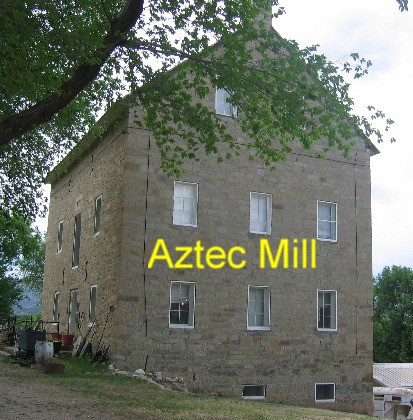
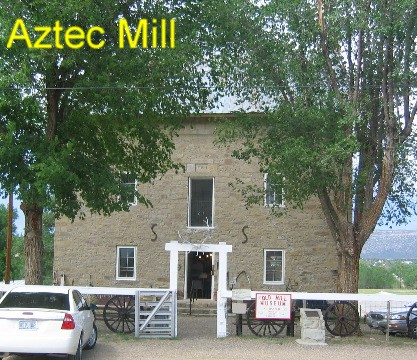
Also in 1864 Maxwell hired an engineer from Boston to design
a three-story grist mill that he called the Aztec Mill. The mill, capable of grinding
15,000 pounds of wheat per day, supplied flour for Fort Union and distributed
supplies to the area Indians, for which Maxwell was compensated by the federal
government. Maxwell operated the Aztec Mill until 1870.
In 1866, a year after
the Civil War ended, gold was discovered nearby and the area filled with miners
in search of fortunes. Between the miners and travelers along the mountain branch
of the Santa Fe Trail Cimarron quickly became a boom town, with 16-saloons, 4-hotels
and numerous trading stores. It was amid all this that the city gained its reputation
for lawlessness.
Aztec
Mill in Cimarron, New Mexico
In 1870 Lucien Maxwell sold his interest in the grant and all his properties and
moved to Fort Sumner, New Mexico.
There is another long and interesting story
dealing with the "company" that purchased the "grant" from
Maxwell. It has to do with Billie the Kid and the Lincoln County War. That will
have to wait.
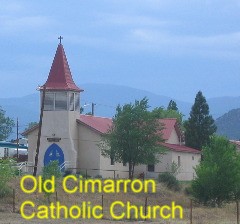
Old Cimarron
Catholic Church
Cimarron
hasn't changed much over they years. The old St. James Hotel is still there and
the old Aztec Mill is still there. Things are much quieter. The residents have
a reverence for the history of this place.
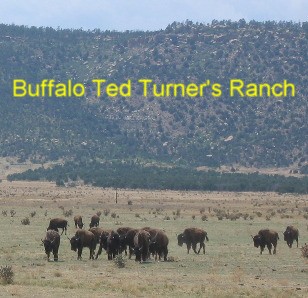
Buffalo
on Ted Turner's ranch near Cimarron, New Mexico
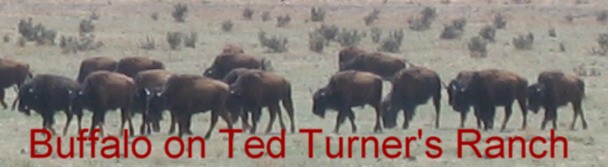
The
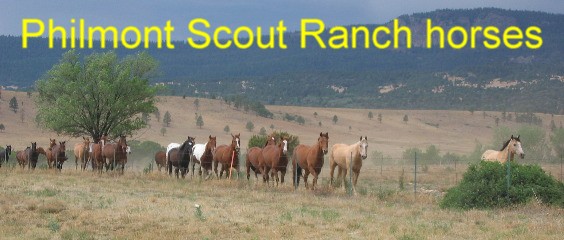
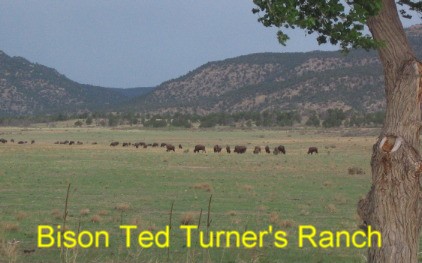
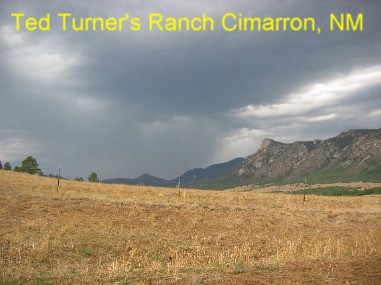
area still draws "big-names" such as Ted Turner who has 558,000 acres
on the northeast side of town and the world famous Philmont Scout Ranch (The world's
largest camping facility at 137,000 acres) is on the west end of Cimarron.
Philmont
Scout Ranch west of Cimarron, New Mexico
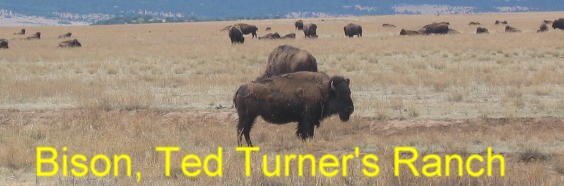
Buffalo
on Ted Turner's ranch near Cimarron, New Mexico
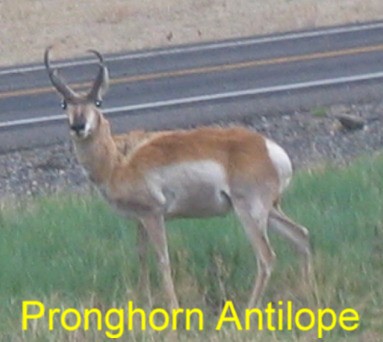
Pronghorn
across highway from Ted Turner's Ranch east of Cimarron, New Mexico
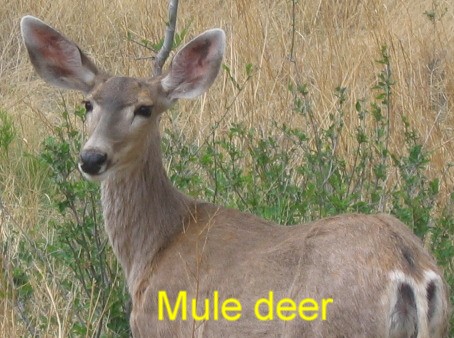
Mule
deer in downtown Cimarron, New Mexico
Ted
Turner's ranch near Cimarron, New Mexico
Buffalo
on Ted Turner's ranch near Cimarron, New Mexico
Buffalo
on Ted Turner's ranch near Cimarron, New Mexico
Cholla
Cactus
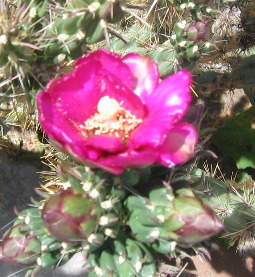
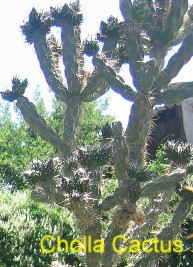
And
last but not least the area is dotted with Cholla Cactus.
Until next time remember how good life is.
Mike
& Joyce Hendrix
Until next time remember how good life
is.

Mike
& Joyce Hendrix who we are
We
hope you liked this page. If you do you might be interested in some of our other
Travel Adventures:
Mike & Joyce Hendrix's
home page
Travel
Adventures by Year ** Travel
Adventures by State ** Plants **
Marine-Boats ** Geology
** Exciting Drives ** Cute
Signs ** RV
Subjects ** Miscellaneous
Subjects
We
would love to hear from you......just put "info" in the place of "FAKE"
in this address: FAKE@travellogs.us
Until next time remember how good life
is.