|
Corkscrew Audubon Wildlife Sanctuary
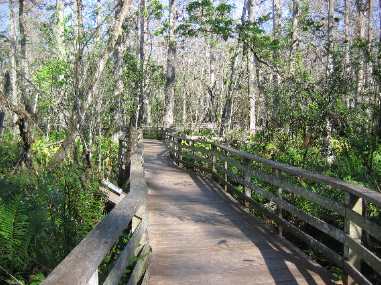
Boardwalk in Corkscrew Audubon Sanctuary
Corkscrew Audubon Sanctuary consists of over 10,000 acres of unique watershed. It is home to virgin bald cypress and a national rookery for endangered wood storks. The Audubon Society has constructed a walkway like the one pictured that wanders over one mile through the dense stand of cypress swamp. Along this walkway visitors meander through several different ecosystems. A change of only inches in elevation means a difference in trees and vegetation. Alligators, birds and a wide variety of plants especially bromeliads are visible from the raised walkway.
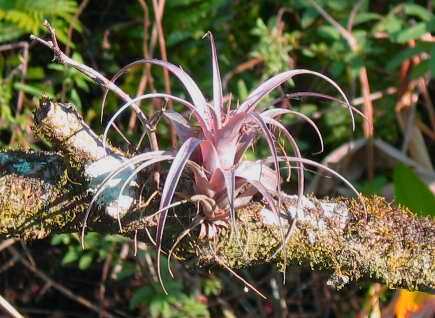
Bromeliad in Corkscrew Audubon Sanctuary
This is one of the beautiful bromeliads visible throughout the sanctuary.
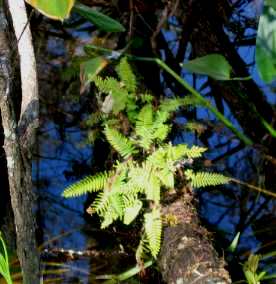
Resurection Fern in Corkscrew Audubon Sanctuary
The resection fern on this log is in an unusual place but has survived on the fallen limb just inches above the water of the swamp.
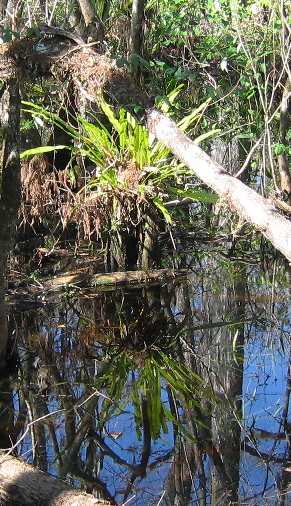
Reflections in Corkscrew Audubon Sanctuary
Joyce took the picture on the right trying to capture the reflection of this plant. I liked the way it came out.
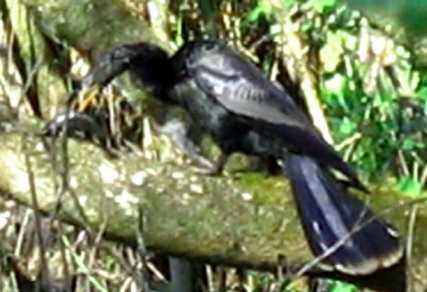
Anhinga with fish dinner in Corkscrew Audubon Sanctuary
We spotted this anhinga wrestling with a nice size fish that was flopping around fighting for its life. The fish did not go quickly. There was a lot of wiggling and flipping over a period of minutes. In the beginning the anhinga was bashing the fishes head against that limb in an attempt to subdue it. Finally, with the fish under control the anhinga flipped it around and with it finally facing in the proper direction the fish slowly disappeared down that snake like neck into the anhinga's stomach. In the picture to the right you can see the back end of that fish about to vanish into the anhingas gaping mouth.
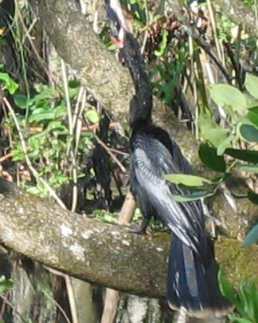
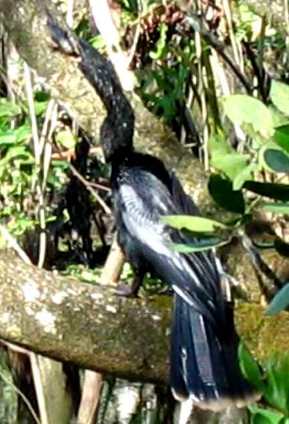
Anhinga with fish dinner in Corkscrew Audubon Sanctuary
The fish is not yet in the "swallowing" position which is head first. With a frantically wiggling, slippery fish and only his bill to hold it the procedure to get the fish into position is tedious and slow.
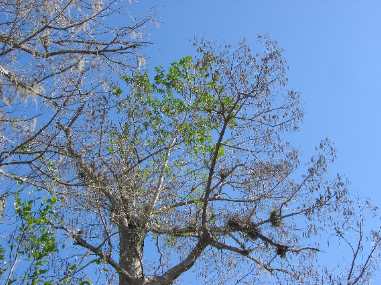
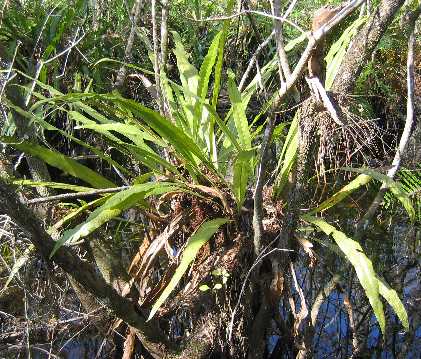
Epiphytes Corkscrew's Audubon Sanctuary
The picture on the right showcases a number of different plant communities being protected in Corkscrew's Audubon Sanctuary. The big trunk you see is an ancient bald cypress tree estimated to be over 600 years old. This stand of virgin cypress is one of the few in the United States that did not fall to the saw during uncontrolled logging of the early 1900's. This ancient cypress tree has been topped by storms but it continues to live. The plants that look like birds nests are bromeliads, epiphytes if you will, as is the Spanish moss (the gray epiphytes) you see in the branches in the top left hand corner. The green tree you see in the middle of the picture is a young strangler fig. It grew from a seed that sprouted in the upper portion of that ancient cypress tree. Once the seed sprouted it started sending roots toward the ground while its trunk and branches reach for the sun from that lofty position. That is an extremely neat survival strategy for this plant.
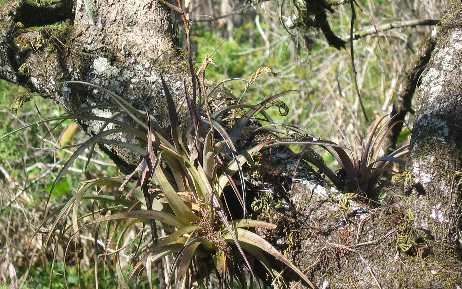
Bromeliads (epiphytes - air plants) in Corkscrew's Audubon Sanctuary
These are different varieties of bromeliads (epiphytes - air plants) deriving moisture and nutrition from the atmosphere.
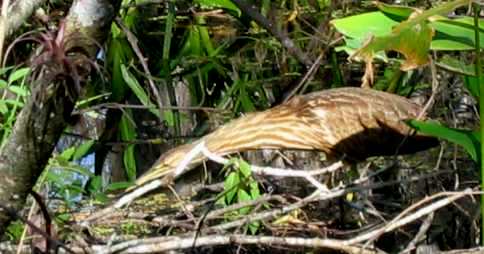
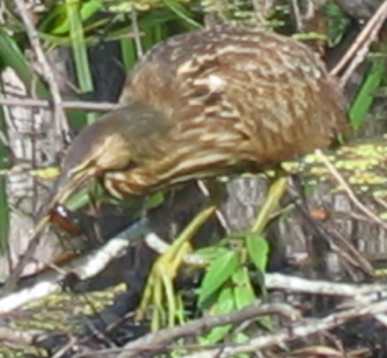
American Bittern was stalking a crawfish in Corkscrew's Audubon Sanctuary
This American Bittern was stalking a crawfish. He held that outstretched position for several minutes before striking with deadly accuracy. The picture on the right shows that crawfish being held tightly in the bittern's beak just before it disappeared into the lunch pail.
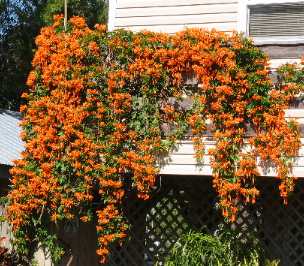
Flame vine
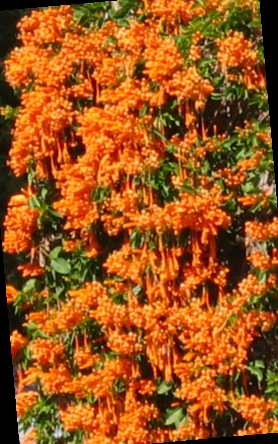
Flame vines are one of the showiest flowers blooming this time of year in south Florida. Some people plant them on large stretches of chainlink fence that really creates a splash of color.
Flame vine
Until next week just remember how good life is.
Click here for some Key West travellogsUntil next time remember how good life is. More Florida AdventuresSome Key West Adventures ** More 2006 Travel Adventures
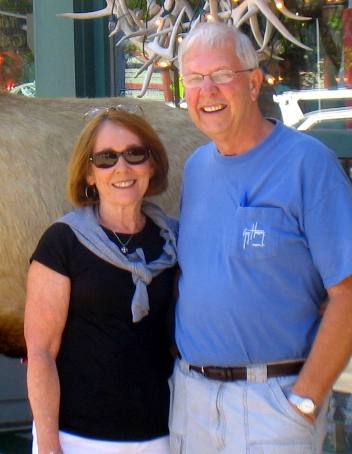
Mike & Joyce Hendrix
Mike & Joyce Hendrix who we are We hope you liked this page. If you do you might be interested in some of our other Travel Adventures: Mike & Joyce Hendrix's home page Travel Adventures by Year ** Travel Adventures by State ** Plants ** Marine-Boats ** Geology ** Exciting Drives ** Cute Signs ** RV Subjects ** Miscellaneous Subjects
We would love to hear from you......just put "info" in the place of "FAKE" in this address: FAKE@travellogs.us Until next time remember how good life is.
|
| ||
|
| |||
|
| |||
|
|