|
Mount Dora We took a great day trip to the charming Central Florida town of Mount Dora today. But first let me give you a little background on where we are. Joyce and I are staying in Lake Louisa State Park on US-27 south of Clermont. The campground is fairly new and includes 50-amps, water with central dump station, paved interior roads and several lakes, $23.31 per-night: N28° 24.194 W81° 33.386'. We would have stayed in a PPA Campground but there wasn't a Pass Port America Campground in the area.
Lake Louisa State Park is fairly close to Disney World as in around 25-miles. It is a nice clean campground with no shade trees in the campground area. It has a lot of hiking trails and equestrian trails, several lakes and preserves several thousand acres of the sand hills forming the northwestern edge of the Lake Wales Ridge. The Lake Wales Ridge is what makes the backbone of Peninsular Florida. It contains the high ground on the peninsular although high ground around here is only 300' above sea level. The high ground is sand hills, remnants of ancient sand dunes. When these sand dunes were being created the ocean covered most of Peninsular Florida. Corals flourished in this shallow tropical sea for thousands if not millions of years. Today the remains of that coral shelf underlies most of Penisular Florida in the form of limestone. Vegetation, in the sand hills area of the Lake Wales Ridge varies from tropical rainforest plants in the moist low lying areas to arid desert plants on the tops of those sand hills. We are constantly amazed at the rich variety of plant life thriving down here. Pink Trumpet tree in full bloom in Mount Dora
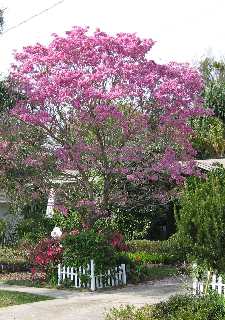
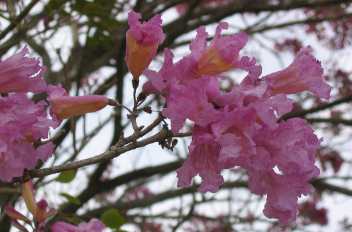
Joyce took this picture of a pink trumpet tree while visiting Mount Dora a small town on the bank of Lake Dora. The pink trumpet is a tropical tree that can have bright yellow or even lavender blooms. No matter what color their blooms they command attention. Like fruit trees they bloom with few if any leaves on the tree.
Pink Trumpet tree in full bloom in Mount Dora
Joyce took this picture of a pink trumpet tree in full bloom while visiting Mount Dora a small town on the bank of Lake Dora, in Central Florida. The pink trumpet is a tropical tree that can have bright yellow or even lavender blooms. No matter what color their blooms they command attention. Like fruit trees they bloom with few if any leaves on the tree.
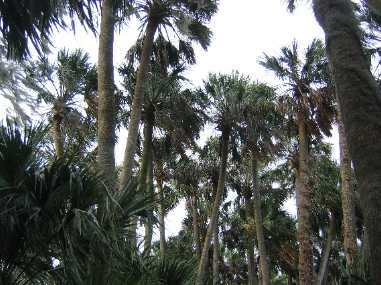
Mount Dora City Park on Palm Island
Within walking distance from the quaint downtown area of Mount Dora was a city park/nature trail on "Palm Island". It was advertised as a one mile nature walk reached via a boardwalk. Once on Palm Island you can walk on trails or stay on the boardwalk. Joyce captured this picture of the namesake palms on Palm Island.
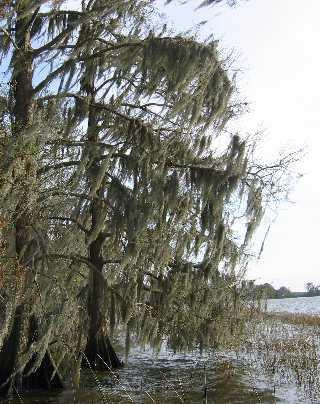
Spanish moss draped cypress along the shore of Lake Dora in Central Florida
From Palm Island there is a dock that wanders along the shoreline of Lake Dora. As you can see we enjoyed our walk through Palm Island. Joyce captured this picture of Lake Dora and the cypress trees draped in elegant Spanish moss. This picture of the cypress trees in Lake Dora was taken from the dock/boardwalk that meandered along the shore from Palm Island.
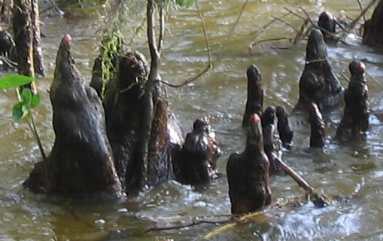
Cypress knees along the shore of Lake Dora in Central Florida
These are cypress knees, part of the cypress trees unique root system. Underwater, cypress trunks and knees provide excellent havens for small fish and invertebrates.
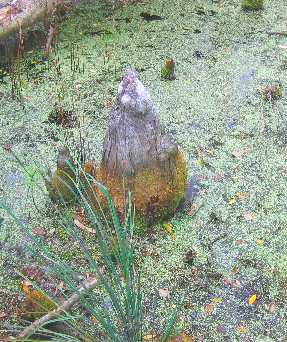
Cypress knee in Lake Dora in Central Florida
To the right is a single fat cypress tree root. Scientists believe that cypress knees provide support in unstable, waterlogged soils and help the tree survive when oxygen is low around the root area.
Until next week just remember how good life is. Click here for some Key West travellogsUntil next time remember how good life is. More Florida AdventuresSome Key West Adventures ** More 2006 Travel Adventures
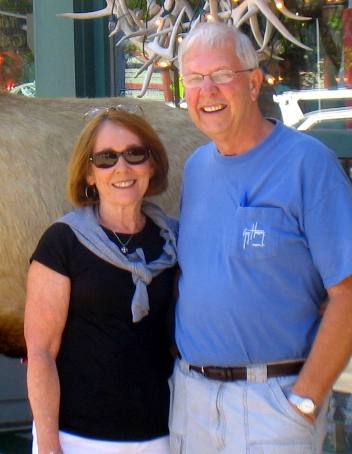
Mike & Joyce Hendrix
Mike & Joyce Hendrix who we are We hope you liked this page. If you do you might be interested in some of our other Travel Adventures: Mike & Joyce Hendrix's home page Travel Adventures by Year ** Travel Adventures by State ** Plants ** Marine-Boats ** Geology ** Exciting Drives ** Cute Signs ** RV Subjects ** Miscellaneous Subjects
We would love to hear from you......just put "info" in the place of "FAKE" in this address: FAKE@travellogs.us Until next time remember how good life is.
|
| ||
|
| |||
|
| |||
|
|