Mike & Joyces Travel logs

Home ** 2005 Travel Logs**


Places Visited:
California: San Luis Obispo & Morro Bay

Saturday, May 28: Cypress Bay RV Park Morro Bay, California: $31 FHU-30amp. Paved interior roads & sites. N35° 72.165' W120° 51.044'

My computer crashed this morning. It will not boot. I can't do anything with my web site or travelogues until I get it up and running.

Just up the street from us is a big Art & Craft show in the city park this weekend. Our first order of business was strolling through all the booths. We like to look at the photography for sale. The more we study "good" photography the more we realize what needs to be in our photographs. What is it about some pictures that catch your eye?

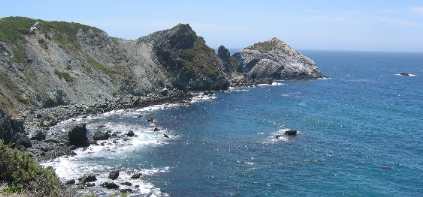
Then we drove out to Montana De Oro State Park located on the extreme southwest corner of Morro Bay. This state park preserves 8,000 acres of rugged coastal cliffs, secluded sandy beaches, coastal plains, streams, canyons and hills if you call 1,347-foot Valencia Peak a hill. It is truly a jewel. The park also preserves Spooner's Ranch one of those wonderful slices of historic natural California.


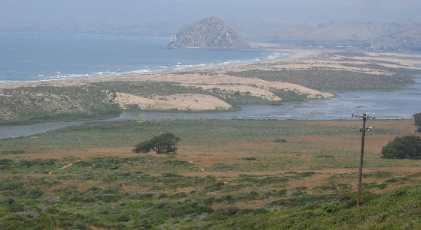
To reach Montana De Oro we just followed signs through the small hamlet of Los Osos. The park entrance is heavily wooded with mature eucalyptus trees. The road climbs through this eucalyptus forest before emerging on the North West side of the mountain to a captivating vista of Morro Bay to the north with Morro Rock standing sentinel over the channel, while the emerald Pacific splashes against the strand of sandy beach separating Morro Bay from the Pacific Ocean. We feel fortunate to be able to stop here and enjoy the sheer beauty displayed before us.


The park is a popular equestrian facility and we watch horses and riders gallivanting on the strand. Many trucks with equestrian trailers are parked in select parking areas.

From that first vista point the state park road turns south and follows the coast for several miles. There are parking places for people who want to access the beach as well as those entering the park with horse trailers. Trails lead back into the forest and the chaparral covered coastal mountains as well as down to the beach. At one point we stopped at a large cove where a number of sun bathers were enjoying the day. On a cliff above the beach snuggled in a small grove of Monterrey Cypress trees is the old Spooner Ranch house now performing duties as the state park visitor center.


I am intrigued by the geology present in Montana de Oro. The exposed rock that I can see is Monterey Shale. Formerly an ancient sea bed, it is composed of mudstone deposited millions of years ago when tiny fragments of once-living organisms drifted to the bottom of the sea and mixed with silt and sand providing the "bonding-agent".


In this area the Pacific Plate grinds against the North American Plate. This is what causes the earthquakes California is noted for. This grinding action has buckled and tilted the sedimentary layers, raising them out of the sea in odd angles.


Over the eons the ocean level has changed as ice ages came and went. This process has been repeated several times over the past five to ten million years. We can see the successive marine terraces (former beaches) in some of the road cuts and hillsides.

The northern end of Montana de Oro sand dunes prevail on that finger of sand that separates the ocean and Morro Bay.

Then to complete the geology picture Morro Rock bulges out of the landscape. Morro Rock is the extremely hard core of an ancient volcano. What else can be crammed into a geologic picture?


I am fascinated by beach composition. It isn't sand as one might expect it is small pebbles. No matter the size they are all rounded like river rock. You can see the size of the "sand/pebbles" in my hand. The smaller ones are actually larger than a BB.


Later we learned that Montana de Oro is Spanish for "Mountain of Gold", after the golden wildflowers that bloom in the spring. One publication says that mustard and California poppy are the flowers that give off that golden color. A golden flower was blooming that was not California poppy so it must have been mustard.

Don't miss Montana de Oro when you visit Morro Bay or San Luis Obispo.


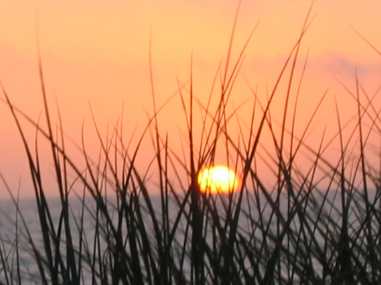
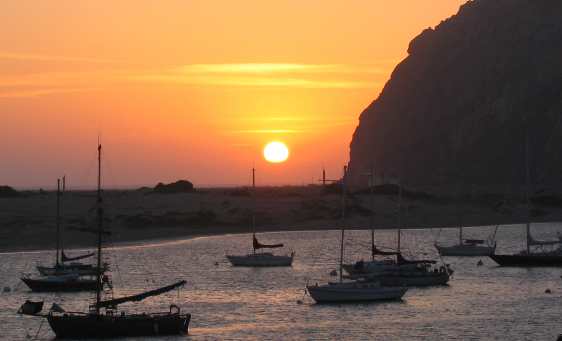
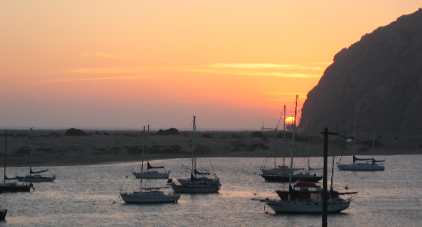
Joyce is getting quiet qood with these sunset pictures.


Sunday, May 29: Cypress Bay RV Park Morro Bay, California: $31 FHU-30amp. Paved interior roads & sites. N35° 72.165' W120° 51.044'


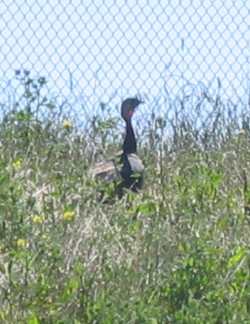
We spent the day exploring the Big Sur on CA-1. As we were on the entrance ramp to CA-1 in downtown Morro Bay I had to stop the Saturn for a hen turkey crossing the road in front of me. I was going slow enough that I was able to stop and take this picture. Morro Bay is a quiet "laid-back" community much like many small communities throughout this great country and this picture shows that. We are literally just two blocks from where we walked through that art show the other day. This is in town.


The stretch of CA-1 that traverses the rugged California coast between Monterrey and Morro Bay is considered by most to be the Big Sur. That area of California is roughly located 150-miles south of San Francisco and 300 miles north of Los Angeles. Historically, the name Big Sur, was derived from that unexplored and unmapped wilderness area which hugs the coast south of Monterey. It was simply called El Sur Grande---The Big South. As CA-1 wends its way along the majestic Santa Lucia Mountains flank the eastern side while the rocky Pacific Coast hug the western side.


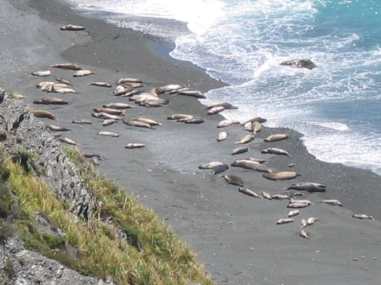
Again today we stopped by pulloffs and peered down the cliff to the beach and ocean below where those sea lions were resting.


Pioneers began settling in the area in the mid-1800's. Today's landmarks bear the names of many of those early settlers-----Mt. Manuel, Pfeiffer Ridge, Post Summit, Cooper Point, Dani Ridge, Partington Cover and others. Other landmarks are telling as well Jade Cove is known for the jade that can be found on the beach and in the surf. Piedras Blancas Lighthouse --- Spanish for the "white rock" lighthouse---a large rock rises from the Pacific just off the point of land where the light house is located. Sea birds roosting on the prominent rock have coated it in white-guano thus why the Spanish called it white rock.

While the turn of the century supported a lively redwood lumbering industry in the northern end of the Big Sur the only link with civilization were steamers transporting goods and supplies. The present highway wasn't completed until 1937 after 18-years of construction. It was declared California's first Scenic Highway and to this day provides a driving experience unsurpassed in natural beauty and scenic variety.

Electricity did not arrive in Big Sur until the early 1950's, and still does not extend the length of the coast or into the more remote mountainous area. To say much of the Big Sur is remote would be an understatement.


The attraction of Big Sur is the scenic qualities and natural grandeur of the coast which result from the imposing geography, rich vegetative compositions, and the dramatic meetings of land and sea. CA-1 along the Big Sur is noted for its sharp curves and step hills. Flat stretches are few and far between. While most RV'ers avoid driving the Big Sur in their RV's rental units were buzzing up and down the entire length. We even saw a few larger Class A motorhomes in addition to one large coach towing a big SUV on a twin axle trailer. It can be done in a motorhome by those so inclined but be aware there are no services and the terrain will severely tax a motorhome drive train.


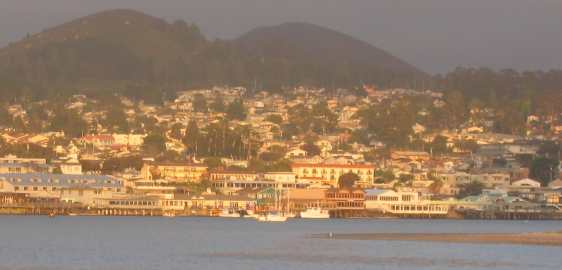
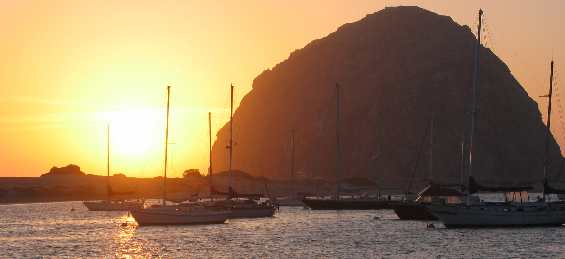
We drove to Morro Rock for the sunset event where we took this picture of the small community of Morro Bay across the mouth of the bay.


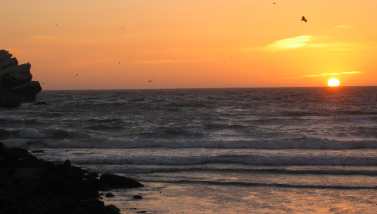
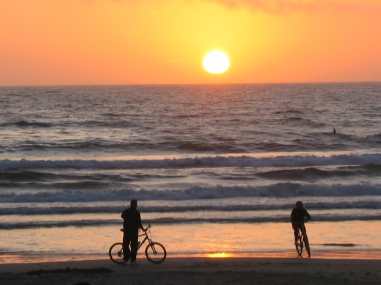
We ended the day by paying homage, once again, to the setting sun. This time we watched from a vantage point on the beach near Morro Rock.

It would be hard for life to get any better.


Monday, May 30: Cypress Bay RV Park Morro Bay, California: $31 FHU-30amp. Paved interior roads & sites. N35° 72.165' W120° 51.044'

Several things are on the agenda for today. We are going to meet Don a virtual friend from the RV-newsgroup. Don lives near here and is driving in to San Luis Obispo to meet us and have lunch.

We met Don in front of Mission San Luis Obispo in downtown San Luis Obispo where Don did a good job of giving us a quick history of San Luis Obispo and Cal Poly the local university.

Don got in our Saturn and we headed out to a small restaurant on Harford Pier at Port San Luis. Port San Luis is an extension of Avila Beach. To reach the pier from Avila Beach is a scenic drive in and of itself. Avila Beach has some of the best sand beaches we have seen and Memorial Day crowds were utilizing them. RV's were parked along Avila Beach Drive for a half mile or so. Then as we neared Port San Luis and Harford Pier there was an RV-Park of sorts. It was the typical California Beach Campground. For $20 you are allowed to park your RV overnight, sans any hookups. These aren't traditional campgrounds with restrooms, bath houses and utility connections. Just a parking space for $20.


Avila Beach Drive ended at Harford Pier where Don directed me to continue on to the fish marked and restaurants at the end. Lucky for us someone pulled out of a parking space just as we arrived at the turn around. If it had not been for that fortunate opportunity we may not have dined on the pier. It was a LONG way back to possible parking on Avila Beach Drive.


The fish market was selling live ling cod, Dungeness crabs and another local crab that looked much like the Dungeness but had a reddish tint instead the Dungeness tan color.

We watched as people picked their crab "lunch" out of the live tank and delivered it to the restaurant to fix. We dined outside where we could watch the harbor activity.


Sea lions were resting on a floating dock nearby while boats were anchored out. The area is not a marina but an anchorage. Each boat is moored to a buoy in the harbor area. Owners get to and from their boats via small boats.


While we were eating a large sport fishing boat pulled up to the floating dock where all the sea lions were. They all squaked before finally dropping in the water, that is all but one -------- that stood his ground.


On the way back to town Don shared some history of the world famous Madonna Inn. When Don was a student at Cal Poly years ago he dated a girl that worked at the Inn and had spent some time there. Of course he said we had to see the men's bathroom. It seems that as outlandish as the Madonna Inn is ----- the men's restroom is the most accessible and most notorious item at the Inn.

After dropping Don off we made our way back to the Madonna Inn where we started looking for "the room". We wandered around the hot-pink dining area and ballroom then several other rooms in the dining/bar complex. I finally asked one of the staff where "The Bathroom" was. She laughed and said the one we were looking for was downstairs and pointed to the stairs.

We weren't the only ones making the pilgrimage down those stairs to view the "men's room" one couple after the other was making the obligatory trek. Men and women alike were entering the famous room to observe what all the fuss is about. Now that we have seen the famous room we can honestly say it is "different" but tasteful even elegant as was the entire hotel restaurant complex. Extremely nice even luxurious one of a kind is the way I would describe it.

Instead of using rocks for the Inn's main fireplace Madonna used boulders.


Wooden banisters were exquisitely carved pieces.


Large elaborately hand carved wooden doors decorated entrances. Brass and copper accents and custom-etched glass is liberally used.


Overall the Madonna Inn appeared to be a first class Inn with a lavish splash of the eccentric. Joyce picked up a handout while we were there that indicates the Inn was built by Alex and Phyllis Madonna to express their unique vision of elegance and comfort. In their words they brought together artisans and unusual materials from around the world building a first class hotel with all the comforts of home.


If you are interested check out: Madonnainn.com where you will find photos of all 109 unique rooms. Each of the Inn's rooms is individually decorated with a special theme and color scheme.


Many include splendid fireplaces and fountains adorned with hand-placed native rock. I can only surmise what the color schemes might include after seeing that stunningly beautiful hot-pink banquet room.


On our way back to Morro Bay we stopped by Baywood Park a small community on the southern bank of Morro Bay. Each community along the shore of Morro Bay seem to have park areas where the community can enjoy the bay. Morro Bay reminds us of our childhood homes where we both grew up in estuary settings, me in Panama City, Florida and Joyce in Brunswick, Georgia. Each of the estuaries has so much in common.


We found yet another location to watch the sun set tonight. This time we chose a bluff overlooking the harbor in town.


Life would be better if my #1 computer would boot. I might be shipping it back to Florida so my BIL can work magic on it if I can't find help here.


Until next week just remember how good life is.

----------------------------------------------------------------------------
If you would like to be added to the e-mail distribution list for these travelogues please let us know via
e-mail Mailto:mikehendrix@isp.com

Mike & Joyce HendrixPlaces Visited:
California: San Luis Obispo & Morro Bay

Saturday, May 28: Cypress Bay RV Park Morro Bay, California: $31 FHU-30amp. Paved interior roads & sites. N35° 72.165' W120° 51.044'

My computer crashed this morning. It will not boot. I can't do anything with my web site or travelogues until I get it up and running.

Just up the street from us is a big Art & Craft show in the city park this weekend. Our first order of business was strolling through all the booths. We like to look at the photography for sale. The more we study "good" photography the more we realize what needs to be in our photographs. What is it about some pictures that catch your eye?

Then we drove out to Montana De Oro State Park located on the extreme southwest corner of Morro Bay. This state park preserves 8,000 acres of rugged coastal cliffs, secluded sandy beaches, coastal plains, streams, canyons and hills if you call 1,347-foot Valencia Peak a hill. It is truly a jewel. The park also preserves Spooner's Ranch one of those wonderful slices of historic natural California.


To reach Montana De Oro we just followed signs through the small hamlet of Los Osos. The park entrance is heavily wooded with mature eucalyptus trees. The road climbs through this eucalyptus forest before emerging on the North West side of the mountain to a captivating vista of Morro Bay to the north with Morro Rock standing sentinel over the channel, while the emerald Pacific splashes against the strand of sandy beach separating Morro Bay from the Pacific Ocean. We feel fortunate to be able to stop here and enjoy the sheer beauty displayed before us.


The park is a popular equestrian facility and we watch horses and riders gallivanting on the strand. Many trucks with equestrian trailers are parked in select parking areas.

From that first vista point the state park road turns south and follows the coast for several miles. There are parking places for people who want to access the beach as well as those entering the park with horse trailers. Trails lead back into the forest and the chaparral covered coastal mountains as well as down to the beach. At one point we stopped at a large cove where a number of sun bathers were enjoying the day. On a cliff above the beach snuggled in a small grove of Monterrey Cypress trees is the old Spooner Ranch house now performing duties as the state park visitor center.


I am intrigued by the geology present in Montana de Oro. The exposed rock that I can see is Monterey Shale. Formerly an ancient sea bed, it is composed of mudstone deposited millions of years ago when tiny fragments of once-living organisms drifted to the bottom of the sea and mixed with silt and sand providing the "bonding-agent".


In this area the Pacific Plate grinds against the North American Plate. This is what causes the earthquakes California is noted for. This grinding action has buckled and tilted the sedimentary layers, raising them out of the sea in odd angles.


Over the eons the ocean level has changed as ice ages came and went. This process has been repeated several times over the past five to ten million years. We can see the successive marine terraces (former beaches) in some of the road cuts and hillsides.

The northern end of Montana de Oro sand dunes prevail on that finger of sand that separates the ocean and Morro Bay.

Then to complete the geology picture Morro Rock bulges out of the landscape. Morro Rock is the extremely hard core of an ancient volcano. What else can be crammed into a geologic picture?


I am fascinated by beach composition. It isn't sand as one might expect it is small pebbles. No matter the size they are all rounded like river rock. You can see the size of the "sand/pebbles" in my hand. The smaller ones are actually larger than a BB.


Later we learned that Montana de Oro is Spanish for "Mountain of Gold", after the golden wildflowers that bloom in the spring. One publication says that mustard and California poppy are the flowers that give off that golden color. A golden flower was blooming that was not California poppy so it must have been mustard.

Don't miss Montana de Oro when you visit Morro Bay or San Luis Obispo.


Joyce is getting quiet qood with these sunset pictures.


Sunday, May 29: Cypress Bay RV Park Morro Bay, California: $31 FHU-30amp. Paved interior roads & sites. N35° 72.165' W120° 51.044'


We spent the day exploring the Big Sur on CA-1. As we were on the entrance ramp to CA-1 in downtown Morro Bay I had to stop the Saturn for a hen turkey crossing the road in front of me. I was going slow enough that I was able to stop and take this picture. Morro Bay is a quiet "laid-back" community much like many small communities throughout this great country and this picture shows that. We are literally just two blocks from where we walked through that art show the other day. This is in town.


The stretch of CA-1 that traverses the rugged California coast between Monterrey and Morro Bay is considered by most to be the Big Sur. That area of California is roughly located 150-miles south of San Francisco and 300 miles north of Los Angeles. Historically, the name Big Sur, was derived from that unexplored and unmapped wilderness area which hugs the coast south of Monterey. It was simply called El Sur Grande---The Big South. As CA-1 wends its way along the majestic Santa Lucia Mountains flank the eastern side while the rocky Pacific Coast hug the western side.


Again today we stopped by pulloffs and peered down the cliff to the beach and ocean below where those sea lions were resting.


Pioneers began settling in the area in the mid-1800's. Today's landmarks bear the names of many of those early settlers-----Mt. Manuel, Pfeiffer Ridge, Post Summit, Cooper Point, Dani Ridge, Partington Cover and others. Other landmarks are telling as well Jade Cove is known for the jade that can be found on the beach and in the surf. Piedras Blancas Lighthouse --- Spanish for the "white rock" lighthouse---a large rock rises from the Pacific just off the point of land where the light house is located. Sea birds roosting on the prominent rock have coated it in white-guano thus why the Spanish called it white rock.

While the turn of the century supported a lively redwood lumbering industry in the northern end of the Big Sur the only link with civilization were steamers transporting goods and supplies. The present highway wasn't completed until 1937 after 18-years of construction. It was declared California's first Scenic Highway and to this day provides a driving experience unsurpassed in natural beauty and scenic variety.

Electricity did not arrive in Big Sur until the early 1950's, and still does not extend the length of the coast or into the more remote mountainous area. To say much of the Big Sur is remote would be an understatement.


The attraction of Big Sur is the scenic qualities and natural grandeur of the coast which result from the imposing geography, rich vegetative compositions, and the dramatic meetings of land and sea. CA-1 along the Big Sur is noted for its sharp curves and step hills. Flat stretches are few and far between. While most RV'ers avoid driving the Big Sur in their RV's rental units were buzzing up and down the entire length. We even saw a few larger Class A motorhomes in addition to one large coach towing a big SUV on a twin axle trailer. It can be done in a motorhome by those so inclined but be aware there are no services and the terrain will severely tax a motorhome drive train.


We drove to Morro Rock for the sunset event where we took this picture of the small community of Morro Bay across the mouth of the bay.


We ended the day by paying homage, once again, to the setting sun. This time we watched from a vantage point on the beach near Morro Rock.

It would be hard for life to get any better.


Monday, May 30: Cypress Bay RV Park Morro Bay, California: $31 FHU-30amp. Paved interior roads & sites. N35° 72.165' W120° 51.044'

Several things are on the agenda for today. We are going to meet Don a virtual friend from the RV-newsgroup. Don lives near here and is driving in to San Luis Obispo to meet us and have lunch.

We met Don in front of Mission San Luis Obispo in downtown San Luis Obispo where Don did a good job of giving us a quick history of San Luis Obispo and Cal Poly the local university.

Don got in our Saturn and we headed out to a small restaurant on Harford Pier at Port San Luis. Port San Luis is an extension of Avila Beach. To reach the pier from Avila Beach is a scenic drive in and of itself. Avila Beach has some of the best sand beaches we have seen and Memorial Day crowds were utilizing them. RV's were parked along Avila Beach Drive for a half mile or so. Then as we neared Port San Luis and Harford Pier there was an RV-Park of sorts. It was the typical California Beach Campground. For $20 you are allowed to park your RV overnight, sans any hookups. These aren't traditional campgrounds with restrooms, bath houses and utility connections. Just a parking space for $20.


Avila Beach Drive ended at Harford Pier where Don directed me to continue on to the fish marked and restaurants at the end. Lucky for us someone pulled out of a parking space just as we arrived at the turn around. If it had not been for that fortunate opportunity we may not have dined on the pier. It was a LONG way back to possible parking on Avila Beach Drive.


The fish market was selling live ling cod, Dungeness crabs and another local crab that looked much like the Dungeness but had a reddish tint instead the Dungeness tan color.

We watched as people picked their crab "lunch" out of the live tank and delivered it to the restaurant to fix. We dined outside where we could watch the harbor activity.


Sea lions were resting on a floating dock nearby while boats were anchored out. The area is not a marina but an anchorage. Each boat is moored to a buoy in the harbor area. Owners get to and from their boats via small boats.


While we were eating a large sport fishing boat pulled up to the floating dock where all the sea lions were. They all squaked before finally dropping in the water, that is all but one -------- that stood his ground.


On the way back to town Don shared some history of the world famous Madonna Inn. When Don was a student at Cal Poly years ago he dated a girl that worked at the Inn and had spent some time there. Of course he said we had to see the men's bathroom. It seems that as outlandish as the Madonna Inn is ----- the men's restroom is the most accessible and most notorious item at the Inn.

After dropping Don off we made our way back to the Madonna Inn where we started looking for "the room". We wandered around the hot-pink dining area and ballroom then several other rooms in the dining/bar complex. I finally asked one of the staff where "The Bathroom" was. She laughed and said the one we were looking for was downstairs and pointed to the stairs.

We weren't the only ones making the pilgrimage down those stairs to view the "men's room" one couple after the other was making the obligatory trek. Men and women alike were entering the famous room to observe what all the fuss is about. Now that we have seen the famous room we can honestly say it is "different" but tasteful even elegant as was the entire hotel restaurant complex. Extremely nice even luxurious one of a kind is the way I would describe it.

Instead of using rocks for the Inn's main fireplace Madonna used boulders.


Wooden banisters were exquisitely carved pieces.


Large elaborately hand carved wooden doors decorated entrances. Brass and copper accents and custom-etched glass is liberally used.


Overall the Madonna Inn appeared to be a first class Inn with a lavish splash of the eccentric. Joyce picked up a handout while we were there that indicates the Inn was built by Alex and Phyllis Madonna to express their unique vision of elegance and comfort. In their words they brought together artisans and unusual materials from around the world building a first class hotel with all the comforts of home.


If you are interested check out: Madonnainn.com where you will find photos of all 109 unique rooms. Each of the Inn's rooms is individually decorated with a special theme and color scheme.


Many include splendid fireplaces and fountains adorned with hand-placed native rock. I can only surmise what the color schemes might include after seeing that stunningly beautiful hot-pink banquet room.


On our way back to Morro Bay we stopped by Baywood Park a small community on the southern bank of Morro Bay. Each community along the shore of Morro Bay seem to have park areas where the community can enjoy the bay. Morro Bay reminds us of our childhood homes where we both grew up in estuary settings, me in Panama City, Florida and Joyce in Brunswick, Georgia. Each of the estuaries has so much in common.


We found yet another location to watch the sun set tonight. This time we chose a bluff overlooking the harbor in town.


Life would be better if my #1 computer would boot. I might be shipping it back to Florida so my BIL can work magic on it if I can't find help here.


Until next week just remember how good life is.

  • Mike & Joyce Hendrix


Home ** 2005 Travel Logs