|
Panama City Beach, O'Leno SP, Gainesville, Paynes Prairie SP, Micanopy, Marjorie Rawlings SP, Florida Places Visited: Florida: Panama City Beach, O'Leno SP, Gainesville, Paynes Prairie State Park, Micanopy, Marjorie Rawlings State Park, Florida. Wednesday, January 29 through Wednesday, February 5, 2003 were spent in Panama City Beach, Florida with family therefore no travelogue material. One fun thing we did was to take my Mother to eat at the Tally-Ho. The Tally-Ho is one of the few remaining "Drive-Ins" in this country. The Tally-Ho remains as it was back in the 50s and 60s. You drive up and turn your lights on for service. The waitress comes to your car and takes your order. She returns shortly with a tray that attaches to the window of your car, just like the days before McDonalds. The hamburgers are original home made from the get go. Located in Panama City proper on the corner of highway 98 and Harrison Avenue (main street) it is a good place to eat plus a fun place to experience. If you are passing through Panama City in your motorhome and tow it is possible to enter and experience the Tally-Ho from the Harrison Avenue side. Does anyone know of other operational drive-ins? In the last travelogue I discussed how pulp wood companies were planting short leaf pines on much of their property in the Panhandle of Florida and South Georgia. A reader wrote to tell me that short leaf pines grew much faster than slash pines. Pulp wood companies are planting the fastest growing crop. Thanks to Jimmy we now know. Thursday, February 6, 2003 We traveled 236-miles in the motorhome from Panama City Beach, Florida to O'Leno SP near High Springs, FL. O'Leno SP, $13 per-night with 50/30amps and water (central dump station) located very near I-75 in High Springs, FL When traveling east across the panhandle of Florida in our motorhome we avoid I-10. This time we traversed old US highway 98 hugging the coast from Panama City Beach east through Tyndall Air Force Base where air superiority jets filled the sky. What a sight to see these high performance machines maneuvering in synchronous harmony. Highway 98 passes through roughly 20-miles of the base. Much of the time US 98 runs parallel with the runways. East of Tyndall we enter Mexico Beach a quiet beach town with beautiful white sand beaches but much less commercial than other Gulf front communities to the west. Shortly we are passing through Port St. Joe a historic old town where the Florida Constitution was written long ago. Then came the quaint fishing villages of Apalachicola, Eastpoint and Carrabelle and the end of riding along the water. As we leave the coast we next encounter the metropolis of Sopchoppy and Medart (VBG). From Sopchoppy US highway 98 winds its way east through 60 or more miles of pulpwood country before the town of Perry emerges.
Perry is a crossroads town. Highway 98 heads west, US 19 south and US 27 east toward I-75 and the University town of Gainesville (home of the Florida Gators noted for their basket ball program) VBG. Regular travelogue readers know that when we pass through Perry we have to stop at the Chaparral Steakhouse Restaurant. Their uniquely Southern buffet is a must. They never disappoint us and today was no exception. O'Leno SP, our destination, is 60-miles east of Perry on US 27. The ride through dairy farms, limestone mines and cement-manufacturing plants was a refreshing country drive. O'Leno SP is very near I-75 and could be a good campground for Snowbirds using I-75 to access South Florida. It is located on the banks of the Santa Fe River. The Santa Fe is unique in that it disappears underground a short walk from the RV-Park. Don't laugh have you ever seen a river disappear? The river disappears and flows underground for more than three miles before it pops up and becomes a free flowing surface river again. O'Leno SP has two campgrounds one is new and close to the front gate. We will not stay in that campground again. The sites were too small for a 33' motorhome to get into, the sites were not level, the sites were muddy (did not have enough aggregate in the mud/sand), the road was too narrow (bushes constantly brushed the side of the MH). In fairness, this new campground would be just fine for popups and other small campers. If you have a Class A or 5th wheel insist that they put you in the older campground near the river. Otherwise move on down the road. Friday, February 7, 2003 We traveled 42-miles in the motorhome from O'Leno State Park to Payne's Prairie State Park in Gainesville. Payne's Prairie SP, $13 per-night with 30amps and water (central dump station). We ate lunch at Mulberry Landing in the small town of Alachua. Several years ago a friend told us about this "wonderful place to eat" and insisted that we stop and try the "Alachua Connection". It seems that the "Alachua Connection" is no more. It has recently changed owners and is now the Mulberry Landing. The only thing that has changed is the name. Locals were packed in the place. Lunch is a buffet of southern vegetables and entrees all for under $6. This is another of those places that you look for when traveling. Like our friend said it is a place you want to tell your friends about. Look for Mulberry Landing on Main Street at the corner with the only traffic signal (in down town). Alachua is noted for having the oldest Methodist Church in the State and the 2nd oldest cemetery in the State, 1822 (the oldest cemetery is in St. Augustine). Even though we know about the cemetery and Church we were not able to locate either.
A short distance away on State Road 121 is the State Champion Live Oak tree. The Cellon Oak is located in Cellon Oak Park 3-miles south of the community of La Crosse. We stopped at the park to view this magnificent tree with a trunk circumference in excess of 30'. The Cellon Oak is one grand tree. We stashed our MH in a grocery store parking lot while we went to eat and view the Cellon Oak as well as search for the cemetery and Church. After reconnecting the Saturn to the MH we headed towards Gainesville and Payne's Prairie SP. Once settled into our site we went looking for great horned owls and turkeys but did not spot any. We did see numerous deer and one wild horse. Don't laugh, wild horses, cows and bison actually roam around in Payne's Prairie. We spotted the wild horse from the observation platform near the visitor's center. Sandhill cranes are also present in the prairie. We could hear them but were unable to see any. The State wants to return Payne's Prairie to the way it was when Europeans first saw it. William Bartram, the noted botanist, first described Payne's Prairie in 1774 and that description is being used to manage the State Park. That date, 1774 bears some comment. The British did not start colonizing Georgia until 1733 yet this botanist from Philadelphia is riding his horse around Florida drawing and writing about the flora and fauna he sees in 1774. This English Colonist from Philadelphia is roaming around Florida because Great Britain had acquired "Spanish" Florida in 1763 as a result of the peace treaty of the French & Indian War (which Great Britain won). Spain had unwisely become France's ally. Now William Bartram is exploring the newly acquired British holding of Florida and writing about what he encounters. Note that Bartram is doing this two years before the Declaration of Independence in 1776. Although the British did not began to colonize Georgia until 1733 the Spanish were busy colonizing Florida much earlier. The Spanish first made landfall around present day Melbourne, Florida in 1513 and established a settlement at Pensacola in 1559 and St. Augustine in 1565. The Pensacola settlement was ravaged by a hurricane 2-years later forcing the Spanish to abandon that settlement. St. Augustine today proudly wears the mantle of the first permanent European settlement and oldest city in the continental United States. To put the 1565 settlement of St. Augustine in perspective much of American History revolves around the English arriving at Jamestown in 1607 and Plymouth Rock in 1620. The way I see it this would make English settlers "Johnnie come latelys".
In 1645 the Marquez family (Spanish) established La Chula Ranch on Payne's Prairie (we are staying in Payne's Prairie SP just south of Gainesville). They ran the ranch with slaves and local Native American Indians. Did you note that date 1645! The Spanish were successfully ranching this area of Florida long before much of the east coast was even colonized. The Marquez family would herd cattle east over the St. John's River to St. Augustine (Atlantic coast) to be sold. In St Augustine the hides were processed and shipped overseas. Some of these Payne's Prairie Spanish cattle, however, were smuggled to Cuba by way of the Suwannee River, (Gulf coast) thus avoiding the Spanish export duties imposed when the cattle passed through St. Augustine. It seems the English Colonists were not the only ones resisting "export duties" or taxes. In 1682 a group of French Pirates came overland from the Gulf and captured La Chula. Native American Indians rescued the Marquez family from the French Pirates. For the next 50-years both French and English rustlers would make forays from the Gulf up the Suwannee River and across land to plunder the Spanish rancher's cattle. In the first half of the eighteenth century these cattle ranches finally collapsed as a result of these marauders. When William Bartram passed through the area in 1774 the cattle were wild. The Spanish had been successfully ranching the area for 130 years before this botanist arrives and describes what he sees. Too bad the Spanish did not write about what flora and fauna they saw when they arrived. Saturday, February 8, 2003 Payne's Prairie SP, $13 per-night with 30amps and water (central dump station). Joyce spent last night with an arm full of books planning what we would do today. My private tour director was up early and guiding us to the antique town of Micanopy. I say antique town because it appears that the only form of business in this small hamlet is a plethora of antique shops and a sprinkling of bed and breakfast places. We drove through town shortly after 9am, much too early for proprietors of smarmy antique shops to be stirring. On the way out of town we passed a pasture containing a large flock of sandhill cranes all within easy view. Payne's Prairie has a migratory group of sandhill cranes that summer in Michigan and Wisconsin as well as a population that do not migrate. This pasture contained the largest concentration of cranes we have seen. We were able to count 33 individuals in the largest group. Groups of cranes were scattered throughout the pasture that followed SE 165th as it approached US-441. We searched each flock bird-by-bird looking for an endangered whooping crane. I have read where breeders are using sandhill cranes as adoptive parents (they take a whooping crane egg from a captive whooper and place it in the nest of a sandhill crane) not knowing what has happened the sandhill crane raises the whooping crane chick. From birth the young whooper associates with the sandhill crane flock. Although I know it is possible to spot a whooping crane within a flock of sandhill cranes we did not spot one today. Our next stop was Marjorie Kinnan Rawlings home in the nearby community of Cross Creek. Marjorie Rawlings home and farm/orchard is now a State Park. Rawlings was a novelist who wrote about people and nature in the Florida backwoods. In 1928, Rawlings gave up a journalism career in the big cities of the northeast to settle on a farm in Cross Creek, Fla. Her difficult life there gave her the setting and theme for a series of novels. Her best-known work, The Yearling, won the 1939 Pulitzer Prize for fiction. I am sure that many of you had "The Yearling" on a reading list at one time or another. I know that I did! Like some of you I managed to get my education without reading this literary work. Other highly acclaimed novels by Rawlings include, South Moon Under, Golden Apples, When the Whippoorwill, Cross Creek and Cross Creek Cookery. Three movies chronicle Marjorie's books: The Yearling (1946 & 1994) Gal Young'Un, (1979) and Cross Creek, (1983). I have a hard time visualizing truly rural life in the backwoods of Florida trying to care for a citrus grove with several thousand trees, a garden, a milk cow, ducks and chickens. Back in those days livestock roamed free. Owners of gardens had to fence in their gardens to keep the "free range" livestock out. Rawlings husband also a writer could not tolerate the summer heat. After two years they divorced when he declared he was moving to the coast with or without her. She stayed. Marjorie gathered eggs from chickens and a flock of "wild" mallards that she protected from marauding bobcats in a duck pen. The ducks produced light green eggs the size of chicken eggs for about 6-months of the year. The wild mallards are still there on the property and producing eggs just like the ones Marjorie wrote about. Marjorie's novels often spoke of good food and her readers insisted that she write a cookbook. I enjoyed reading the following piece from her book Cross Creek Cookery "Through one hot summer I trained a vine from my garden over the Mallards' duck-pen, so that it provided shade for them. The chayotes grow pendulous, pear-shaped, their color the palest jade-green_I grieve to speak of it to those who may live their lives without tasting it." You will recall a travelogue several months ago when we were dining in Louisiana and I tried a dish called "Marlinton with ground meat". I requested help from anyone that knew anything about "marlinton". A good number answered my plea for help and informed me that "marlinton" was a Louisiana name for chayote squash or "vegetable-pear". Little did I know that Marjorie Rawlings had written about "chayote" squash and grieved for those who live their lives without tasting it. I wonder if she knew Cajuns referred to her beloved squash as "marlinton or merliton" (Cajuns spell it both ways)?
Sunday, February 9, 2003 Payne's Prairie SP, $13 per-night with 30amps and water (central dump station). We got a wonderful call this morning informing us that longtime friends in Atlanta became Grandparents yesterday. Congratulations to Les and Macklyn and Jeff and Wendy. The rest of the day was spent being lazy. Click here for more Florida travellogsUntil next time remember how good life is. More Florida AdventuresAdventures by State ** 2003 Travel Adventures
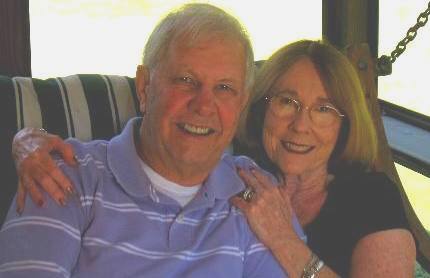
Mike & Joyce Hendrix
Mike & Joyce Hendrix who we are We hope you liked this page. If you do you might be interested in some of our other Travel Adventures: Mike & Joyce Hendrix's home page Travel Adventures by Year ** Travel Adventures by State ** Plants ** Marine-Boats ** Geology ** Exciting Drives ** Cute Signs ** RV Subjects ** Miscellaneous Subjects
We would love to hear from you......just put "info" in the place of "FAKE" in this address: FAKE@travellogs.us Until next time remember how good life is.
|
| ||
|
| |||
|
| |||
|
|