|
Hillsborough River State Park, Lake Kissimmee State Park, Melbourne
Places Visited: Florida: Hillsborough River State Park, Lake Kissimmee State Park, Melbourne Sunday, February 3, 2002 Hillsborough River State Park near Tampa/Zephyrhills We had an uneventful drive through rolling Florida landscape before arriving at Hillsborough River State Park around 1:00. We are staying in Hillsborough River State Park to visit with RV friends Lee and Joe Belanger who are volunteering at the park. We talked and reminisced about places and individuals we know. Some of you should shudder, just joking. While we were talking the New England Patriots were taking it to St. Louis. We parted discussing getting together again tomorrow night. Monday, February 4, 2002 Hillsborough River State Park near Tampa/Zephyrhills Today was a time for sleeping late, making repairs, doing laundry and long walks. On a 4-mile walk through the river flood plane we kept running across orange trees. To began with we picked and ate the fruit like Adam & Eve. Close to the end we were full so we picked around 20 to take back to the motorhome. The trail was through old growth live oak and cabbage palms along with a complete range of swamp trees from cypress to sweet gum. Free oranges were neat but watching pileated woodpeckers at very close range was probably the highlight. Our memories of Hillsborough River will be of the pileated woodpeckers, wild oranges, and of course Lee & Joe. We went to dinner with Lee and Joe where we discussed mutual friends, lifestyles along with places to go and see. As we parted ways we agreed to see each other again for coffee in the morning before we pull out and before they go about their volunteer functions. Tuesday, February 5, 2002 Trek mileage 34,107 Lake Kissimmee State Park: Near Kissimmee/Disney World The short (66-mile) drive to Lake Kissimmee SP transitioned us from the coastal plain to the Lake Wales Ridge. The coastal plain is generally flat and just above sea level. The Lake Wales Ridge is an upland running down the spine of the Florida Peninsula. As you would expect the "uplands" region is higher than the coastal plane. However, the average elevation is only between 200 to 298 feet above sea level. This higher elevation comes complete with a string of large lakes.
Before leaving the coastal plain we drove through miles and miles of strawberry fields. Most fields had large groups of migrant workers harvesting the sweet berry. How those migrant workers can stand up at the end of a long day harvesting strawberries is beyond my comprehension. For those of you that are not familiar with strawberries they grow right on the ground. Suddenly gigantic phosphate mines replaced the strawberry fields. The town of Bartow could easily have been called phosphate. Right in the middle of this extremely flat land are these mountains of mined material (either phosphate or the tailings). Florida has the largest phosphate deposits in the United States and much of the state's phosphate comes from mines in and around Bartow. Phosphate rock is Florida's most valuable mineral product producing about four-fifths of the nation's supply. Fertilizer factories were located adjacent to these mines. For those of you that did not pay attention in physical science, phosphate rocks are chemical sediments that were once dissolved in water. Rock salt and gypsum are other "chemical sediments" that you may be familiar with. Just as sudden as the phosphate mines appeared they disappeared to be replaced by citrus groves. It was like we were driving through a sea of orange trees. Dark green citrus trees are planted in neat parallel rows that seem to stretch to the horizon. Eighteen-wheelers were hauling truckloads of oranges to processing plants. Roadsides were littered with oranges like the roadsides in southern Louisiana are littered with sugar cane. Land along the Lake Wales Ridge not utilized for citrus groves is predominantly cattle ranches. Our destination of Lake Kissimmee State Park is on the western shore of Lake Kissimmee. Lake Kissimmee SP has historically been a "cow camp". Back in the 1870s early Florida "cow hunters" used this area as a "cow camp". Just like out west in the mid-1800s, cattle roamed the countryside (before fences). Cow hunters had to find, brand and "cut" cattle as well as drive them to the west coast of Florida for shipment. The Park maintains one of the few remaining herds of scrub cows in existence. In addition to scrub cows the park maintains a recreated cow camp. The Florida Park system has done an excellent job of preserving Florida's history. Joyce and I had a super afternoon touring the recreated cow camp and learning about this part of our States history.
Wednesday, February 6, 2002 Lake Kissimmee State Park: Near Kissimmee/Disney World We decided to visit Bok Tower and Gardens this morning. Edward Bok came to America from the Netherlands when he was 6-years old. When he left Europe his grandmother told him, "Make you the world a bit better or more beautiful because you have lived in it." Ed was extremely successful and never forgot those words. In 1922, Edward Bok decided to create a sanctuary for birds and people in Florida. He acquired a large tract of land atop the Lake Wales Ridge covered with pines and palmettos. Then he hired America's most famous landscape architect to transform the area into a sanctuary that would "touch the soul with its beauty and quiet." As the transformation proceeded, Mr. Bok decided to add a carillon tower to be a visual and aural centerpiece for the garden. Yea, I know, you want to know what a carillon tower is. According to World Book it is: "a bell tower" "a set of bells arranged for playing melodies. The bells are played upon with hammers, either by hand or by a keyboard or other mechanism." Understand that this no ordinary tower. It is a magnificent large carillon tower, built of pink and gray Georgia marble and coquina stone (a type of limestone created by thousands upon thousands of seashells compressed together). The tower is constructed atop peninsular Florida's highest point (298'). Florida actually has some land above 300' somewhere around Tallahassee. You would think that a 205' tower situated on the highest point around would make a good viewing platform. Wrong! Visitors are not allowed into the tower. The purpose of the tower is to house the carillon. This particular carillon is comprised of 60 bronze bells ranging from 16 pounds to nearly 12 tons that span a range of five octaves. A 12-ton bell is one big bell if you get my drift. The bells were cast in England. After casting, the manufacturer turns the bell on a lathe removing small amounts of the inside of the bell until the correct tone is achieved. The manual and pedal keys of the (clavier) keyboard are connected by a transmission system to the clappers of the corresponding bells. The carillonneur depresses keys to activate the clappers. A light touch is required for delicate music, more force for grandiose effects. The action is entirely mechanical, as has been the case with carillons since the seventeenth century. Around 3:00 pm a carillonneur plays the bells. It seems that certain arrangements are made special for a carillon and famous carillonneurs from around the world are invited to play recitals. For those friends back in Pensacola I suppose the closest individual we know to a carillonneur would be Steve Baker. I have seen Steve play some big bells before but nothing like a 12-ton bell, do you suppose Steve could be considered a carillonneuring attorney? How about them bells?
Just out the front gate of the state park is Camp Mack a combination dock, RV-Park, store and boat launch. We enjoyed spending the afternoon on the Camp Mack docks watching fishermen returning from a days fishing on Lake Kissimmee. Wood storks, limpkins and a variety of herons and egrets kept us entertained when the fishermen weren't. Once back in Lake Kissimmee SP we watched some deer, a group of 7 to 10 turkeys, and some scrub jays. How can things get any better? Tomorrow we are off to Melbourne where we will visit with Joyce's father and her younger sister and her family. Thursday, February 7, 2002 Land Yacht Harbor RV-Park: Melbourne, Florida. On the way out of Lake Kissimmee SP we stopped at the ranger's station to feed scrub jays. That is right; we stopped to feed some birds. Scrub jays are kin to blue jays except they do not have the topknot of feathers on their head. Scrub jays only inhabit the wild scrub located on the Lake Wales Ridge. They do not seem to be able to adapt to other habitats so they are a fairly scarce species. Although rare, Lake Kissimmee SP has groups that hang out at the ranger's station. This group of scrub jays will eat out of you hand. We stopped to get pictures of these scrub jays sitting on our outstretched hands eating sunflower seeds. As we headed east on highway 60 we quickly fell off the Lake Wales Ridge and left the citrus groves behind. The land became extremely flat rangeland and stayed that way until we reached the coast. The only unusual thing we noticed was the pairs of sand hill cranes along the roadside. So far we have not seen a single sand hill crane. Each time we have seen them they are in pairs. After arriving in Melbourne we visited Joyce's father then took him to dinner with Joyce's Sister and her husband. Friday, February 8, 2002 Land Yacht Harbor RV-Park: Melbourne, Florida We picked Pop's up around 10:00am, took care of some errands for him then treated him to lunch. From there we headed south 18-miles along 1-A to Sebastian Inlet State Park. After walking along the man- made pass from Indian River to the Atlantic Ocean we continued our journey south to the causeway over the Indian River Lagoon to Vero Beach where we turned north on US-1. For the next 25-miles we followed the eastern bank of Indian River back to Melbourne. Not very exciting and very slow, about all we can do is ride in the car.
Click here for more Florida travellogsUntil next time remember how good life is. More Florida AdventuresAdventures by State ** 2002 Travel Adventures
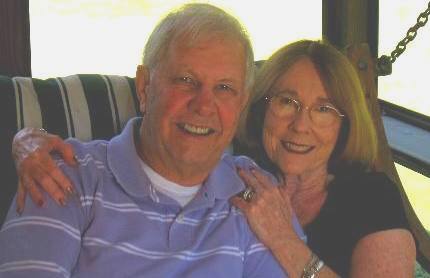
Mike & Joyce Hendrix
Mike & Joyce Hendrix who we are We hope you liked this page. If you do you might be interested in some of our other Travel Adventures: Mike & Joyce Hendrix's home page Travel Adventures by Year ** Travel Adventures by State ** Plants ** Marine-Boats ** Geology ** Exciting Drives ** Cute Signs ** RV Subjects ** Miscellaneous Subjects
We would love to hear from you......just put "info" in the place of "FAKE" in this address: FAKE@travellogs.us Until next time remember how good life is.
|
| ||
|
| |||
|
| |||
|
|