|
Brenham, Burton, Round Top, Austin & Georgetown Places visited: Texas: Brenham, Burton, Round Top, Austin & Georgetown Thursday, April 12, 2001 We were able to download and upload e-mail this morning at the State Park office. We are 20 miles from town (Brenham) and the phone lines are not the best (understatement). I am only able to connect to my e-mail at a bit over 4K (this is a very marginal connection) and the downloading is SLOW especially when one of our friends sent us a cute picture. That graphic took 10 minutes to download. How embarrassing can it get? Hopefully, we will not have many people forwarding graphics and attachments. We drove about 40 miles to Washington-on-the-Brazos State Historical
Park today. This is the spot where Texas declared its independence
from Mexico in March of 1836. At the declaration of independence
Texas also became a Country or a Republic. Texas is the only state
that can lay claim to also being a country at one time. The Republic
of Texas only lasted ten years because in 1846 Texas joined the
United States at the same time as Florida. While delegates were
declaring independence from Mexico in Washington, Texas How about that for a short history lesson on Texas? Another remarkable thing about this time in Texas history is that the "Anglo's" did not start to populate Texas until 1820 when Stephen Austin received permission from the Mexican government to settle there. It only took 16 years for the Texan's to decide that they did not like Mexican rule. A lot of history took place between 1820 when the Anglo settlers from the American states started to arrive and 1846 when Texas became a state.
Another exhibit at Washington-on-the-Brazos State Park is the Barrington living history farm. This was the home and farm of Anson Jones, the last president of the Republic of Texas. A costumed staff operates a "working farm of the 1850's" complete with period livestock, cooking in the detached kitchen (over hot coals) with cast iron pots and Dutch ovens. When we arrived the costumed staff were eating the meal that had been prepared on that day. One of the staff toured us on an operating smoke house complete with the salting process through the curing and the moldy meat hanging in the smoke house. They had demonstrations where cold ashes were placed on a bed of straw where they slowly poured water over the ashes to get the lye out. The lye water was mixed with melted fat rendered when the pigs were butchered. When the lye water and melted fat are mixed it causes a chemical reaction that produces heat and soap is the result. I was impressed. As you can see it does not take much to entertain me. They were also demonstrating how to make candles out of bees wax. I am a city boy and even though I have heard about bees wax candles I have never seen them made. Some of the costumed staff hitched up two VERY LARGE draft horses to a wagon. They were not Clydesdales but they were that big. They were at least 6' tall at the withers (isn't that where the saddle fits?). They asked us if we wanted to ride around an open field with them. What fun. The driver was training them to obey Gee and Ha signals (Gee is right and Ha is left for you city slickers J). In addition to the draft horses they had a brace of oxen used to demonstrate how they were used on the farm. Last night we were treated to some locals sharing area history. One of the best stories was how the town of Dime Box got its name. It seems that it stemmed from the days when it took 10¢ to mail a letter. Locals used to leave 10¢ in the mailbox along with a letter to be mailed. The postman would take the dime and put a stamp on the letter for them. In 1944, then Senator Lyndon B. Johnson talked President Franklin D. Roosevelt into launching his March of Dimes drive after getting the idea from _____. Dime Box, Texas. Now you know the rest of the story.
Friday, April 13, 2001 Next weekend the town of Burton, Texas (population 311) is having a Cotton Gin Festival. When we passed through Burton this morning we noticed some folks gathered around the Cotton Gin Building so we stopped by to chat. One of the men, Ed Hoppmann, had the keys to the building. Ed agreed to take us on a personal tour. Ed is one of the townspeople who take groups on scheduled tours of the old Cotton Gin so he knew the workings of the place backwards and forward. What a completely awesome tour and tour guide. Ed had grown up around here and worked at the Cotton Gin. Built in 1914 the gin originally was powered by a steam engine that was replaced in 1925 by a 125-horse power Bessemer twin-type IV oil engine. Let's cut to the chase this engine looks like a HUGE two cylinder diesel engine the size of a small motorhome. Seriously. The two flywheels, one for each cylinder, were 7' in diameter. The glow plugs were heated with a blowtorch affair. When running at speed this behemoth turns at an incredible 250-rpm. The engine provided power to a 3" shaft that ran the entire length of the 250' building. All along that shaft were belts and pulleys that drove all kinds of mechanical things. One large belt powered another drive shaft that ran the entire length of the second floor. That shaft also had 25 or 30 belts and pulleys powered off of it. The Cotton Gin complex was established as a co-op. Shares were
sold to local farmers and no one could own more than 6 shares. Needless
to say the Gin was constructed in an era when cotton reigned supreme
in the Brazos Valley. It was built in the early 1900's and the large
plantations of the slave era were gone. Individual farmers populated
the area. These farmers, by themselves could not afford, a cotton
gin. Therefore, the concept of the Co-op was adopted. Individual
farmers would bring heaping wagonloads of cotton to the gin. The The lint was pressed into tightly packed bales weighing approximately 500 pounds. The farmer could either sell his bale of cotton on the spot or could take it back to his farm and sell it later in the year, hopefully, at a better price. Cotton was the "cash crop" for area farmers. Everything else grown on the farm was for the farmer's own consumption or the consumption of their animals.
With the guidance of the Smithsonian Institution and the National Trust for Historic Preservation, the gin will become part of a national museum complex for Cotton Ginning and Fiber Production. The gin is a Texas Historic Landmark, it is listed on the National Register of Historic places and is a national Historic Mechanical Engineering Landmark. I have a brother-in-law, Van Comer, in Calera, Alabama that would love to see this operation. His mechanical mind would run wild seeing all of the pulleys and shafts powered by that old Bessemer engine. Van, I could not help but think of you when we were touring the building. After the Cotton Gin tour we went to Chappell Hill, Texas where the City had a museum commemorating the history of that area. It was an excellent museum. One room of display caught our eye. In 1856 Soule University was the 3rd institute of higher learning established by the Methodist/Episcopal council of churches. The female department was incorporated as "Chappell Hill Female College". In 1856 men and women could not learn together especially in a church operated facility. Things went good for a few years then there was the Civil War. Things were so bad after the war that there just was not enough funding to continue so the Colleges closed in 1869. In the meantime, 1865, the five Texas Methodist groups decided to create a new university for all Texas Methodism. That "new university" was Southwestern at Georgetown. My mother Graduated from Southwestern at eorgetown and we are going to visit the campus in the next week or so. While in Chappell Hill we drove out to a local Masonic cemetery because it was advertised as having a lot of Texas History. Most impressive were monuments that the State of Texas had placed on the graves of soldiers that fought at the Battle of San Jacinto. That is the battle where Sam Houston and his troops defeated Santa Anna and the Mexicans. The markers were impressive and a tribute to both the State of Texas and the individuals that fought in that historic battle.
We ate lunch in Chappell Hill at Beaver's Kitchen. In accordance with our policy of trying to find the positive in everything____ we will not go any further. Needless to say we did not find anything positive. On the way back home we passed through Brenham and stopped at the Blue Bell Creamery. The line was out the door. Oh how I wanted some more of that Banana Pudding Blue Bell Ice Cream -------- but not bad enough to stand in that line. Saturday, April 14, 2001 We slept late took a walk then headed to Round Top, Texas about 15 miles down the road. Round Top is a weekend destination for Houston's BMW convertible crowd. In the State Park where we are staying we are the only ones not in a pick-up truck with a Texas Truck tag. In Round Top we are the only ones without a BMW convertible and a Houston tag. Round Top was chartered in 1870 and has a current population of 81. The town has a lot of charm, with antique shopping and B&B as its forte. The first settlers were rosperous Anglo-American plantation owners who settled there as early as 1826. By the late 1840's German immigrants started to settle there leaving their indelible imprint on the region's landscape. Round Top is a pocket of rural tranquility. We toured the local Museum Village that included about 20 period buildings transported to this site from the surrounding country side (up to 50 miles). This was a well-done village of mid 1800 and early 1900 houses complete with furnishings. At $3.00 per person this was a very good museum. Much of the town is situated on a town square concept consisting of quality antique stores. We ate lunch at Royer's Round Top Café. Royer's had been recommended to us earlier by some "elite" people we met on one of our tours. True to what the "Houston Elite" had told us the place was jam packed with ____ you guessed it, the Houston elite. We shared a table with a delightful couple from Sugar Land, Texas. He was a dentist and she was his bashful bride. They were good Christian people and wanted to know our plans for Easter. Both of us had a bowl of corn chowder with sour dough bread. It was very good though different from any corn chowder we had previously experienced. It had chunks of tomato, and chicken and very little corn. There was a distinctly unique flavor to it. When I asked Royer about it he said that it was cilantro. He said that the cilantro set it off. He explained the effect of cilantro as only a 400 pound cook can do with the fingers and thumb of his right hand together and his lips puckered like he is about to kiss the love of his life. I have never heard of cilantro but it is supposed to look like parsley and be a favorite herb used in many Mexican dishes. Now Joyce can tell Macklyn, Vicki and Brenda that she has eaten at "Royer's". After doing the obligatory rounds of antique shops we headed to Brenham for a stop at the Blue Bell Creamery. It was not crowded and we got our treat. Ugh, it is laundry time. Do retired people have to do laundry? Sunday, April 15, 2001 Well, this is Easter Sunday. Everyone was pulling out of the State Park while we were getting ready for church. By mid afternoon there were only a few of us remaining in the park. Joyce and I picked First Baptist Church in Brenham, Texas for Easter Sunday. Joyce checked and found a publication with their Sunday schedule. Church starts at 11:00am. Now mind you this church is 25 miles from where we are staying so we get an early start only to arrive to an EMPTY parking lot and a marquee sign advertising Easter services at the local high school auditorium 10:30am. Ooooooops! In football parlance it was time to PUNT. There was a First United Methodist across the street and their marquee said services started at 11:00am. We worshiped with the Methodist on this Sunday. At the beginning of the service the Pastor walked down the aisle asking for input from the audience on what they were thankful for. One woman blurted out that she was thankful that "tax season was over". She was serious the audience just chuckled. I thought of my good friend, Tom Riggs, a CPA back in Pensacola, who would say it is just time to start working on the extensions. After church it was time to find a place to eat. The places that
Joyce had picked out in Brenham were closed so we headed back to
the motorhome. When we were going through Burton (population 311)
the last "town" before we get to the motorhome Joyce was
breaking out in a cold sweat at the thought of having to COOK. I
was apprehensive at that thought also. To our surprise the Brazos
Belle Restaurant was open and hopping. We stopped, Joyce did not
have to cook and I did not have to eat it. J As it turns out the
Brazos Belle Restaurant is quite the place for Sunday lunch. It
seems that the Sunday crowd drives from Houston and Austin just
to dine here. Chef Andre Delacroix is a noted Texas Chef. He is
featured in the Top Texas Chef's Favorite Recipes cookbook along
with several of his recipes. Andre was born in France and apprenticed
with Club Med before deciding Monday, April 16, 2001 We moved 78 miles west to McKinney Falls State Park in Austin, Texas Monday morning. On the way we stopped at Bastrop State Park in Bastrop, Texas. Bastrop was made for golfers. The State Park has a beautiful golf course in addition to awesome camping facilities and hiking trails. Bastrop lies in the heart of an isolated stand of tall loblolly pines in Central Texas. The loblolly pines are out of place in this area of Texas where they are surrounded by post oak, mesquite and cedar. After taking a two-mile hike through several of Bastrop's better trails we ate lunch and continued on our way to Austin and McKinney Falls State Park. Once inside McKinney Falls we started seeing deer. Shortly after arriving at McKinney Falls we headed in to Austin to tour the Capital building. The Texas Capital is the largest state capitol building in the United States. It is a magnificent example of Classical Renaissance Revival. The Texas pink granite construction medium makes a striking building. The most impressive feature of the Capital building has to be the cavernous circular open rotunda rising to the top of the Capital dome. The dome, including the statue, is rumored to be taller than that of the National Capitol. Both inside and around the Capitol Texas has done a good job of honoring the men who were significant in their history with impressive statuary and monuments. We dined at Scholz Garden, a favorite among locals. It boasts that
it has been operating since 1866. It is just a stone's throw from
the Capitol and the University of Texas. We shared the facility
with a mixture of government employees (legislators?) students and
professors. I had beef brisket. It was ok, however, I have been
spoiled by thinking all beef brisket should measure up to the brisket
served by friends Rob and Linda Farrell from Pensacola. Rob and
Linda learned to do brisket in Texas then imported their talent
to the While in Scholz we learned some important German terms: "herren" men and "damen" women. As you know some foreign words are very important. We had already learned "banos" which is Mexican for bathroom. One of the things we had planned to do was watch Austin's famous "bats" that roost under the Congress Street Bridge over the Colorado River. At dusk for nearly 20 years 1.5 million bats have exited their roost, under the Congress Street Bridge in down town Austin. We had planned to view this phenomenon. However, we were told that the bats were not leaving the roost until around 9:00pm because of the abundant insects this year. It is dark at 9:00 and we did not think we could see the bats. Oh well possibly another night. A walk around McKinney Falls after we got home revealed the picturesque waterfall for which the State Park was named. Did we mention that the park is overrun with deer? Tuesday, April 17, 2001: A cold front moved through last night and it is cold this morning. We put on jeans and long sleeves before heading to Georgetown, Texas. Georgetown is the home of Southwestern University where my mother graduated (long, long ago). J Southwestern is the first institution of higher learning in Texas, chartered by the Republic of Texas in 1840. It is affiliated with The United Methodist Church. Southwestern bills itself as a "highly-selective, independent, four-year, undergraduate, national liberal arts college". They boast a student/faculty ratio of 11:1 with 1,309 students 91% from Texas. The 100-acre academic campus is festooned with elegant Gothic Revival style buildings that appear to be constructed of native Texas sandstone. Many, buildings in Georgetown are made from this same sandstone. Downtown Georgetown's businesses that front the courthouse have impressive facades reflecting more of this Gothic Revival style. At the recommendation of several locals we dined at the Monument
Café 1953 S. Austin Avenue for lunch. We were there with
everyone else in Georgetown. The Monument Cafe is highly recommended
by us. After lunch we went to the car and hooked our cell phone
to the speaker attachment and called my mother from the parking
lot. I think she was Later Tuesday night we decided to watch the famous bats of Austin's Capital Street Bridge. They were supposed to make their grand appearance around 9:00. They could not tell time. At 9:20 they started flying out from under the bridge and within 5 minutes the show was over. Later in the summer they emerge earlier in the afternoon and the sight is supposedly more impressive. Oh well, we have been there and done that. Wednesday, April 18, 2001 It was cool when we awoke this morning but the wind from yesterday
had subsided. By the time we got back from an hour and a half walk
around McKinney Falls hiking trails we were sufficiently warm for
the day. Today we went to Lady Bird Johnson's Wildflower Center.
The Center is the only national nonprofit research and educational
organization By mid afternoon we are back in the mid-70s for temperature. In ending our stay at McKinney Falls State Park RV'ers will find this to be an excellent park with over 80 excellent sites with water and 30 amps. The park consists of several miles of well maintained hiking trails, and a nice waterfall. We highly recommend it at $12 per night. Tomorrow we move 50 miles south to New Braunfels. Mike & Joyce Hendrix Click here for more Texas travellogsUntil next time remember how good life is. More Texas AdventuresAdventures by State ** 2001 Travel Adventures
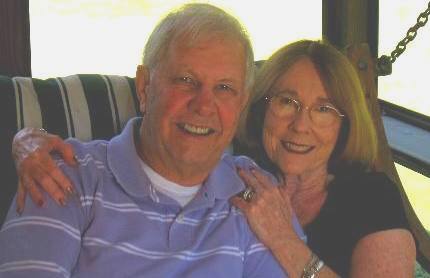
Mike & Joyce Hendrix
Mike & Joyce Hendrix who we are We hope you liked this page. If you do you might be interested in some of our other Travel Adventures: Mike & Joyce Hendrix's home page Travel Adventures by Year ** Travel Adventures by State ** Plants ** Marine-Boats ** Geology ** Exciting Drives ** Cute Signs ** RV Subjects ** Miscellaneous Subjects
We would love to hear from you......just put "info" in the place of "FAKE" in this address: FAKE@travellogs.us Until next time remember how good life is.
|
| ||
|
| |||
|
| |||
|
|